
How the communications industry deals with stress
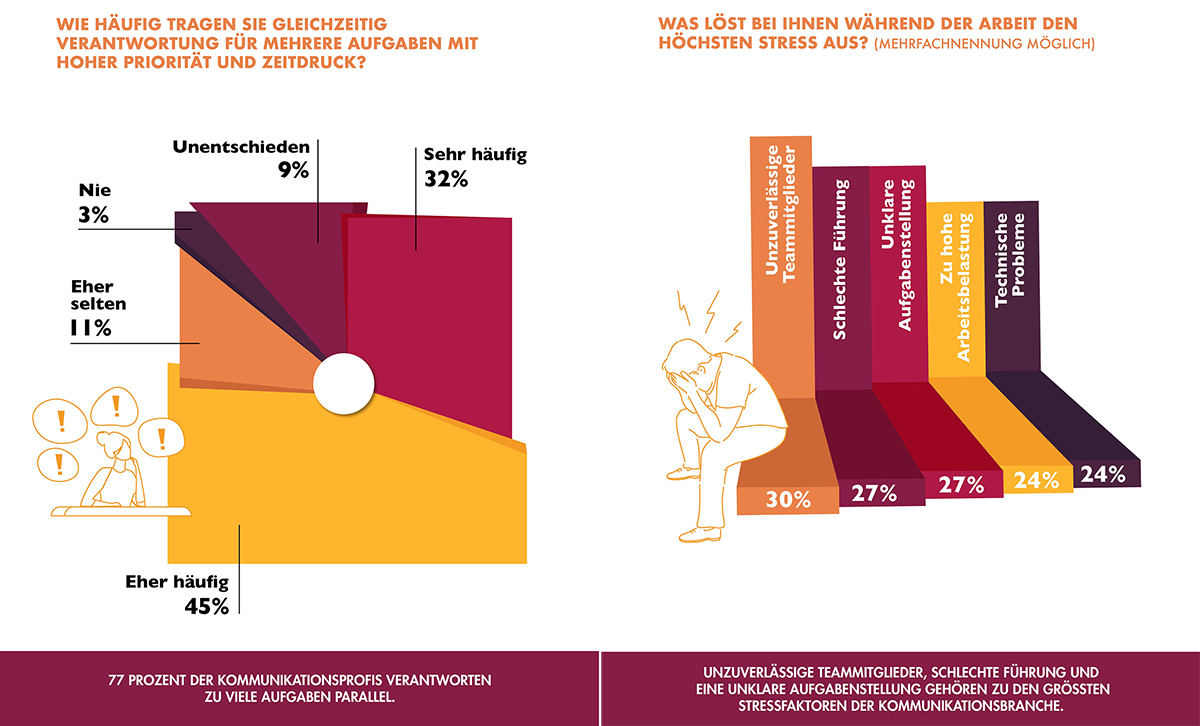
Three out of four communications professionals are responsible for multiple high-priority, time-sensitive tasks simultaneously. More than half also believe they must be available at all times. Among the biggest stressors in the communications industry are unreliable team members, poor leadership, and unclear job descriptions, as shown by a recent survey by News Aktuell.


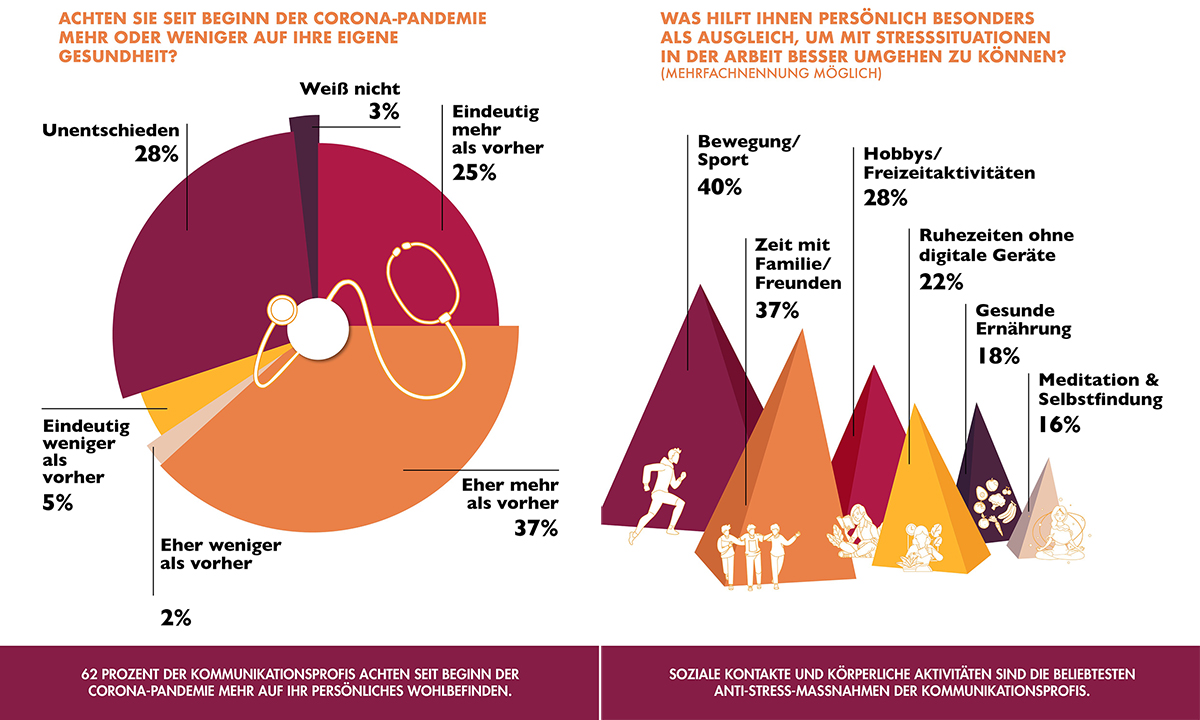
However, the survey shows that well over half of PR professionals are paying more attention to their own health since the Corona pandemic and are focusing on sports and social contacts to counteract the stress of the job.
Permanent availability and parallel tasks
When asked whether they feel they have to be permanently reachable at work - even after work - 51 percent of communications professionals answered "Yes, definitely" (24 percent) or "Somewhat yes" (27 percent). Significantly more men state that they believe they have to be permanently available in any case (30 percent versus 19 percent women). A total of only 43 percent said "Rather no" (21 percent) or "No, definitely not" (22 percent) to this question.
Stress point multitasking
In addition to permanent accessibility, multitasking also ensures a high workload. Three quarters of the survey participants tend to work on several tasks at the same time under high time pressure and bear responsibility at the same time (77 percent). "Rather rarely" or "never" is the case for only 14 percent of respondents. The answers to this question also differed to some extent between male and female communications professionals: While 81 percent of the women surveyed said they were rather to very often responsible for too many tasks in parallel, only 72 percent of the men surveyed felt this pressure.
Interpersonal factors biggest stress triggers
The greatest stress for communications professionals is unreliable team members. 30 percent of respondents are stressed when they cannot rely on their colleagues. Women are significantly more stressed by unreliability than men (35 percent compared to 25 percent). Both genders feel almost equally under pressure when management provides poor leadership or tasks are not clearly defined. In each case, 27 percent of communications professionals cite this as a stress factor. Just under one in four PR professionals also feels stressed by too much work or technical problems (24 percent each).
Fewer communications professionals, on the other hand, are stressed by too much pressure or responsibility (16 percent). Too few staff, and thus more work for the existing team, also causes stress for only one in seven (14 percent).
More mindfulness since Corona
Covid-19 has caused many communications professionals to become more aware of their personal well-being. For example, 62 percent of survey participants say they are paying more attention to their health since the pandemic began than before. 28 percent continue to take the same care of their health as before the pandemic, and only 7 percent have taken rather or definitely less care of their health since then.
In terms of increased mindfulness, there are no significant differences between male and female respondents; women are a few percentage points ahead (65 percent), but the majority of men have also been paying more attention to their own health since the pandemic began (60 percent).
What do communications professionals do specifically to reduce professional stress and stay healthy? Most respondents rely on physical compensation through sports and social contacts. For 40 percent, exercise and for 37 percent time with family and friends are the most popular anti-stress measures. Hobbies or other leisure activities, in turn, help just over one in four survey participants to cope better with stressful situations at work (28 percent). Digital detox is the ideal way for one in five to switch off and wind down (22 percent). Communications professionals, on the other hand, rely less often on healthy eating (18 percent) or meditation (16 percent). Shopping is the most popular anti-stress remedy for a mere 2 percent of respondents.
Women relax more often with the help of Digital Detox than men (25 percent to 17 percent). As many as 4 percent of male communications professionals go shopping to relax, compared with just 1 percent of women.
Participation in the representative online survey "Stress in the communications industry" by Civey on behalf of News Aktuell, 500 professionals in communications, marketing and media in Germany were surveyed from August 5 to August 18, 2020. The statistical error is between 8.4 and 8.5 percent. The percentages were rounded. Multiple answers were possible for the questions "What triggers the highest stress for you during work?" and "What helps you personally in particular as a counterbalance to better deal with stressful situations at work?"


