
Travel together with the customer
The customer looks online - and then buys offline? In order to find out for sure and to map a seamless customer journey, testing and trials are carried out - often so much that the consumer becomes suspicious. It is therefore better to involve the consumer right from the start and offer him real added value at every touchpoint.


Following the consumer from the poster motif to the supermarket is child's play. Cameras scan the face via Facial Recognition and set a visual cookie while his eyes rest on the poster. Later, at the point of sale, the same technology captures him as he purchases the advertised product. Previously, he has already seen an online ad, which amplified the impact of the poster message.
His customer ID, which combines personal data and facial characteristics, and thereby online and visual cookies, reveals the individual steps of the transparent customer. The customer journey is complete. In theory.
China as a role model?
In China, this - rather invasive - method is already in use. In Switzerland, too, the tools are ready, but for the advertiser, following the customer path is paved with some stumbling blocks. With data protection laws in force and customer preferences, the consumer - in this case, the viewer of the poster - is quickly lost sight of. This is how Oliver Stäcker, CEO of Gotomo, sees it: "Consumers perceive it as an advantage to unlock their cell phones via facial recognition. But having a camera scan his face in public places makes him uncomfortable."
High-frequency sound signals: Is this really added value?
However, facial recognition is just one method among many. In 2019, Swisscom tried to lure consumers to the store checkout via high-frequency tones. APG|SGA billboards and cinema spots emitted an acoustic signal outside the audible range, which are received by the Beem platform. In some apps on the user's cell phone, Beem is already pre-installed like on the app of 20 minutes and Bluewin: When the signal is sent to the cell phone, the user sees the advertiser's current offers. These range from simple additional information to competitions and coupons. Swisscom spoke of a revolution in the advertising market.
Because this technology has a catch: For many, the sounds are too oblique for them to follow - like the Pied Piper of Hamelin. The fine sequences are not heard by most people, but by small children, tinnitus patients and animals. This group is very sensitive to very high tones and experiences the vibrations in an unpleasant way. In the press, citizens accuse Swisscom of "grievous bodily harm", animal rights activists join in the current heated debate: For cats, dogs and wild animals, the sound is torture. Ouch!
After the criticism announced Swisscom, with Beem solely using Bluetooth and Audio Content Recognition (ACR) technologies to interact with the user's smartphone. The question remains: Is advertising really worth the clamor?

When the Beem signal arrives on the cell phone, the user sees the advertiser's current offers.
Unpleasant advertising is not accepted
The answer is simple: If the customer finds advertising unpleasant, he will not accept it. If the opposite is true, they will welcome it. For Stäcker, this is the crux of the matter: "The customer must actively participate in his customer journey and enter into a dialog with the advertiser. This is achieved through - the so often invoked - added value. In online marketing in particular, this is at the center of debates about advertising acceptance and data protection.
The latest EU cookie directive requires advertisers to obtain the user's active consent to be tracked for advertising purposes. However, the user only checks the box if he also benefits from it.
What does the customer want?
But what does the customer want? Suitable offers, good prices and other rewards. Everything that enriches the customer's experience of products and services - and leads him to a dialog with the supplier and ultimately to the POS.
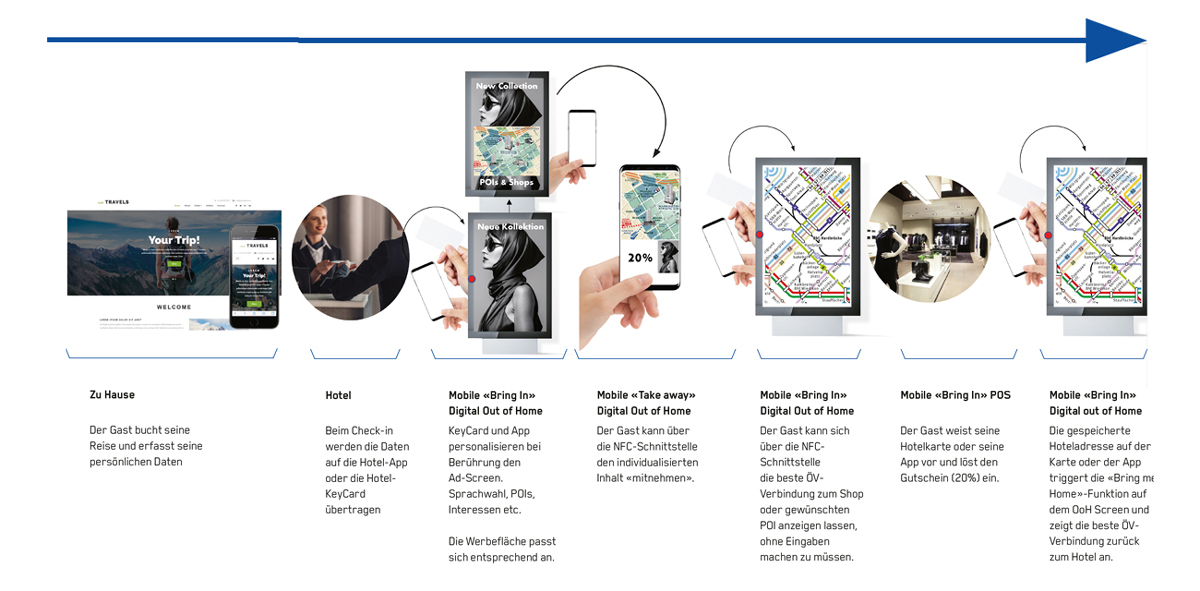
Stäcker compares the dialog that makes the customer journey visible in the first place to a relay race. "From one channel to another, the advertiser must provide the customer with something that the customer takes and carries on to another channel." To that end, the Gotomo boss is experimenting with Near Field Communications, or NFC, on billboards. One possible scenario looks like this: A tourist books a trip to Zurich, and his data is transferred to the hotel app, which in turn provides him with offers tailored to him at interactive screens in the city, which he can download to his cell phone (see image above). The scenario involves several partners who all have one thing in mind: to serve the consumer with various services and to enrich his trip with the appropriate added value.
No customer journey succeeds without the help of the consumer
This shows that a customer ID is essential if the customer is to become the focus of the customer journey. "If the consumer is willing to give us their personal data, we have everything we need to give them convenience in the form of personalized offers and make it easier to complete the purchase," also says Axel Schäfer, Head of Product Marketing Analytics EMEA at Adobe Experience Cloud. "However, in order for consumers to give up this data, they need to be transparent about how it's being used and what value they're getting in return." In short, without consumer cooperation, no customer journey will succeed.
For an online retailer, Schäfer modeled the customer journey based on initial data.To do this, he placed a discount offer of 30 percent on certain products on the retailer's website and selected a predefined local target group for it: the top 100,000 customers who had made a purchase in the past six months and identified themselves via a login on the site. Using the segment-based discount code, the retailer can then also identify these customers in the store and continue to maintain their customer account with the purchase information, offering them the prospect of further coupons or other valuable offers.
In addition, the retailer learns how many of the customers from the narrowly defined group have converted and can transfer the collected insights to other customer segments that behave similarly: These can be successfully addressed with comparable strategies in the future.
Trust as a prerequisite for customer data
The more that happens on the website, and the more the customer benefits from their customer relationship, the better. "Through access to content or better offers, combined with insider prices and free delivery, for example, the customer has real added value and is therefore also willing to share his identity via a log-in," says Schäfer. By including social networks, such as on Facebook, retailers can then learn even more about him: what he is interested in or talking about, how he feels.
This also includes not bombarding customers with newsletters or tracking them too intensively. "Everything that is technically possible doesn't have to be implemented," says the Adobe manager. Just like the use of facial recognition in China: What may work there backfires with local consumers. To capture the consumer's interest, more and more content marketing strategies are therefore coming up with tips and entertainment.
In order to strengthen customer loyalty and maintain a shorter line to the customer, Schäfer advises financial institutions to introduce a real estate calculator or, for outdoor and FYI stores, a configuration tool for electronic irrigation systems - especially if the customer has already indicated through his surfing behavior that he is interested in such products as a garden owner.
Use surprises
The more surprising, the better: This includes greeting cards for birthdays. "Such relatively simple gestures pay off," says Schäfer. In the end, it's the holistic brand experience that counts - the little things as much as the big ones. Content creates added value and customer care, which is what makes a real customer journey possible in the first place.
Increase conversion rates enormously
Take Raiffeisen, for example: For the bank, Adobe Analytics looked at the behavior of 1.2 million e-banking customers on the website and found that customers don't want to be shown new offers right away. When they log on to the site, they want to take care of their business first. Then they are open to interaction. An important finding.
A/B tests were then used to determine which messages and offers resonate with different customers and which channels they prefer. In addition to the website, these included e-mails, direct mails, call centers and personal conversations with consultants. The result: average conversion rates are 14 percent.
The article is from MK Marketing&Kommunikation 10/2019.


