
How do customer expectations arise?
In the first part of her two-part guest post on customer expectations, Nicole Schnetzer of Echonovum highlights four areas that contribute to the formation of customer expectations.



What are the factors that contribute to an expectation? Is it your own needs, other people's product recommendations, a company's communication, or is it a mix of all of these?

1. needs
The first thing that emerges is the need. Or to put it another way, a person notices a lack of something. They want to remedy this and imagine what a possible, ideal solution could look like for them. Companies satisfy people's needs (or lacks) with their offerings - sometimes they even create them with an innovation.
Today, a person encounters many different solutions on the way to satisfying a need: There are countless companies on the market offering their solution to satisfy a specific need. Let's say a potential customer, Ralf, wants to make his living room a little more atmospheric. A floor lamp should remedy the lack of atmosphere. He is spoiled for choice - which floor lamp should he choose?

2. promise
Every company that offers a suitable product to satisfy a need makes a promise to the customer. The customer's expectations or catalog of requirements regarding the quality of the product and the associated services increase with each of these promises.

3. experiences and adventures
On his journey through the world of offers, Ralf has his first experiences with the respective companies and remembers these as evaluated experiences: He quickly found his way around the website of company A, the products are well described and illustrated. The conversation with the customer service team was friendly and he felt he had received competent advice.
He had a bad experience with company C a few years ago. This experience is also anchored in his inner catalog of requirements and he does not want to have this experience again. All experiences from previous customer relationships and current experiences with the companies form the third area of customer expectations.

4. recommendations
Somewhat confused by the many options, Ralf looks at the product ratings and reviews on the online portals. Two companies and their offers now fall out of his shortlist. He sends his friends a request via Facebook and asks for their recommendation. He receives replies within 15 minutes. Four of his friends recommend offer A, saying they have had very good experiences with it.
Customer expectations have evolved
Ralf now decides in favor of company A. Based on his needs and ideas, the experiences he has gathered, company promises and recommendations during his purchasing decision journey, he has formed his individual expectations. He now knows what he wants and thinks that company A is most likely to meet his requirements in terms of product quality and the associated services.
Were the expectations met?
At some point, the floor lamp will break or there will be a more modern, improved version. Ralf wants to replace it. He can now look back on a wealth of experience that he has gained with company A. Has company A met or even exceeded his requirements and expectations? If so, then Ralf will certainly buy the product from company A again. If not, the purchase decision journey starts all over again.
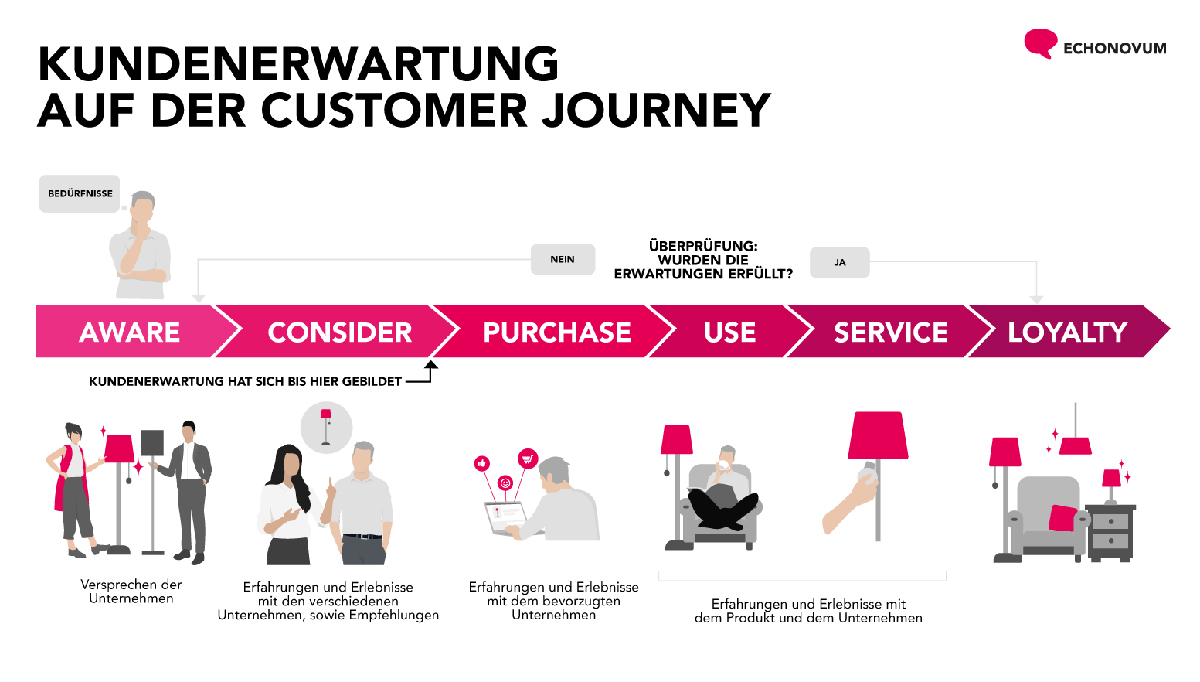
The infographic explains in which phase of the customer journey customer expectations arise.
Key Takeaways
Expectations are formed from the four areas:
- Needs, wishes and own ideas
- Corporate communication and promises
- Recommendations from third parties
- Experience with the company and direct/indirect competition
Today's customer expectations of companies are high. It is important for marketing to understand that the expectations of customers can be managed via the dimension of the promise. All of a customer's accumulated experiences and previous experiences with competing companies contribute significantly to their expectations on the way to making a purchase decision.
Companies that proactively approach their customers and seek dialog via customer feedback know at all times at which point in the customer journey they are meeting or not meeting consumer expectations. They are able to actively shape the customer relationship in order to create positive customer experiences. Customers then also report on these positive experiences, thereby shaping consumer expectations in the market.
* Nicole Schnetzer is Head of Marketing at Echonovum, a Swiss software company for intelligent, digital solutions around Insights-driven Leadership.
She has already published a three-part series of articles on customer experience with Felix Horner:
CX Part 1: What does Customer Experience mean?
CX part 2: Why customer experience leads to success
CX part 3: How do you measure customer experience?
Customer expectations part 2


