What skills do "digital leaders" need?
According to the meta-study by the Institute for Leadership in the Digital Age IFIDZ, demands on managers in the digital age are becoming more multi-layered and complex. But the relationship from person to person remains the decisive success factor.


To determine which competencies executives need to lead successfully in the age of digitalization, IFIDZ conducted 61 studies and surveys on the topic of leadership from 2012 to 2018. Among the more than 100,000 participants were not only managers but also employees and scientists.
Among other things, we examined which leadership competencies were named as particularly relevant in the studies. For this purpose, a competency ranking was created according to the frequency with which they were mentioned, but this does not provide a conclusive picture of the relevant leadership competencies in the digital age. The discussion about which competencies executives need is an ongoing one in a constantly changing environment. In addition, the terminology used changes in the course of the discussion.
For example, in studies published between 2012 and 2015, the terms agility, ambidextry and disruption are still used quite rarely, which is why they are not in the top 20 most frequently mentioned competencies in the meta-study (see chart below). The situation is different in studies from 2016 to 2018. In them, at least the term agility plays an important role almost across the board.
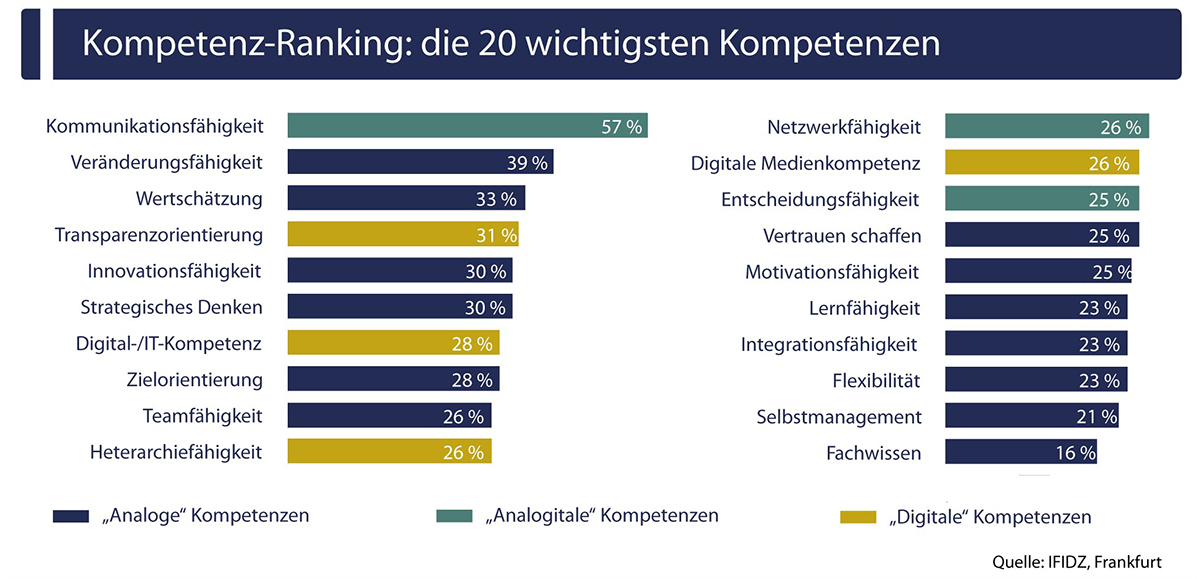
The competency ranking lists a total of 86 competencies that are relevant to leadership success according to the primary studies. The three most frequently mentioned include:
- Communication skills (57 percent)
- Ability to change (39 percent)
- Appreciation/employee orientation (33 percent)
Among other things, the meta-study distinguishes between three types of competence.
"Analog" competencies include competencies that were already known and relevant in the "pre-digital age," for example in the 1980s, and have not changed or have changed only marginally in their nature and content. These include, for example, the frequently mentioned competencies of change capability, appreciation, and innovation capability.
"Analogital" competencies comprise competencies that were already known and relevant in the "pre-digital age" but have changed significantly in their nature and content as a result of digitization. These include communication skills, networking skills and decision-making skills.
"Digital" competencies include competencies that either did not exist in the "pre-digital age" or had little significance and only became relevant in the context of digitization. These include transparency orientation, digital/IT competence, and heterarchy capability.
From the analysis of the primary studies on which the meta-study is based, the following conclusions or results can be derived.
According to the primary studies, a leader in the digital age should ideally have 86 competencies. This means that the requirements for managers are so multi-layered and complex that the perfect manager appears to be a "master of the universe.
It should be noted, however, that many of the competencies - or skills and personality traits - mentioned in the primary studies are interrelated. In addition - as already mentioned - the terminology is changing. Therefore, it should be said that leadership in the digital age is demanding, but not only for "super people".
Communication skills are by far the most frequently mentioned competence. In more than half of the studies (57 percent), it is named as an important leadership competence.
It is striking that "dialogic communication skills" in particular, such as giving feedback, listening and coaching, are seen as relevant to success. In the digital age, dialog with employees is seen as more significant for leadership success than the top-down monologue with them based on the hierarchical system.
The second most frequently named competence, at 39 percent, is the ability to change. The fields of action for change are very comprehensive. They relate, among other things, to processes and structures, (employee) relationships and expectations, business models and strategies, attitudes, and also to leadership itself.
The primary studies clearly show that permanent change in the digital age represents the greatest challenge for managers. In the future, being a manager will mean being both a change manager and a change leader. The topic of change, with all its prerequisites and effects, is not a leadership topic, but a leadership topic.
In the future, the top leadership competencies will also include "appreciation" or "employee orientation" with 33 percent in third place. Behind this is the requirement to place people or employees at the center of the leadership process. The focus of management activities should be more on the needs of employees and their potential, strengths and weaknesses.
The high importance of employee orientation is an indication that leadership is breaking free from the grip of "factual management. In the future, leadership work will focus more on motivating, integrating, enabling and empowering - or in short, leading - employees and less on managing day-to-day operations.
The top competencies also include "transparency orientation" with 31 percent in fourth place. Behind this is the requirement for managers to ensure transparency above all in their relationships with employees and colleagues - including with regard to values and goals, the planned approach, and internal and external constraints. After all, transparency creates trust, has a motivating effect and forms a basis for independent and responsible work. "Transparency orientation" should be a stronger focus of management development as a new competence in the digital age, as it is an essential feature of digitization and modern teamwork and at the same time a management tool.
It is striking that "digital competence" only ranks seventh in the competence ranking at 28 percent, even though many companies are currently in the digital transformation process. This is primarily because leadership remains a largely analog process even in the digital age, in which the trust factor plays a central role.
In order to be able to make decisions and take action, executives do need assessment competence in the digital field, but as a rule they are not experts or specialists, which means that "digital competence" is not central either.
Many companies are currently rethinking their management development because they are aware that their managers need a different skills profile in the digital age. However, it is often still unclear which competencies these are in concrete terms. The results of this meta-study can provide some impetus in this regard.
When implementing their new leadership development programs, companies should take an incremental and iterative approach - just as they do when dealing with topics such as "innovation" and "agility". In other words, they should try a (solution) in dialog with their executives, then reflect on the experience and subsequently readjust or readjust the approach.
A dialog with managers is important so that they do not get the feeling that they are being left alone to develop their competence. In addition, dialog helps to ensure that the search for an answer to the question of how to lead in the digital age goes in the same direction and that a new shared leadership culture gradually emerges in the organization.
* Barbara Liebermeister heads IFIDZ and is a management consultant and speaker.
* Patrick Merke is a member of the IFIDZ management team. He is responsible for business development at IFIDZ. He is also responsible for the IFIDZ studies.h.
For more information about the "Metastudy 2019: Leadership Competencies in the Digital Age", interested parties can visit the Website of the IFIDZ.