
Internal communication 2.0


Internal communication: one-sided information?
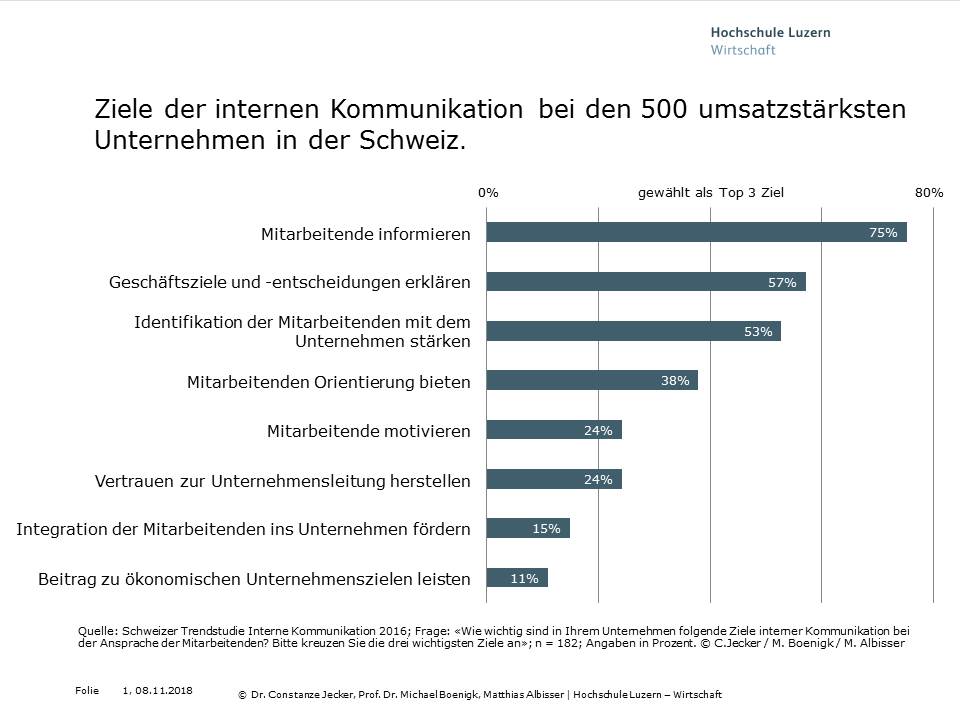
The primary finding of the study is that, even in the digital age, internal communication is primarily understood by respondents as a one-way transfer of information (see chart): The three most important objectives of internal communication are to provide employees with comprehensive information (one of the top 3 objectives in 75% of the companies), to explain business objectives and decisions (57%) and to strengthen employees' identification with the company (53%).
The topics are determined by the management
In 78% of all companies, the topics for internal communication are "very clearly" or "more often" determined by management. Once the topics for internal communication have been determined, they are "always" or "often" disseminated as quickly as possible in 80% of companies and "always" or "often" cross-media in 67% of companies. Only 23% of the companies "always" or "often" prepare content using multimedia. 56% want to do this more in the future:1. Promoting collaboration, knowledge exchange and transfer is becoming increasingly relevant as a task of internal communication.2. Conveying information (top-down) is becoming less important as the primary task of internal communication.3. The role of internal communication employees is evolving from gatekeeper to moderator of dialogues - between employees and between employees and managers. These developments are to be empirically observed by repeating the trend study (every two years). The second Top 500 survey in Switzerland will run from September to December 2018.
Status quo of internal communication in Switzerland
Further results of the first Swiss trend study on internal communication will be published at the end of October in this book: Constanze Jecker (ed.), "Interne Kommunikation. Theoretische, empirische und praktische Perspektiven", Herbert von Halem Verlag, approx. 420 pages, CHF 50 The book contains 23 chapters in which authors from various academic disciplines as well as from consulting and business practice shed light on internal communication. Topics include communication in agile companies, change communication, employer communication and social intranet. The book launch will take place on November 21 from 6.15 p.m. to 7.45 p.m. at the Lucerne School of Business, right next to Lucerne main station. The Institute of Communication and Marketing IKM will be offering an aperitif afterwards. Participation in the "IKM Update" is free of charge. Information and registration: hslu.ch/ikm-update
Reduce uncertainty, build trust
Would you like to acquire sound skills for professional communication with a company's employees (in change processes)? The CAS Internal and Change Communication of the Lucerne School of Business offers knowledge and exchange over 24 teaching days. Next start: 25.1.2019. Information and registration: [email protected], T 041 228 99 50, www.hslu.ch/icc.0



