On the way to more success through customer orientation
Editorial
-
July 19, 2016
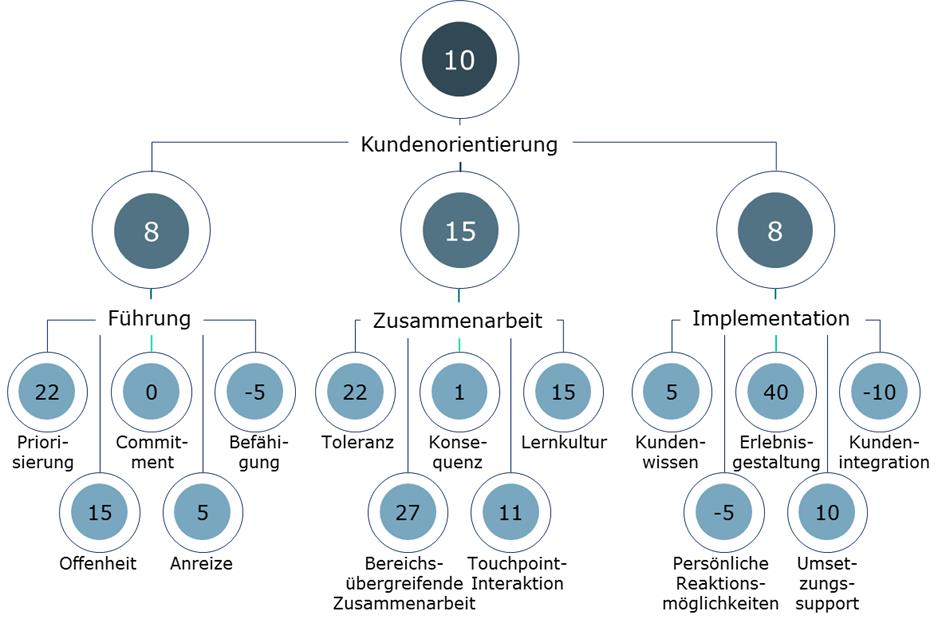
CUSTOMER FOCUS The Lucerne University of Applied Sciences and Arts has developed the Customer Centricity Score (CCScore). This tool supports companies in their efforts to become more customer-centric.The success of a company depends to a large extent on its customer orientation. The most successful companies of recent years, such as Apple and Amazon, and future giants, such as AirBnB and Uber, are characterized by a consistent focus on customer value. However, implementing customer centricity is a complex task because it affects all departments and employees of an organization. For this reason, the Lucerne University of Applied Sciences and Arts has developed a tool that can be used to initiate change processes towards more customer orientation: the Customer Centricity Score (CCScore). The CCScore uses an online survey of employees to indicate how customer-centric an organization actually is. The 15 empirically derived factors of customer centricity are the basis for this (see figure, example values for Swisscom). The factors are assigned to the three topic groups of leadership, collaboration and implementation, with each group comprising five factors.- Leadership: Leadership creates the framework conditions so that customer centricity can be lived throughout the organization.- Collaboration: Reflective, open and tolerant interaction across all organizational units enables customer-centric collaboration.- Implementation: The implementation of customer-centric processes and systems creates relevant offerings and holistic customer experiences.
The measured values form the starting point for improving customer centricity. Based on the CCScore, concrete measures can be developed in a 3-step process using the reflection-to-action method.Stage 1 - Reflection to Action: Derive concrete options for actionThrough supported reflection, the causes of the CCScore results are analyzed by employees themselves and relevant options for action to improve customer centricity are derived and recorded.Stage 2 - Prioritization: Determine strategy and measuresA major advantage of the CCScore is that it can be used for corporate management. This is because the options for action collected in the reflection can be prioritized and then transferred into a strategy as concrete measures. In order to make this strategy binding and share it with the workforce, measures and goals are mapped in a simple score-improvement overview.Stage 3 - Implementation: Define and implement action planIn order to effectively implement the strategy, an action plan is developed for the selected measures: The implementation of the measures is initiated, the progress is regularly monitored and the achievement of the objectives is checked with a next CCScore measurement.
Swisscom - Application in practice
Swisscom is one of the companies where the CCScore is applied. The insights gained at Swisscom regarding the use of the Reflection-to-Action process prompted the company to introduce the CCScore and the process for developing measures extensively in 2015. With a zero measurement, a starting point was created from which the respective divisions - under the methodical guidance of a change management team and the use of the reflection-to-action process - developed relevant measures for improvement.Furthermore, at Swisscom, the thesis that customer centricity can be used purposefully as a driver in corporate development is confirmed: Not only can all stakeholders across all corporate functions identify with the issue, but they also understand that customer centricity is a core task of the company. The correlation of the measured CCScore values with the respective external values of customer satisfaction (measured via the so-called Net Promoter Score, NPS) also shows that there appears to be a direct relationship between the nature of a company (the degree of customer centricity) and the customer approval it receives.Further information on the Customer Centricity Score can be found at: www.ccscore.comAuthor: Prof. Dr. Dominik Georgi, Lucerne University of Applied Sciences and Arts.
More articles on the topic
Cannes Lions Study: Creative Inspiration for Tourism Marketing
FLAYR Agency: One Year, Many Clients, Little Fuss
Performance Architects: These Are the Top 10 CMOs in the World