
Targeted advertising - the solution for the future of TV?


TV ADVERTISING An important component of the new advertising marketer Admeira is target group-oriented TV advertising - even if this is not yet possible for licensed broadcasters. How important is this form of advertising for the Swiss market? And what are the biggest challenges?

TV is still one of the media with the widest reach. Nevertheless, it is becoming more difficult for advertisers to reach relevant target groups efficiently and effectively.Nowadays, every second person owns a mobile device and regularly watches videos on it. Nevertheless, the classic TV set remains the number one device in terms of TV consumption. Never before has so much audiovisual content been consumed in Swiss households as in the first half of 2015, as an analysis by Mediapulse shows. Daily viewing time in German-speaking Switzerland was around 130 minutes. That is nine minutes longer than in the semesters of previous years. For advertising campaigns, too, TV is and remains one of the media with the widest reach. But who really watches the advertising? Precisely because every second person owns a smartphone or tablet, it is highly likely that viewers will reach for it during the broadcast break.A series of studies by Seven One Media and the market research institute Interrogare proved that only five percent of respondents refrain from using their tablet or smartphone while watching TV. The devices are primarily used for communication - whether Whatsapp, e-mails, Twitter, Facebook. Viewers have developed a need to communicate with others about the show. In addition, 42 percent have indicated that they use their tablet to research additional information about the TV program or even about advertising. This makes it increasingly difficult for advertisers to reach relevant target groups efficiently and effectively. The advantage, however, is that viewers are less likely to change the channel. The task of marketers is now to draw attention back to the TV and include the mobile device.The spectator becomes a participantThis is achieved by addressing the viewer directly, for example through interaction on the smartphone or through content that really interests the viewer. The former method is already being used in this country: The pioneering role is taken by the private broadcaster Joiz, which only recently announced its mobile-first strategy. Joiz uses the so-called "Red Button," which lights up during a program and encourages viewers to participate in contests on the website or via app. The new direction is additionally intended to give viewers a say in the shows. In this way, the viewer becomes part of the show.SRF is taking a more direct approach to advertising and has founded the "advote.ch" platform with the company Filmwords. The app complements the classic TV advertising block with interactive offers on the mobile device. The audience is invited to rate, comment or share the commercials. In addition, playful elements with prizes increase the entertainment factor of the commercial.Targeted AdsThe second method indicated is to target viewers with content that interests them. With "addressable advertising," i.e., advertising that addresses a specific target group, a direct one-to-one connection with the consumer is possible. In television, this advertising format is still uncharted territory, but in the cinema it is part of the daily routine. The profile of the moviegoer is created according to the film audience. A simple example: an action film is watched by a majority of men, and the film is very likely to be preceded by advertising for a beer or car brand.This should also be made possible for television in the future. Cat owners will not receive dog food ads, or messages from restaurants in Basel will not be broadcast in Geneva. Target group-specific television advertising makes it possible to show content that is tailored to the consumer and thus relevant to him.
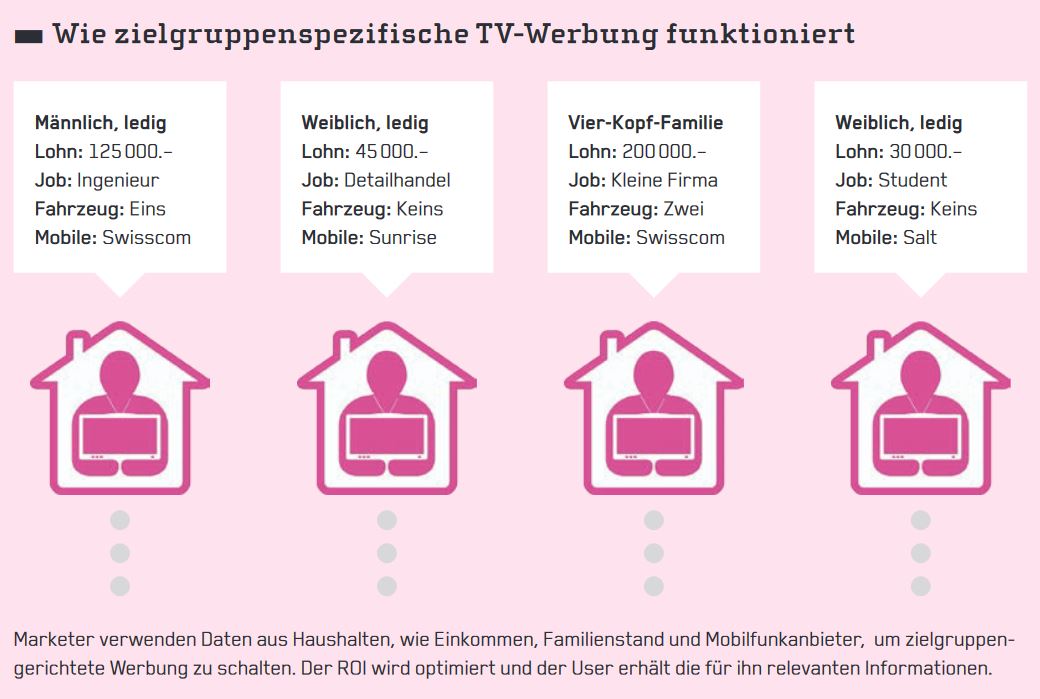
Linear merges with DigitalIn Germany, a pilot project in this direction was already launched in 2014. The Pilot agency group in Hamburg launched a campaign for the Gillette, Opel, and Fisherman's Friend brands. The campaign targeted Internet-enabled TV sets, i.e. HbbTV. This stands for "Hybrid Broadcasting Broadband TV" and links broadcasting and broadband technology. The fusion of classic television with the Internet enables advertisers to place their spots on demand and deliver them precisely when the right target group is sitting in front of the TV. The measurability via the ad server and the more flexible marketing options are particularly exciting for small special-interest and local stations as well as medium-sized advertisers who want cost-effective TV advertising.Where does the data come from?The technical prerequisites are in place today, but HbbTV is still not mature enough, and the number of owners of such devices is increasing, but that does not mean that they are using TV to its full extent. Another option is to work with demographic data, as the USA is doing on a large scale and with a positive response. Target group characteristics such as marital status, net household income, interests, age, gender, car leasing or mobile contracts would provide the market with sufficient new impetus for precisely tailored TV advertising. In addition, data from pay TV providers can be used to assign individual receivers to their respective subscribers. But in this country, the data protection hurdles are much higher than in the USA.As a complementary optionEven though the potential is great and the advantages are obvious, the two big Swiss marketing players Publisuisse SA and Goldbach Media see opportunities but not yet a great future for this method. And this despite the fact that SRG entered into a joint venture with Swisscom and Ringier in the summer of 2015 (see below) - among other things with the idea of making target group-specific advertising. "Digitization makes it possible to address specific target groups on TV and thus also to target TV consumers directly, which not only enables advertisers to address them in an even more targeted manner, but also benefits consumers by making them more relevant. However, I think traditional advertising will continue to be the mainstay of commercialization on TV, because the opportunities for rapid reach building are still unbeatable. Audience-based targeting could become a very exciting complementary opportunity," says Martin Schneider, CEO Publisuisse SA, when asked. The alliance received approval from Bakom in early March, but with the condition that it refrain from target group-specific advertising - this would require license changes. "With the bundling, we can nevertheless develop new and innovative forms of advertising in the Swiss advertising market, which none of the three partners could offer on their own. The new company wants to combine all moving image channels into one big 'all-video advertising platform'," says Schneider.Scattering is sexyGoldbach Media also sees the appeal: "Thanks to the flood of data from online and mobile usage, the ability to target campaigns precisely is now, for the first time, more than just a nice fantasy. Addressable advertising means little wastage in delivery with the greatest interest from consumers," says Alexander Duphorn, CEO of Goldbach Media. His concerns are about targeting: is the person in the individual being addressed or the entire household? After all, unlike mobile devices, which are mostly used by one person, the TV set is a mass medium. "Besides," he adds, "wasted coverage is also sexy. How else could you find and convince new users? "Perhaps the cat owner is toying with the idea of getting a dog, so the dog food ad would help. And if the viewer only ticks off what he wants to see, he'll miss out on other exciting offers. "In a perfect world, perfect advertising becomes information, because advertising is delivered directly to the interested consumer," Duphorn says. So it remains to be seen to what extent target-driven advertising will establish itself on TV.Author: Melanie Granados___________________
Admeira advertising alliance launched

The Executive Board of Admeira with Chief Executive Officer Martin Schneider (fourth from left).The joint venture between Ringier, SRG and Swisscom "Admeira" Admeira is the largest marketing company in Switzerland and has a multimedia portfolio with advertising opportunities in around 80 strong media brands. Admeira is intended to be the Swiss response to the digital transformation and the resulting new needs of the Swiss advertising industry. Based on the latest technology combined with data and marketing expertise, new prospects are emerging for innovative forms of advertising - including TV advertising targeted at specific groups. Admeira's services are open to all advertising clients, agencies and other providers of advertising inventory.Admeira employs over 280 people at its locations in Zurich, Berne, Lausanne, Geneva and Lugano._________________



