
The Swiss Brand Landscape in Flux


BRAND At the Swiss Brand Congress on June 18, the seventh edition of the Swiss Brand Poster was unveiled. It provides an overview of the 650 most relevant Swiss brands. The poster is complemented by an online platform. In 2015, 36 brands were added to the landscape. The most prominent new addition is Salt. With this new brand, the telecommunications company aims to market itself directly to Swiss customers and is no longer required to pay licensing fees to the French company Orange SA.In addition to Salt, brands were also added this year that we do not consciously notice in our daily lives but that exert a global influence within their respective industries. For example, while we may not find Bühler on store shelves, Bühler is behind almost everything we eat. The mills operated by the Uzwil-based company process about 65 percent of the world’s harvested wheat into flour. In addition to Thermoplan and Bühler, Feintool has also been added to the „Technopark“ of the brand landscape. The Lyss-based company is a global leader in the manufacture of precision cutting systems. Virtually every car contains up to 200 components manufactured using Feintool’s high-precision technologies. „Hidden champions“ such as Bühler, Feintool, and Thermoplan form the backbone of the Swiss economy. They are global market leaders in highly specialized industries and are recognized abroad for precision and quality „Made in Switzerland.“.
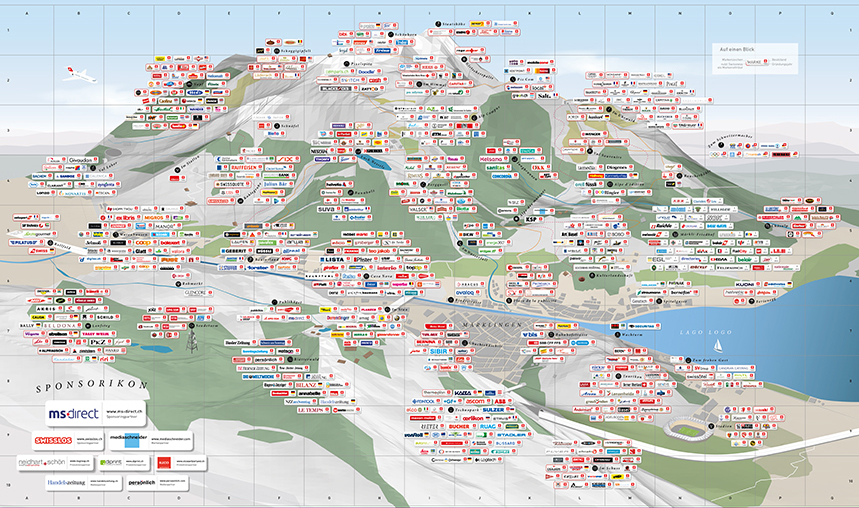
An Overview of the Swiss Brand Landscape.Nationale Suisse, Schlör, and Villiger Bikes at the Märkli CemeterySince the last issue of the brand poster, the Schlör brand era has come to an end. The cider mill in Menzikon was sold to Ramseier Suisse AG. Nationale Suisse was also „laid to rest“ following its acquisition by Helvetia Insurance. The Villiger bicycle brand, which was discontinued by its American owner Trek, can also be found in the „Märkli graveyard.“Is the brand landscape about to lose its „Swissness“?30 percent of the brands on the brand poster clearly identify themselves as „Swiss.“ The count included only those brands that communicate „Swissness“ directly through their logo, name, or slogan—for example, by incorporating a Swiss cross into their logo or describing themselves in their slogan as „swiss,“ „suisse,“ or „Swiss Made.“Nestlé has announced that it will no longer include the Swiss cross on several of its products. The background to this is the “Swissness” legislation, which is set to establish uniform rules for the use of the Swiss brand starting in 2017. Kambly and Toblerone are also officially considering discontinuing the use of the Matterhorn, the Swiss cross, and “of Switzerland” on their packaging. More information at brandlandscape.ch


