
Journalistic quality environments improve advertising impact by 28 percent
Under the title «Quality Alliance 2018 – Our Quality Media Make a Difference,» four leading German quality newspapers will present a foundational study on Thursday that examines the impact of the quality of the media environment.


The "Quality Alliance" - consisting of Frankfurter General Newspaper, Handelsblatt, South German Newspaper and The time - examined the question of whether the environment of a quality media brand influences the perception of advertising in this environment across all channels.
The Quality Alliance Study 2018 is based on two research modules: Firstly, on a quantitative advertising media test with implicit and explicit data on the perception of advertising. The second was a supplementary app-based reception test, which was carried out using consumer neuroscience methods such as measuring brain activity.
New findings on the influence of the environment on advertising impact.
Modern media planning uses targeting, programmatic and other powerful algorithms to offer comprehensive selection and targeting options for the target group, albeit largely detached from consideration of the advertising environment. The attention that is essential for the reception of the message is created and provided by media environments. Choosing the right environment is therefore an important prerequisite for the effectiveness of advertising.
"The aim of the new Quality Alliance study was to fundamentally determine whether one and the same advertising medium has a different effect in a neutral journalistic environment than in journalistic quality media environments. In the comprehensive study now available, the impact of advertising in branded and unbranded media environments was measured among around 2,400 people," explains Martina Winicker, Managing Director of the IFAK Institute, which carried out the quantitative part of the study on behalf of the four media.
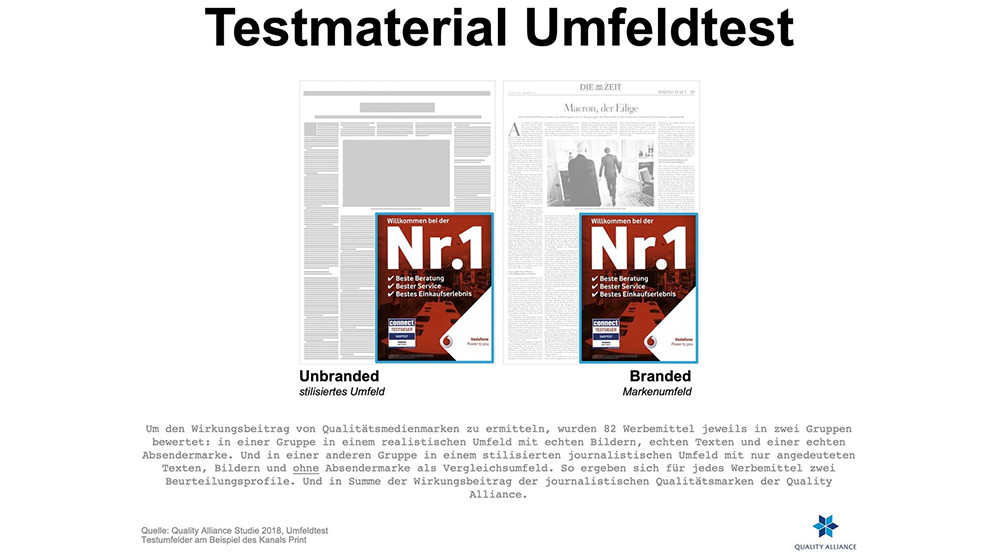
In the study, 82 advertising media were tested and analyzed in the three media channels print, online and mobile. In order to determine the impact of quality media brands, the tested advertising media were either embedded in the environment of the media brand (branded) or presented for comparison in a schematically similar environment but without a recognizable media brand (unbranded) and assessed using 17 positive and negative items. This results in two comparable assessment profiles for each advertising medium.
The study revealed the following fundamental findings:
1. quality media have a positive influence on the assessment of advertising
Across all three channels and 82 advertising media, advertising in the environments of journalistic quality brands is significantly more effective than in other, non-branded environments. On average, 62% of respondents in brand-neutral environments rated an advertising medium positively. In the branded environments of the Quality Alliance, however, the figure was 79 percent. This results in an impact uplift in branded environments of 28% on average. A result of the branding effect of the quality media brands.
2. quality media brands increase the certainty of assessment
The more difficult or uncertain a decision is, the longer it takes to make it. In the environments of the Quality Alliance, the promise of security of the media brands is obviously transferred to the advertising messages: Decisions on the evaluation of advertising are made significantly 7 percent faster when it appears in the environment of quality media.
3. quality media brands increase impact on all channels
The effect of journalistic quality brands on the reception of advertising content applies to print, desktop and mobile devices. Both the more positive assessment and the increased speed of judgment are evident across all channels. The assessment was between 16% (desktop), 33% (print) and 37% (mobile) more positive.
"In summary, it can be seen that the high-quality journalistic environment offered by quality media has a direct positive effect on the perception of brand communication. This is because brands benefit from the quality media environment by increasing the efficiency of their advertising media. The perception of quality media also manifests itself in the impact of advertising in these environments. Across all brands, sectors and channels, the advertising impact uplift is 28%. The high quality standards of Quality Alliance media are therefore also paying off for advertisers," is how the initiators of the study summarize the results.
4. quality media increase user activation
The supplementary reception test carried out by the Hamburg Media School using modern consumer neuroscience methods also shows that quality media is physiologically measurably more activating than neutral environments in both the print and mobile media tested. In an overall index summarizing neurophysiological measurements such as eye movement, heart rate, skin resistance and brain activity, the tested texts with the branding of a quality media brand resulted in a 13 percent higher activation level.
Specifically, the test subjects in the laboratory test paid attention to content branded with quality brands for an average of 145 seconds, 5 seconds longer than non-branded articles, all other things being equal. In addition, brain activity, which indicates higher engagement, is significantly higher when receiving branded content than in non-branded environments. This indicates a more intensive examination and higher engagement during use. Possibly also because the question of the credibility of the content concerns the test subjects less.
Further results and background information on the study can be found at Quality-alliance.com


