Study proves negative effects of poorly placed advertising
Placing advertisements near negative content has a negative impact on a brand’s image. Consumers even suspect that the brand intentionally chose that advertising environment. This is shown by a new study from Germany.


In a recent study on brand safety, brand safety company Cheq, together with media agency IPG Mediabrands, BMW and online entertainment platform Hulu, investigated how ads that appear near negative content affect consumers' brand perceptions. Even more, consumers suspect advertiser intent behind poorly placed ads. The negative consequences on brand image are enormous. The study was conducted in collaboration with BMW and the online entertainment platform and is the first to examine the exact impact of the placement of advertising, next to sensitive content.
Better badly placed than no advertising at all?
This is still common practice. Independent brand safety firm CHEQ, IPG Mediabrands, BMW and online entertainment platform Hulu announced the results of their study, "The Brand Safety Effect," on this topic Friday. The study examined how ads that appear near negative content affect consumers' brand perceptions. The study was initiated by CHEQ and conducted with MAGNA, the intelligence, investment and innovation unit of IPG Mediabrands, and IPG Media Lab, the media and consulting division of IPG Mediabrands. In Germany, the agencies Initiative, Reprise and UM belong to IPG Mediabrands.
More than 2,000 consumers were surveyed about their reactions to ads that appeared alongside three different types of "negative" content: generally negative content (for example, reports of violent acts); off-brand content (for example, an airline ad next to an article by an airline kicking a passenger off a plane); vertically off-brand content (for example, a soft drink ad next to posts about diabetes).
Consumers assume deliberately chosen advertising environment
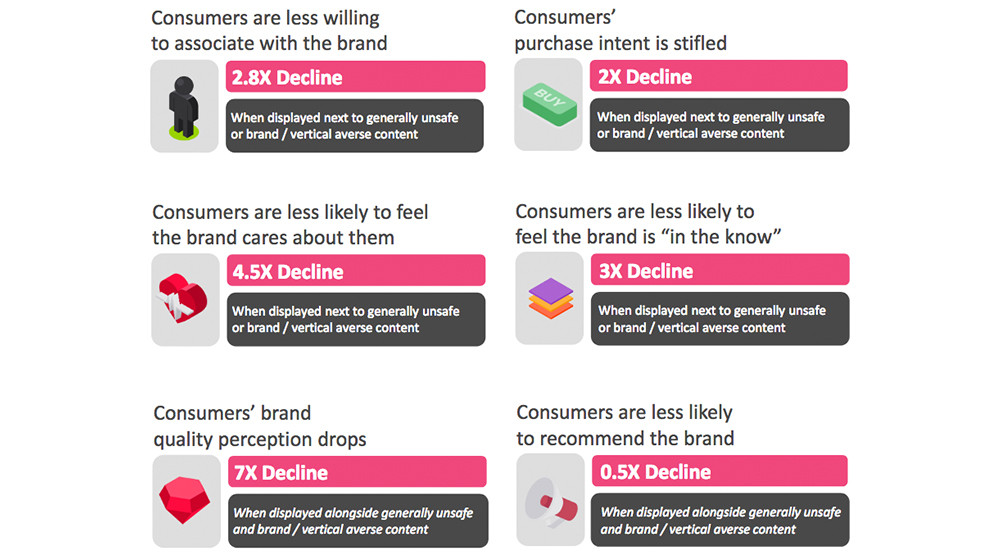
One of the most important findings is that many consumers assume that the advertising placements are deliberately placed in this way. Many respondents were critical of this. "It seems to be manipulative," one respondent surmised. "I would prefer a company that doesn't use these methods." Another respondent added, "It's troubling that they generate revenue through disasters." Another respondent went even further, saying, "It looks like they are taking advantage of the shock value." As a result, consumers are up to 2.8 times less willing to interact with the brand in question. In addition, two-thirds of consumers who previously signaled high purchase intent for a particular brand were less likely to make a purchase. Decreasing willingness to buy is thus also as a result of the poor placement of the ad next to negative content.
"Our joint research with CHEQ shows that most consumers believe ad placement is always flawless. That means, for example, if an ad runs next to violent and or offensive content, they assume the brand intentionally placed it there and in some way supports the content," said Joshua Lowcock, global brand safety officer at UM Worldwide, part of IPG Mediabrands. "Brands need to be aware that if they're only looking at the cheapest price when it comes to playout, it can have a devastating impact on their brand's long-term reputation."
"Previous solution approaches have primarily focused on protecting the brand by reporting non-brand compliant content, rather than preventing it in real time," said Guy Tytunovich, CEO and founder of CHEQ. "This means that advertisers or their brands are consistently seen alongside potentially harmful content. That's why we conducted this study to measure the impact of negative exposure on brand image. The results clearly show how compromised brands already are and how even a few negative ad placements can destroy years of reputation gains."
Results in detail
The study goes into detail about a number of other negative consumer perceptions when ads are played out in an untrustworthy environment.
Other key findings include:
- The brand is not interested in me: In poorly placed advertising, consumers are 4.5 times more likely to feel that the brand is not interested in them.
- The brand is out of date: Consumers are 3 times more likely to feel that the brand is not up-to-date, the advertising for it is poorly placed.
- The brand is undesirable: the perception of brand quality drops 7-fold with poorly placed advertising.
- The brand should be avoided: Consumers are 50 percent less likely to recommend the brand to others.
The full study can be found at Cheq.ai/the-brand-safety-effect downloaded after submitting the contact details.