 The third edition of the Teads Agency Cup brought Swiss media agencies together for an evening filled with team spirit, competition, and networking.
In seven different mini-games, the teams competed for points and the coveted title. In addition to classics like beer pong and a quiz, new challenges also added extra excitement: The boxing machine required speed and punching power. In the «Dollardusche,» the teams had to catch and hold onto as many “Teads Dollars” as possible in a wind tunnel. The “Abhäng-Challenge” demanded a fair amount of muscle strength and endurance from the teams. The scoring system made every challenge count and kept the race open until the very end.
After the welcome and the team briefing, the games began at 7:30 p.m. Following the final challenges, the results were announced on stage and the winning teams were honored. The raffle for AirPods 4 among guests who had registered on-site for the audience prize added to the excitement. Afterward, everyone celebrated together, toasted to the successful evening, and continued networking within the Swiss agency scene.
Claudio Lumbiarres, Managing Director of Teads Switzerland, says: «The Teads Agency Cup has now become a staple event in the Swiss agency scene. The third edition once again demonstrated the energy, ambition, and team spirit the agencies bring to the competition. It’s especially great that the competition not only provides exciting challenges but also creates opportunities for personal interaction and new connections. I’d like to extend my heartfelt congratulations to Webrepublic on their victory and thank all the teams for this wonderful evening.»
The third edition of the Teads Agency Cup has once again demonstrated how important in-person interactions, friendly competition, and knowledge-sharing are within the Swiss agency industry.
Teads Holding Co. („Teads“) (Nasdaq: TEAD) is a leading omnichannel advertising platform that delivers measurable results for brand and performance advertisers across all screens. With a clear focus on profitable business outcomes throughout the entire marketing funnel, Teads ensures the effective use of advertising budgets. Using AI-powered predictive models, Teads optimally combines high-quality media, creative brand experiences, context-based targeting, and precise measurement solutions. Teads partners with more than 10,000 publishers and 20,000 advertisers worldwide. The company is headquartered in New York City and employs approximately 1,700 people in over 30 countries.
For more information, visit www.teads.com
]]>
Webrepublic and PeakJet Launch Partnership for Shared-Private Flights
The Webrepublic-PeakJet partnership has begun: Webrepublic, the independent Zurich-based agency for integrated marketing, has launched a strategic partnership with the Swiss aviation and technology company PeakJet in collaboration with Season Studio. The goal is to provide communications support for PeakJet’s new «Mobility-as-a-Service» platform during its market launch and ongoing operations—across both digital and traditional media.
PeakJet positions itself as a provider of premium smart travel and is committed to democratizing shared-private air travel. According to the company, the new mobility platform not only allows users to book flights but will also offer a wide range of other experiences in the future. The platform has been live since June 2026; Peak Class offers are available for booking now, and the first flights will depart in August 2026.
A Cross-Channel Strategy for a Discerning Target Audience
The key challenge of the Webrepublic-PeakJet collaboration lies in precisely targeting an audience that values flexibility, convenience, and a seamless digital experience—all within a highly competitive market environment. To position PeakJet optimally, Webrepublic and Season Studio are relying on a cross-channel performance and media strategy, underpinned by consistent brand management and creative execution. The campaign will be rolled out on social media, YouTube, search engines, and select publishers.
Adrian Wenzl, Executive Account Director at Webrepublic, describes the approach: «With a data-driven media and performance strategy, we aim to establish PeakJet with a discerning target audience over the long term and support the brand through our communications efforts.»
Patrick Stoll of Season Studio adds regarding the creative direction: «This new way of traveling needs a language that delivers on its promise before the first flight even takes off. That’s exactly where we come in—in the look, the tone, and the entire experience.»
First destinations starting in August, with more to follow in October
The PeakJet platform’s initial destinations include Zurich, Nice, Palma de Mallorca, and Málaga. Starting in October, additional business-focused destinations are set to be added, including Paris, Milan, Munich, and London. PeakJet CEO Gianni Tronza sums up the company’s vision: «We’re not just developing another flight service—we’re creating a new category of travel.»
Webrepublic was founded in 2009 and, according to the company, employs more than 200 experts. The company covers all relevant areas of integrated marketing, from Strategy & Consulting to Performance & Automation to Data & Technology.
For more information about the PeakJet platform and the available offerings, visit: https://www.peakjet.com
Responsible at Webrepublic: Adrian Wenzl, Executive Account Director. Person in charge at Season Studio: Patrick Stoll. Person in charge at PeakJet: Gianni Tronza, CEO.
]]>A peculiar tension hangs in the air at SOHO Zurich this evening. Outside, a storm is raging over the city; inside, the room is filled with a different kind of pressure. The topic is finding one’s bearings in a media landscape increasingly shaped by algorithms, artificial intelligence, and a nearly unmanageable number of platforms.
Advertising has always been a business of attention. But attention alone is no longer enough. Nor is reach. The question that keeps coming up this evening is therefore: How do you create an impact in a world where machines have long since been helping to decide what content people even get to see?
A glance around the room is enough to show that this issue now extends far beyond advertising agencies. Publishers meet platforms. Marketers meet advertisers. Researchers meet practitioners. With Tamedia Advertising, Admeira, Meta, TikTok, Migros Bank, and Emmi, the room is filled with representatives from organizations that handle millions of advertising francs every day.

The Architect of Dialogue
Marjan Iglesias plays an important role this evening. As Director of Client Services at Webrepublic, he not only guides the audience through the program but also articulates the vision behind Media Now. He is convinced that research must find its way from studies and datasets into practical application. That is precisely why Webrepublic has deliberately brought together representatives from platforms, publishers, marketers, advertisers, and academia on the same stage.

The event is not intended to be a product showcase, nor is it a platform for the same old industry clichés. Rather, it aims to highlight different perspectives and spark discussions in areas where the industry has not yet reached a consensus. This is exactly what happens several times throughout the evening.
The stage first belongs to Tobias Zehnder, co-founder and managing director of Webrepublic. And he doesn’t start with a success story about digital advertising. Instead, he tells the story of a YouTube channel that transformed from a harmless travel channel into a platform for crypto scams. It’s a story about trust, deception, and the difficulty of distinguishing truth from illusion in digital environments.
Six trucks full of VHS tapes
To put the scale of the challenge into perspective, Zehnder draws on an image from a different media era. Every minute, around 500 hours of video are uploaded to YouTube worldwide. Extrapolated over a single day, this amounts to six truckloads of VHS tapes. It would take about 82 years to watch all of this material.

The metaphor elicits a chuckle from the audience, but it highlights the real problem. What sounds like unlimited reach is, for advertisers, one thing above all else: a gigantic black box.
That is precisely why Webrepublic, in collaboration with GfK, conducted a comprehensive study on YouTube usage in Switzerland. The platform is now one of the country’s most important video channels and generates significant advertising revenue. At the same time, it often remains unclear in what context ads actually appear and what impact they have there.
The results are surprising. YouTube’s actual prime time isn’t in the evening, but in the afternoon. The platform is primarily used on smartphones. Above all, however, it becomes clear that YouTube is not a uniform channel, but rather a melting pot of completely different reasons for use—ranging from focused learning to entertainment to pure distraction.

The YouTube Black Box
The deeper Zehnder and his team delve into the data, the clearer it becomes that technical reach and actual advertising impact are not the same thing. A music mix that plays in the background for hours generates views. An ASMR video to help you fall asleep generates views. Kids’ channels generate views. But that doesn’t automatically translate to attention.

Perhaps the most provocative finding of the evening is therefore that about half of all advertising spending on YouTube ends up in contexts that generate very little ad recall.
In an exclusive interview with m&k, Zehnder speaks of a «data illusion» from which the industry suffers. Engagement doesn’t mean the same thing everywhere, and reach certainly doesn’t. Platforms provide enormous amounts of metrics, but not every metric actually says anything about impact.
The audible murmur from the audience shows that this statement strikes a chord.
The Quest for Attention
At first glance, the question posed by Damian Chandler and Kevin Haab seems surprisingly simple: How can the context of a YouTube channel be reliably determined in the first place?

For years, advertising has been evaluated based on metrics such as impressions, views, and reach. But there is one crucial variable that lies between successful ad delivery and actual advertising impact: context. That’s exactly where the YouTube Impact Engine comes in.
Chandler describes the challenge as the interplay of four factors: media KPIs, quality, context, and impact. While the industry has a relatively large amount of data available for the first two factors, context often remains a black box. Those who rely on platform automation may achieve reach, but they often have only limited insight into the actual environment in which their ads appear.

The search for answers took the team deep into YouTube’s structure. What at first glance looks like a straightforward category such as «Gaming» branches out into dozens of subcategories—from battle royale games to simulations and strategy games, all the way to chess and educational content. Although the platform itself provides categorizations, according to Chandler, these are often insufficient for drawing conclusions about advertising effectiveness.
That is why Webrepublic developed its own logic. Using artificial intelligence, channels were first analyzed based on relevance, language, semantics, and context. This process resulted in 21—and later 22—transparent Webrepublic Impact categories that are based not on platform logic but on usage scenarios.
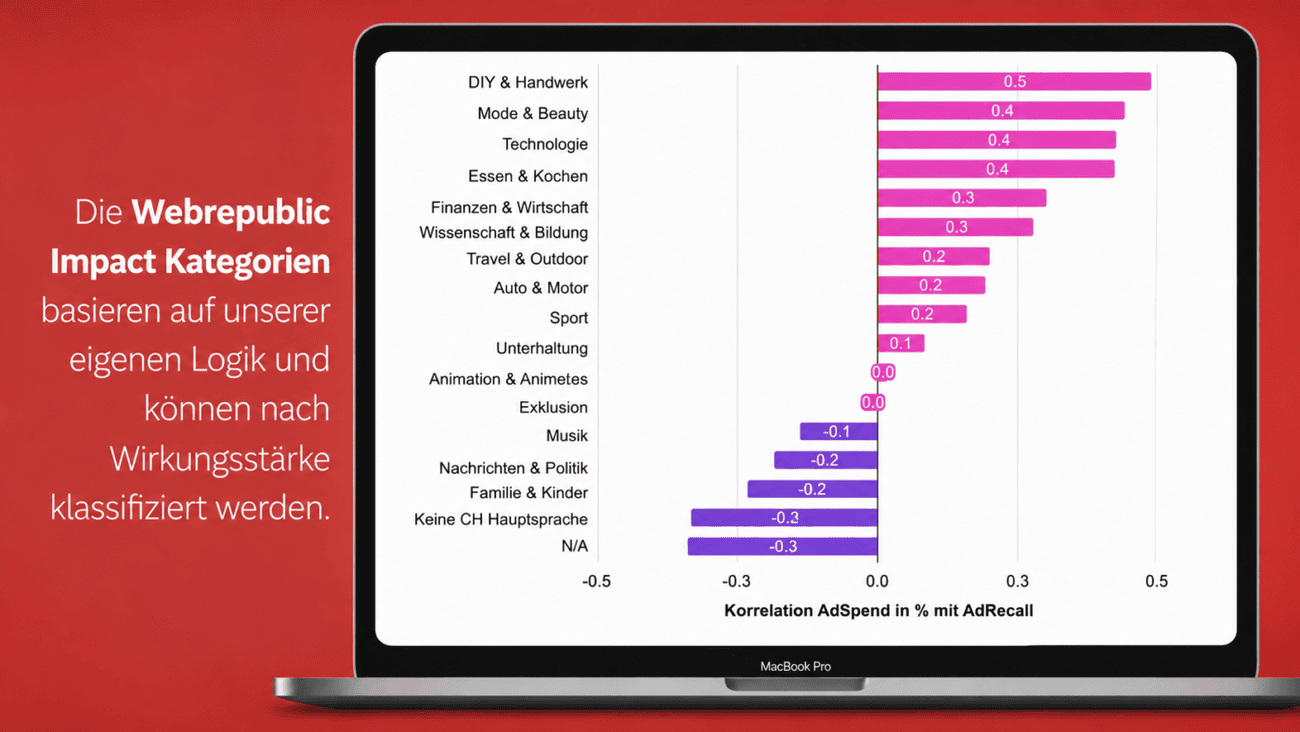
The crucial step came only after that. The new categories were cross-referenced with data on ad recall. The results show clear differences. Categories such as DIY & Crafts, Fashion & Beauty, Technology, Food & Cooking, and Finance & Business exhibit an above-average correlation with ad recall. While other categories generate reach, they achieve significantly lower recall rates.
This is precisely what led to the project’s key finding: Good delivery metrics do not automatically translate into high advertising impact. Or, as one of the slides presented states: «Media KPIs are the foundation, but they are no guarantee of impact.»

For Chandler and Haab, this is where the true value of the YouTube Impact Engine lies. It is not meant to replace automation, but rather to scrutinize the algorithms. Those who better understand user behavior can allocate budgets more effectively, reduce wasted spending, and increase the likelihood that ads will actually stick in viewers’ minds.

Ultimately, the two see their development less as a new planning tool and more as a new perspective on Switzerland’s largest video platform. The YouTube Impact Engine is designed to enable audits, benchmarking, and new setups—and thereby reveal why two campaigns with identical reach can have completely different impacts.

The Big Debate
After the break, the evening shifts its focus. The discussion is no longer just about YouTube, but about how different stakeholders understand impact in the first place.

Konstanze Fichtner makes it clear that while attention is important, it explains only part of the impact. For the Meta manager, the actual business results remain the decisive factor. Brand impact, ROI, or ROAS are ultimately more relevant than individual media metrics. She finds Webrepublic’s attempt to link context and impact particularly exciting. At the same time, she points to another key factor: creative. In her view, creative quality accounts for about half of engagement and thus remains one of the strongest influencing factors of all.
Philipp Mankowski argues from the perspective of high-quality journalism. For him, quality means not only content but also engagement. Those who are willing to pay for content tend to consume it more mindfully. On average, articles on Tamedia are read for about four minutes, while commercial content is still read for about two minutes. For Mankowski, this time invested is a form of attention that differs fundamentally from the logic of quickly scrolling feeds.

Stefanie Fritze articulates what is probably the most pointed customer perspective of the evening. After the study results were presented, she said, half-jokingly, half-seriously, «I want my money back.» Behind this, however, lies a serious concern. Today, advertisers must not only buy media but also invest additional money in measurement, analysis, and channel-specific creative work. The number of platforms is increasing, usage scenarios are becoming more diverse, and it’s getting harder and harder to keep track of everything. At the same time, pressure from senior management is mounting to directly link marketing spending to business success.

Marie-Theres Schramm points out that the industry has been discussing common measurement standards for over ten years. For a long time, it had been impossible to bring all relevant market participants to the table. Only now are the first initiatives for cross-platform measurement emerging in the U.S. and the U.K. At the same time, she warns against making overly simplistic comparisons. Not every platform serves the same function, and not every KPI is equally relevant for every brand. E-commerce providers focus on different metrics than brands that are primarily seeking to build brand awareness.

Frank Zelger ultimately takes up Zehnder’s VHS metaphor and expands on it with a historical analogy. In the past, VHS, Betamax, and Video 2000 competed for market share. In the end, one standard prevailed. That is precisely what is missing today in advertising effectiveness measurement. As long as every provider measures according to its own criteria, the market will remain fragmented. The challenge is not the measurement standard alone, but rather a common reporting standard that CFOs, marketing directors, agencies, and media companies can all understand equally.
The view from the outside
Perhaps the clearest perspective on the evening is provided by Marcus Schögel,
In an exclusive interview with m&k, he expressly praises Webrepublic’s approach. Global platforms would be hard-pressed to achieve this level of localization and regionalization. The question of which platforms are actually effective will become even more important in the future—and not just on YouTube.

Even more intriguing, however, is its fundamental classification.
«What I take away above all else is that we’re once again having a discussion about effectiveness, not just efficiency,» says Schögel. For him, this is precisely what makes the evening so significant. The industry is once again focusing more closely on the question of whether advertising actually reaches its intended audience.
Schögel pays particular attention to what advertisers have to say. Their expectations, he notes, are clearly articulated and entirely justified. At the same time, he has gained the impression that clients’ demands are sometimes formulated more precisely than the answers the industry is able to provide.
When AI Becomes a Customer
But Schögel is thinking even further ahead.
He does not see the next major change coming from platforms or channels, but rather from the recipients of communication themselves. In the future, advertising will have to convince not only people, but also their digital assistants and AI agents.
These systems would evaluate information based on different criteria than their human users. Purchasing decisions would increasingly result from a collaboration between humans and machines. For marketing professionals, this means a new level of complexity that is only beginning to emerge today.
All of a sudden, the discussion about YouTube almost seems like a preview of something bigger.

The Winkelried Moment
The most significant innovation of the evening was not just the YouTube Impact Engine, but the willingness to even open up their own “black box” for discussion. Platforms, publishers, marketers, advertisers, and academics were all in the same room—stakeholders who view impact from different perspectives and do not always pursue the same interests.
The discussion wasn’t about reach records, click counts, or the next technological sensation, but rather about the fundamentals of the business: attention, impact, and trust. While a summer storm swept through Zurich outside, it became clear inside just how paradoxical the industry’s situation has become. Never before have we had access to more data, more technology, and more artificial intelligence. At the same time, there is more uncertainty than ever about what actually works in advertising.
This is precisely where the true value of Media Now lies. Not because all the answers are already known, but because someone is taking the first step to ask the right questions. In Swiss history, this is known as the “Winkelried moment”: someone steps forward, opens a path, and thereby paves the way for a movement that is greater than themselves.
The YouTube Impact Engine thus remains not only the most visible outcome of this evening, but also the spear that was deliberately thrust into the black box of advertising effectiveness. The industry will now have to figure out together what comes of this.
]]>
YouTube has long since ceased to be a secondary channel in Switzerland. The platform is a search engine, learning space, moving image stage and accompanying medium all in one. This is precisely where its power lies - and the difficulty of mastering its planning. After all, anyone who still thinks of YouTube according to the logic of linear television may be missing out on its actual impact. This is precisely where a new study by Webrepublic in collaboration with GfK comes in. It provides insights into the use of YouTube, but is ultimately aimed at something bigger: the future of the media agency itself.
From digital pioneer to integrated media provider
Webrepublic still has the web in its name. And yet today, the Zurich agency wants to be much more than a digital specialist. For Tobias Zehnder, Managing Director and co-founder, this change is not an abrupt repositioning, but the logical development of an attitude that has been there for a long time: wanting to understand how marketing works as a whole.
When it became clear around 2020 that the complete digitalization of marketing was changing not just channels but the entire system, Webrepublic felt that it was no longer enough to just master the digital part. People continue to see posters, watch television, move between screens, environments and usage situations. If you seriously want to understand advertising impact, you have to be able to read it as a whole.
This led to the move from a provider with a strong digital focus to an integrated media agency with national aspirations. Not as an end in itself, but out of the conviction that complexity for customers cannot be reduced by having more partners, but by having a better overview.
Reach alone only tells half the story
The real crux of the conversation, however, isn’t the agency’s history, but the question of what actually matters in the media industry today. Kevin Haab, Head of Media Strategy at Webrepublic and a specialist in impact research, deliberately focuses not on reach or frequency, but on ad recall. For him, ad recall isn’t just a nice-to-have metric, but a KPI with strategic relevance. After all, a campaign can, in theory, build reach very quickly and generate technically sound impressions. Whether these contacts were actually visible, triggered a cognitive response, and were genuinely associated with the brand, however, is another matter entirely.
This is precisely where the criticism of a market that likes to be dazzled by platform figures begins. Visible is not automatically effective. And a contact is far from being a memory.
The YouTube illusion
The YouTube study conducted in collaboration with GfK dispels several assumptions that have become entrenched in the market. The context of use is particularly important. YouTube is not just consumed casually. Many people use the platform in a very focused way to delve deeper into specialist topics or learn specific skills. For example, anyone looking for an Excel command, a fitness exercise or wanting to understand a problem in detail has long since ended up on YouTube.
This is highly relevant for advertising. This is because the impact of advertising depends heavily on the mental state of the user at the time. Anyone who is immersed in a topic will encounter advertising messages differently than someone who is simply watching entertainment on the side. "Context is king" is therefore not just an old industry mantra, but a tangible operational reality.
The second finding concerns the device debate. Connected TV is currently generating a lot of hype, and YouTube is also driving this trend. However, from Webrepublic’s perspective, the study clearly shows that the real drivers of reach and impact on YouTube are still mobile and desktop. Those who let themselves be too dazzled by the big screen in the living room miss out on the ad inventory where YouTube often demonstrates its decisive reach in practice. Added to this is the multiplier effect of young target audiences. Those who buy a lot of impressions on YouTube quickly end up reaching a disproportionately high share of younger audiences. This complicates traditional age-based targeting. The platform does not distribute attention neutrally, but rather according to its own usage patterns.
Why inventory is not simply inventory
Things get particularly interesting where Webrepublic combines the findings of these studies with its own impact research. From the platform’s perspective, much of this data is initially considered to be of equal value. A contact is a contact. This is precisely where the agency’s criticism comes in. Kevin Haab points to situations in which ads are technically displayed but, in reality, there is hardly any visual contact. Such «radio contacts» are often treated in the same way by large platform systems as fully visible, attentively consumed advertising moments. For Webrepublic, it is precisely this equivalence that is problematic. The agency therefore attempts to systematically categorize inventory based on its impact potential and to weight it differently using AI. The goal is not merely more elegant planning, but a more robust allocation of budgets. Money should not simply buy visibility anywhere; rather, it should be directed to places where visibility is more likely to translate into recall.
The agency as a counter-model to the black box
This brings us to the broader strategic question. What is the raison d’être of a media agency when Google, Meta, and other platforms are increasingly automating, optimizing, and shifting processes into black boxes? Tobias Zehnder puts it succinctly. An agency has a reason to exist if it outperforms the platforms’ automated AI logic. If it doesn’t simply trust the black boxes, but understands what’s happening behind the scenes. If it can identify wasted spending and direct budgets toward where advertising actually has an impact.
This view is not only an attack on platform logic, but also on the business model of many traditional networks. Zehnder makes no secret of the fact that he often sees large media agencies today less as pure service providers than as commercial platforms that earn their money through inventory, trading and their own products. Webrepublic counters this with the narrative of independence. That sounds self-confident. And it strikes a nerve at a time when many advertisers are receiving more data than ever, but do not necessarily feel better oriented.
AI speeds up the process—but does not replace human judgment
Of course, Webrepublic is also part of an industry that is currently being swept up by AI with full force. But in conversation, it quickly becomes clear that Zehnder and Haab do not view AI as an end in itself. For them, the more interesting question is not where AI is being used, but what mindset lies behind it. It’s simply not enough to just make existing processes faster and cheaper. AI becomes truly relevant where new forms of value creation emerge: at the intersection of data, modeling, consulting, and strategic judgment. Especially in a world where platforms are increasingly automating their systems, this judgment becomes the true differentiator.
This can also be seen in the new search environment. With Google's AI offensive, generative search and terms such as GEO, the logic of findability is shifting again. Clicks now only tell part of the story. Many things are becoming more indirect, more diffuse and more difficult to measure. This is precisely why, according to the implicit message, partners are needed who can not only read dashboards, but can also classify contexts.
Consistency beats the next hype
Another idea that Zehnder emphatically brings into the discussion seems almost pleasantly unagitated: Brand Consistency. While LinkedIn and TikTok produce new hypes every day and many are under pressure to innovate, he considers consistency to be massively undervalued.
Brands aren’t built on a constant stream of new claims, ever-changing visual styles, and seasonal shifts in direction. They are built on recognizability, a consistent visual and narrative language, and the ability to resonate over the years. Especially in an era of rapid change, this consistency becomes increasingly valuable. This is not a rejection of innovation. Rather, it is a reminder that even in the age of AI, brand management is not merely a game of optimization, but continues to be about memory. And patience.
The message behind the study
The YouTube study by Webrepublic and GfK is ultimately more than just a study about YouTube. It serves as a starting point for a broader debate about media, impact, and responsibility—about how much trust platform data deserves. It raises questions about how ad inventory needs to be reevaluated. And it explores what role a media agency can still play as systems become increasingly self-governing. Webrepublic offers a clear answer: through independence, its own impact research, in-depth technological expertise, and the commitment to reduce uncertainty rather than simply sell reach. Whether this approach will work as confidently in practice as it sounds in conversation is something the market will decide. But the approach certainly provides plenty of food for thought.
And perhaps that's the real point: that a study about YouTube ultimately tells us less about YouTube than about an industry that is currently having to reorganize itself.
«An agency has a reason to exist if it outperforms the platforms» automated AI algorithms."
From Insight to Impact
Building on our research into impact and usage, we have developed a data-driven approach that, for the first time, systematically evaluates YouTube inventory based on usage context and impact potential. This ensures that the budget is allocated to the channels with the greatest impact.
Learn more via the QR code:
]]>«The study serves as a starting point for a broader debate on media, impact, and responsibility.»
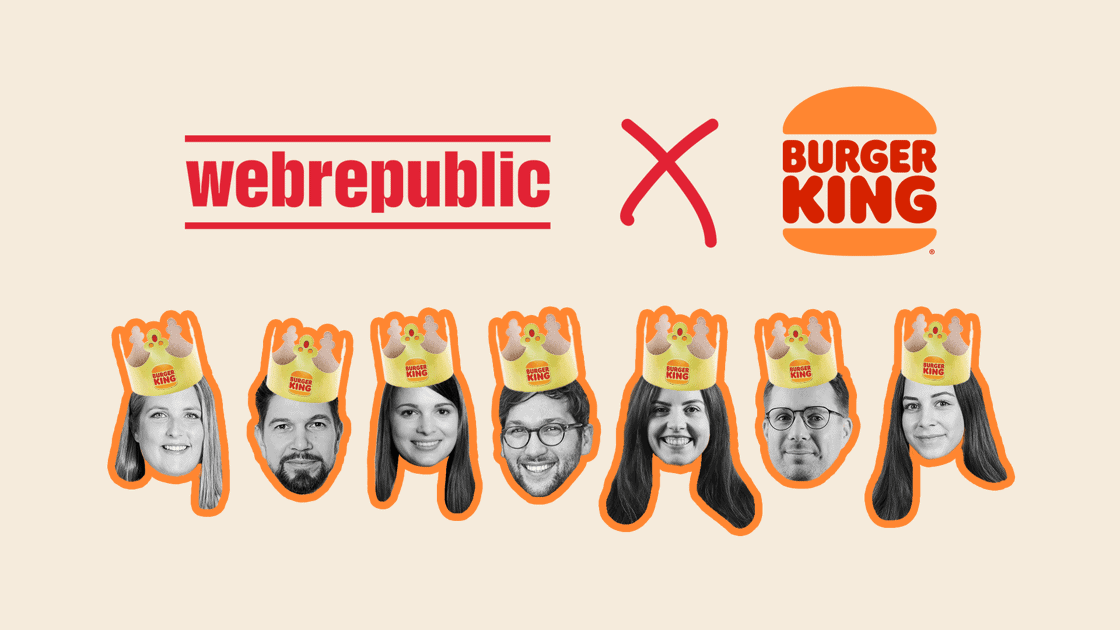
The Zurich-based agency Webrepublic will be responsible for the media account of the global restaurant brand Burger King in Switzerland from April 2026. The mandate includes strategic and operational responsibility across the central digital and traditional advertising channels. After an intensive selection process, Webrepublic was able to prevail against the competition. The Zurich-based agency impressed with a holistic approach that anchors the Burger King brand in the minds of consumers in the long term, while also achieving short-term sales success.
Focus on advertising impact
In a highly competitive market environment, the agency relies on a unique media approach that is fully geared towards media effectiveness. This is made possible by the agency's in-house impact research. In addition, there is a strong focus on maximum budget efficiency, which is achieved through intelligent, data-based planning and advantageous media conditions.
Independence as a success factor
As an independent agency, Webrepublic guarantees consulting services that operate free of external incentives and are geared exclusively towards the client's business success. This transparency forms the basis for a long-term partnership.
«Burger King is a global icon and it is a great pleasure for us to be able to support this brand in Switzerland,» says Marjan Iglesias, Director Client Services at Webrepublic. «We are proud and extremely excited to use our expertise to strengthen Burger King's market position, and perhaps enjoy a burger or two ourselves along the way.».
Webrepublic is an independent agency for integrated marketing based in Zurich, founded in 2009. More than 200 experts cover all relevant areas of modern marketing: Strategy & Consulting, Performance & Automation, Media & Campaigning, Content & Creative and Data & Technology. Burger King has been represented in Switzerland since 1981 and today serves guests in around 92 restaurants with specialties grilled over an open flame. Since 2020, the expansion of the brand in Switzerland has been driven by the QR Group as master franchisee.
]]>
YouTube is no longer a niche portal, but a central pillar of the Swiss video landscape. But how is the platform actually used? A new study by Webrepublic in collaboration with GfK provides detailed insights into usage motives, timing and the quality of advertising contacts in German-speaking Switzerland. User surveys and findings from operational campaign work are combined to gain insights.
While YouTube scores with almost unlimited advertising space and impressive reach, it is important to bear this in mind: Reach alone is no guarantee of advertising success. The decisive factor is the quality of contact. The study contributes to the investigation of the conditions under which an impression becomes a real advertising impact.
Focus is the key to success
A key finding of the study is the importance of usage motives. Advertising primarily has an impact where users consume content in a focused manner - for example, to learn something new or to delve deeper into a topic. In contrast, "unfocused" contacts, where YouTube is merely used as background entertainment, have a significantly lower impact.
"YouTube is not just YouTube", the authors of the study conclude. It is therefore essential for advertisers to target those channels and environments in which a focused consumption of content is expected.
High usage duration and young audience
On average, Swiss people spend 41 minutes on the platform on weekdays and as much as 50 minutes at weekends. The age group of 15 to 34-year-olds has the highest intensity, while usage decreases significantly with increasing age. Both during the week and at weekends, the afternoon is the time with the highest usage.
Success on YouTube is based on a balanced mix of reach and inventory quality across different devices. In the end, it's the content that counts for users, not the device.
The complete study is available here.
]]>
YouTube has long since ceased to be a secondary channel in Switzerland. The platform is a search engine, learning space, moving image stage and accompanying medium all in one. This is precisely where its power lies - and the difficulty of mastering its planning. After all, anyone who still thinks of YouTube according to the logic of linear television may be missing out on its actual impact. This is precisely where a new study by Webrepublic in collaboration with GfK comes in. It provides insights into the use of YouTube, but is ultimately aimed at something bigger: the future of the media agency itself.

From digital pioneer to integrated media provider
Webrepublic still has the web in its name. And yet today, the Zurich agency wants to be much more than a digital specialist. For Tobias Zehnder, Managing Director and co-founder, this change is not an abrupt repositioning, but the logical development of an attitude that has been there for a long time: wanting to understand how marketing works as a whole.
When it became clear around 2020 that the complete digitalization of marketing was changing not just channels but the entire system, Webrepublic felt that it was no longer enough to just master the digital part. People continue to see posters, watch television, move between screens, environments and usage situations. If you seriously want to understand advertising impact, you have to be able to read it as a whole.
This led to the move from a provider with a strong digital focus to an integrated media agency with national aspirations. Not as an end in itself, but out of the conviction that complexity for customers cannot be reduced by having more partners, but by having a better overview.
Reach alone only tells half the story
However, the real pivotal point of the discussion is not agency history, but the question of what still counts in the media trade today. Kevin Haab, Head of Media Strategy at Webrepublic and a specialist in impact research, deliberately focuses not on reach or frequency, but on advertising recall.
For him, ad recall is not just a nice additional parameter, but a KPI with strategic relevance. After all, a campaign can theoretically build up reach very quickly and generate technically clean contacts. But whether these contacts were also visible, triggered something cognitively and were actually linked to the brand is another matter.
This is precisely where the criticism of a market that likes to be dazzled by platform figures begins. Visible is not automatically effective. And a contact is far from being a memory.
The YouTube illusion
The YouTube study conducted in collaboration with GfK dispels several assumptions that have become entrenched in the market. The context of use is particularly important. YouTube is not just consumed casually. Many people use the platform in a very focused way to delve deeper into specialist topics or learn specific skills. For example, anyone looking for an Excel command, a fitness exercise or wanting to understand a problem in detail has long since ended up on YouTube.

This is highly relevant for advertising. This is because the impact of advertising depends heavily on the mental state of the user at the time. Anyone who is immersed in a topic will encounter advertising messages differently than someone who is simply watching entertainment on the side. "Context is king" is therefore not just an old industry mantra, but a tangible operational reality.

The second insight relates to the device debate. Connected TV is currently being heavily hyped, and YouTube is also driving the topic. However, from Webrepublic's perspective, the study clearly shows that the real drivers of reach and impact on YouTube are still mobile and desktop. Those who allow themselves to be dazzled too much by the big screen in the living room will miss out on the inventories in which YouTube often unfolds its decisive breadth in practice.

Added to this is the multiplier effect of young target groups. Anyone who buys a lot of impressions quickly ends up disproportionately with younger people on YouTube. This makes classic age targeting more difficult. The platform does not distribute attention neutrally, but according to its own main areas of use.
CLICK HERE FOR THE M&K ARTICLE WITH IN-DEPTH INFORMATION ON THE STUDY.
Why inventory is not simply inventory
Things get particularly exciting when Webrepublic combines the study findings with its own impact research. Because from the platform's point of view, many things are worth the same. A contact is a contact. This is precisely where the agency starts its criticism.
Kevin Haab refers to situations in which advertising is technically played out, but in fact there is hardly any visual contact. Such "radio contacts" are often treated similarly to fully visible, attentively consumed advertising moments in the large platform systems. For Webrepublic, it is precisely this equation that is problematic.
The agency is therefore attempting to systematically categorize inventory according to its impact potential and weight it differently with the help of AI. The aim is not just more elegant planning, but a more robust allocation of budgets. Money should not just buy visibility anywhere, but should end up where visibility is more likely to turn into recall.

The agency as a counter-model to the black box
This opens up a view of the bigger strategic question. What is the raison d'être of a media agency when Google, Meta and other platforms are increasingly automating, optimizing and shifting to black boxes?
Tobias Zehnder formulates the answer succinctly. An agency is justified if it is better than the automated AI logic of the platforms. If it does not simply trust the black boxes, but understands what is happening behind them. If it can make waste of money visible and steer budgets to where advertising impact actually occurs.
This view is not only an attack on platform logic, but also on the business model of many traditional networks. Zehnder makes no secret of the fact that he often sees large media agencies today less as pure service providers than as commercial platforms that earn their money through inventory, trading and their own products. Webrepublic counters this with the narrative of independence. That sounds self-confident. And it strikes a nerve at a time when many advertisers are receiving more data than ever, but do not necessarily feel better oriented.
AI speeds up everything - but it does not replace judgment
Of course, Webrepublic is also part of the industry that is currently being hit hard by AI. However, it quickly becomes clear in conversation that Zehnder and Haab do not see AI as an end in itself. The more interesting question for them is not where AI is being used everywhere, but the mindset behind it.
It is not enough to simply make existing things faster and cheaper. AI becomes truly relevant where new forms of value creation emerge: in the combination of data, modeling, consulting and strategic judgment. In a world where platforms are increasingly automating their systems, this power of judgment is becoming the real differentiator.
This can also be seen in the new search environment. With Google's AI offensive, generative search and terms such as GEO, the logic of findability is shifting again. Clicks now only tell part of the story. Many things are becoming more indirect, more diffuse and more difficult to measure. This is precisely why, according to the implicit message, partners are needed who can not only read dashboards, but can also classify contexts.
Consistency beats the next hype
Another idea that Zehnder emphatically brings into the discussion seems almost pleasantly unagitated: Brand Consistency. While LinkedIn and TikTok produce new hypes every day and many are under pressure to innovate, he considers consistency to be massively undervalued.
Brands are not built with constantly new claims, constantly changing imagery and seasonal changes of direction. They are created through recognizability, through a consistent visual and content-related language, through connectivity over the years. Especially in a time of maximum acceleration, this consistency gains in value.
This is not a rejection of innovation. Rather, it is a reminder that even in the age of AI, brand management is not just a game of optimization, but still has something to do with memory. And with patience.

The bigger message behind the YouTube study
The YouTube study by Webrepublic and GfK is therefore ultimately more than just a study about YouTube. It is a catalyst for a larger debate about media, impact and responsibility. About how much trust platform data deserves. About how inventory needs to be re-evaluated. And about what role a media agency can still play when systems increasingly control themselves.
Webrepublic has a clear answer to this: with independence, its own impact research, technological depth and the claim not to sell reach, but to reduce uncertainty. The market will decide whether this works in every case as confidently as it sounds in conversation. But the approach certainly provides food for thought.
And perhaps that's the real point: that a study about YouTube ultimately tells us less about YouTube than about an industry that is currently having to reorganize itself.
]]> With today's publication of the new figures, the gaming (incl. gaming genres) and POS (point of sale) categories were published for the first time. New messenger services, additional social media platforms, a streaming network and expanded podcast genres have also been integrated. These complement the previous genres of the study: press, cinema, TV, streaming, radio, podcasts, websites / apps, social media, messenger services, out-of-home / digital out-of-home, digital signage, public transport, direct mail and e-mail marketing.
The ongoing expansion of Mach Strategy is reflected in record-high usage figures among media agencies and underlines its increasing importance for the Swiss advertising market. In the last four years, access to the "Next>Level" data portal has increased significantly. In September 2025, they reached a new record with over 8,000 hits from agencies (rolling annual total) (see chart).
Valérie Goridis, Co-Head of Media Strategy at Webrepublic AG, says of the study: "The Mach Strategy is indispensable for us. It provides the basis for our integrated media strategies and helps us to optimize marketing budgets."
Wemf's Mach Strategy is the central tool for campaign planning and the evaluation of media strategies. All Swiss media agencies use the study as a basis for strategic media planning. The national media study combines socio-demographic information and consumption data with media usage data. This makes it possible to precisely analyze which channels or channel combinations have the highest reach potential for a target group.
Benefits for the advertising market and media market For the advertising market, MACH Strategy offers the possibility of creating cross-genre reach scenarios for advertising planning and thus supports the optimization of marketing strategy, media planning and budget deployment. For the media market, MACH Strategy makes it possible to present multimedia media brands and their usage profiles across the board and to locate them in the advertising market across genre boundaries.
]]>
PACE: A new playmaker in sports marketing
With the founding of PACE, Webrepublic is launching a new company that takes a consistently digital approach to sports marketing. As a spin-off from previous projects with FIFA, PACE combines nine years of experience in global sports projects with offices in Zurich, Lausanne, London, Miami and Cape Town.
The mission: to translate the fast pace of sport into strategic and creative experiences - data-based, cross-media and with a real fan focus. Over 150 activated campaigns, six major international events with more than one billion viewers and billions of digital contacts underline this claim.
Tom Hanan: Sponsoring as a lever for data-driven marketing
For Tom Hananfounder of Webrepublic, PACE is the logical step after years of intensive work with FIFA. Today, sponsorship is more than just a way to generate coverage - it is a vehicle for conversion, community building and data strategies. The comparison between the 2018 FIFA World Cup in Russia and the 2022 FIFA World Cup in Qatar makes this clear: while visibility once mattered, it was recently about First-party data acquisition and direct activation of fans.
PACE stands for an integrated model in which Sponsoring, media, creation and technology not working side by side, but together. This requires flexible teams, digital hunger - and a passion for sport as a world of experience. This is exactly what PACE offers as a platform for talents, customers and brands.

New Leagues: Digital pitches with a global fan base
Maurits Schön COO at OneFootball, sees the "New Leagues" such as the Kings League, Icon League and Baller League as the most radical change in the football business. These formats rely on short match times, digital first publishing strategies via Twitch and YouTube, and influencers as "team heads" who bring entire communities with them.
With spectator numbers exceeding 60 million per match day and a target group that has little to do with traditional Bundesliga stadiums, a new playing field is emerging - faster, more direct, more emotional. Storytelling and fan interaction take center stage, and brands benefit from significantly greater freedom of activation.
Women's football: a pitch with potential
In the panel with Lisa Währer Co-Founder & Managing Director FK Viktoria Berlin and Luis Vincente (Mercury 13), women's football was presented as a "marathon" and not as a trend. The narrative is changing - away from the fight for equality and towards independent clubs with authentic communication and alternative target groups.

Brands that rely on real stories instead of flat logos will find ideal platforms here. The UEFA Women's Euro in Switzerland for which PACE was responsible for the national promotion campaign, became a prime example: families, millennials, hipsters - a different stadium experience that scores with authenticity and sets new standards.

PACE in practice: From Mexico to the Letzigrund
Alexander RiggersManaging Director and Co-Founder of PACE, and Lea Nobs, an expert in digital campaign management, provided deep insights into the operational work of the new spin-off at the event - and made it clear how sports marketing works today.
At FIFA Club World Cup in the USA PACE and FIFA were responsible not only for activating major sponsors as partners, but also for a comprehensive ticketing campaign. To this end, Lea Nobs' team worked for months in Intercontinental coordination between Zurich, Mexico and the USAto successfully promote a new tournament format with global reach locally. All digital tools were used - from Google Search, YouTube and Meta to X and local publisher platforms.
An important learning according to Lea Nobs: Team and player-focused creatives worked best - in other words, formats that focused on key players or specific matches. This visual personalization generated significantly more clicks and ticket sales than generic advertising media. Another decisive factor was the ability to test and optimize on an ongoing basis and to set up new creative assets at short notice - 24/7 operation across time zones, without traditional weekends.
Also with the UEFA Women's Euro 2025 in Switzerland the effectiveness of this data-driven approach was demonstrated. Here, PACE managed the entire national promotion and ticketing campaign. Nobs describes how important it was, the right tone and the right environment for families, millennials and female target groups - for example through clear, reduced information on venues and teams, combined with direct ticket integration.
Alexander Riggers emphasizes the emotional power of the stories told: The success of the Euro has shown how much people identify with female players and their characters - if you offer them a platform. This is precisely where he sees the potential for future formats: Create digital narrative spacesthat have an impact beyond the event - into everyday life, social networks and club football.
Both Riggers and Nobs advocate sports marketing that is not based on short-term KPI fixes, but rather on long-term relationships, continuous learning and genuine fan orientation. Or as Lea Nobs says: "The more precisely we know who our audience is, the more effectively we can communicate. But that also means constantly listening, thinking and rethinking."
Conclusion: Total commitment instead of classic banding
The "Reinventing the Game" event impressively demonstrated that sports marketing is at a turning point. Between TikTok, Twitch and the stands, new ways of thinking are needed - and players who break down old silos. Sponsorship is becoming data-driven, fans are becoming co-creators, women's football is becoming a role model.
PACE is exemplary of a new era: strategically well thought-out, operationally agile, creatively courageous. Today's sponsors not only have to create reach - they have to generate resonance. The rules of the game have changed. And those who know them have the chance to help shape the game.

From digital specialist to integrated media agency
"When we made the bold decision five years ago to take the step from the purely digital world into the holistic, fully integrated media world, no one was seriously waiting for a new media agency," said Tobias Zehnder, Co-Founder and Managing Director of Webrepublic, right at the start of his presentation. Despite a saturated market, the agency has successfully established itself today. With over 200 employees, it has the power of a large network - and at the same time the heart, courage and ambition of an independent, owner-managed agency.

Zehnder emphasized that Webrepublic has found a clear place in a market that is becoming increasingly integrated, while at the same time the media landscape is becoming more and more fragmented. Budgets have to achieve more, and that with increasingly complex requirements. In an industry where there is often a lot of noise, there is a lack of focus on actual impact. This is precisely where Webrepublic comes in - with differentiation, new ideas and, above all, measurable success. The central question is no longer just where to place advertising, but what it really does.

"Reach is good. Impact is better."
Sabrina Pantic, Director Media at Webrepublic, explained the agency's impact-oriented consulting approach. Her media team of around 50 employees manages all channels in an integrated manner - digital, social and classic media - and thus creates a cross-channel perspective. The aim is to take the media strategy to a new level, where it is not just reach that counts, but impact.
Pantic emphasized: classic KPIs such as CPM or clicks are still important, but are no longer sufficient. Today, every campaign pursues an overarching goal - whether brand building, awareness, consideration or concrete action. Strategies must be anchored in the minds of the target groups and generate emotional and rational competitive advantages. The channel-agnostic approach makes it possible to align strategy, planning and purchasing precisely with these goals.

Director Media at Webrepublic
Integration is a key component: online and offline, performance and branding, always-on and push - everything has to be considered together. A strong technical foundation is crucial for this. Webrepublic works with its own in-house engineering team, which develops AI-based analysis tools, automated performance monitors and multichannel dashboards, among other things. This also includes the "Attention Builder", which evaluates each impression in terms of visibility, size, audibility and screen and thus automatically optimizes it for attention.

At the heart of this is a five-stage model, starting with a consumer analysis, a media playbook and value-based budget planning through to impact measurement. The latter is based, among other things, on Adrecall surveys by GfK - a systematic building block for evaluating campaigns beyond pure click figures. Pantic emphasized: "If an advertisement is not remembered, then no change in behavior will follow."
AMAG: Campaign impact as the central currency
Jeannine Micheli, Head of Digital Marketing & Media at AMAG Import, showed what implementation looks like for a major customer - and what role impact plays in this. Today, the AMAG Group is much more than just a garage, she emphasized, and explained the various business areas: From vehicle import, leasing and photovoltaics to mobility services and spare parts logistics. More than 7,500 employees work for AMAG - including over 800 apprentices.

With a market that has shrunk by 20% since 2020, the challenge is clear: achieve more impact with the same infrastructure. Micheli highlighted the collaboration with Webrepublic as a decisive match. For almost two years, Webrepublic has been responsible for all media measures for all AMAG brands. The goal is a complete 360° media strategy.
The central KPI at AMAG is "advertising impact". This is defined and systematically recorded using ad recall, brand awareness and other indicators. Findings from each campaign are evaluated and implemented across the Group. TV has proven to be particularly effective as the lead medium, while digital moving image channels are used as a supplement where there are gaps - for example with younger target groups.
Micheli referred to a Volkswagen commercial that was well received - but with an unexpected effect: many viewers thought it was a new movie. Nevertheless, the brand was able to score with clearly higher recall values and lower gross costs per 1,000 recall points. All KPIs increased in the double-digit range.
Impact in transition - five perspectives in the panel
Finally, five industry representatives discussed the influence of environments, technology and creation on advertising impact. The panel was moderated by Johannes Hapig. On the podium: Alex Duphorn (Goldbach Media), Remo Baumeler (audienzz), Adriano Beti (Lifesystems), Stefan Wagner (Goldbach Audience) and Alex Streufert (Meta).
Duphorn emphasized the importance of context: "Emotions, visual stimuli, sounds - all this continues to make TV an extremely powerful medium. Studies show how strongly the DNA of an advertising spot contributes to its impact. The demand for quality in the environment also remains high. For Swiss publishers, it is important to create trust through editorial quality and transparent measurement.

Baumeler emphasized that KPIs are increasingly being determined individually. Not every brand measures in the same way - but the central questions are always: What should be achieved? What works in which environment? His experience: click-to-play, audio and full screen are decisive factors for video.
Streufert explained how Meta is investing billions in AI, data science and content moderation to increase advertising effectiveness - also through better creation. Up to 70% of campaign performance depends on creation, Streufert said. At the same time, it is crucial to test and continuously optimize advertising media based on data. Studies have shown that advertisers with many tests achieve up to 30% more impact.
Beti addressed the limits of measurability. Despite being fully measurable in theory, a proper evaluation is difficult in practice. This is why panel-based values such as recall, likeability and recognition remain key indicators for him. He also conducts 150,000 interviews a year in order to better understand environmental effects - and to digitize these in the future.
Wagner presented two paths to impact: machine-controlled optimization via AI and data-based budget allocation - and the classic path via contextual advertising with the targeted use of high-quality formats. The challenge: the right content at the right time in the right environment.
There was a consensus on the importance of total video measurement, individualization through AI and new content formats - for example in digital out-of-home. The tenor: creation remains king. Technology provides support. And impact is the new reach.
Networking
Although it was over 30 degrees outside, the smart Soho was pleasantly cool - and above all well filled. The thematic nerve was obviously struck. The guests took the opportunity to engage in in-depth discussions at the concluding flying dinner. An evening with a lot of substance, practical insights - and a clear signal: media must do more today. And that means: impact - now.
]]>

Following the successful launch of five sustainable thematic funds in the fall of 2024, Zürcher Kantonalbank’s asset management division is taking the next step in the ETF segment in partnership with Swisscanto and expanding its offering with the four sustainable «ESGeneration SDG ETFs». The new product is based on proprietary indices and is available through both ZKB and other banks. And it can be used in even the most unusual everyday situations, as the accompanying launch campaign is designed to show.
In collaboration with TBWA\Zurich, ZKB developed a B2C/B2B2C campaign featuring 360-degree initiatives based on the overarching concept «Why not now?» The goal: to highlight the uniqueness, simplicity, and sustainability of the «ESGeneration SDG ETFs.» This resulted in an eye-catching key visual, two TV spot variations tailored specifically to target audiences with varying levels of financial literacy, and an SRF stock market sponsorship.


Take the escalator to the countryside
As the central element of the campaign, a woman—smartphone in hand—rides upward on a lushly landscaped escalator in an unusual pose. With an intense gaze directed at the camera, she invites viewers to invest now. To maximize the visual impact, the set at the Olma exhibition halls in St. Gallen was elaborately decorated with real plants native to Switzerland during the photo shoot.
The visual is being used on various large-scale posters in high-traffic cities across Switzerland. In addition, starting in mid-April, a special mega-poster at Zurich Central Station will attract attention. A section of the key visual will be covered with plants to emphasize the products’ focus on sustainability. On digital channels, the physical mega-poster will also be brought to life using CGI.
Customized Strategy
To ensure effective media placement, Webrepublic developed a tailored media strategy aimed primarily at independent and informed investors in German- and French-speaking Switzerland. For each age group, the appropriate key media outlets were identified, with a focus on high-reach channels in line with the upper-funnel objective. An increased use of video content is intended to convey the core messages even more clearly.
Branding Days, featured on high-reach news platforms, are intended to further boost the visibility of the new product line during the first week of the campaign. At the same time, Meta and YouTube serve as touchpoints for storytelling, while LinkedIn is used for more in-depth content-driven communication.
Alongside traditional ads, the social media campaign generates increased attention within the organic networks of relevant thought leaders. In addition to traditional print ads, OOH placements complement the digital presence with a selective “cherry-picking” approach focused on relevant financial institutions.
Person in charge at Zürcher Kantonalbank (campaign): Jan-Hendrik Völker-Albert, Melania Molinari, Alexandra Rahm, Bernhard Gschwandtner, Sandro Moccetti, Dominik Streich, and Pham Kim Phung. Creative Director at TBWA\Zurich (Strategy, Concept, Creative): Manuel Wenzel, Sarah Rüegger, Stéphanie Seematter, Naomi Gulla, Selina Engeli (Creative), Claudia Sigg, Sina Gelin (Consulting), Lukas Diem, Julia Lenauer (Strategy). Person in charge at Vido Video (Production): Stefanie Bereiter (Executive Producer), Future Punch: Jonas Riemer, Pascal Schuh (Directors), Stephan Fallucchi (Director of Photography), Maurice Haas (Photographer), Jane Lord, Eftihia Baka (Lead Actors), Daniel Seelos, Tim König (Post Supervisor/VFX), Dom Catena (Editor). Responsible at Webrepublic (Media): Nadine Schuler, Kevin Haab, Meret Jean-Petit-Matile, Sandra Fischer, Andrea Giovanoli, Pablo Buettikofer, Chiara Naunheim, and Beatrice Krischan. Person in charge at Blish (Production): Jlona Kopf, Jana Weber, Fabrizio Rutishauser, Rebecca Gerritsen, Jessica Kottmeyer, Roman Aebi, Martin Sautter, and Jasmin Knecht.
]]>Just in time for its anniversary, Webrepublic is presenting its new management structure: Tobias Zehnder is taking over day-to-day operations as Managing Director, while CEO Tom Hanan will focus more on the strategic direction in the future. "I'm looking forward to focusing all my energy on our customers and teams," explains Zehnder. For Tom Hanan, it is the perfect opportunity to use his experience in an even more targeted way. This clear division should strengthen Webrepublic for the next challenges.
From startup to integrated marketing agency
Webrepublic was founded in 2009. The small start-up for search engine marketing developed into one of the leading integrated marketing agencies in Switzerland with over 200 employees. Important milestones were the Partnership with Wirz and the expansion into traditional media planning in 2020. "Today, strategic consulting and an integrated offering are more in demand than ever," explains Zehnder.

Hilarity from the early days
In his entertaining speech, Tom Hanan also recalled some anecdotes from the early days of the agency. The pitch for UPC Cablecom is particularly memorable. Back then, the young team wanted to impress with innovative ideas, but technical problems threatened to ruin the entire presentation. "Everything went wrong - from the technology to the timing," laughed Hanan. But the team improvised skillfully and was ultimately able to convince the customers. It was one of those moments that showed that even setbacks can lead to success if you don't give up.
Anniversary party in the Enge: team spirit and a good mood
The anniversary was celebrated with a big party at the Webrepublic headquarters in Zurich's Enge district. On two floors, guests enjoyed Wiediker sausages, gelati, disco beats and drinks at the highly frequented bar. The terrace was also a great place to party, even though the temperatures dropped a little in the evening. The exuberant atmosphere stood out in particular, underlining Webrepublic's cohesion and vibrant corporate culture.

m&k-reporter Beat Hürlimann was also on site, filmed the party atmosphere and asked Tom Hanan and Tobias Zehnder for short statements in front of the camera. The party impressively demonstrated how important team spirit is for the agency's success.
Look into the future
Despite the challenges facing the industry in 2024, Webrepublic is optimistic about the future. The strong corporate culture and the good cohesion that was palpable that evening give the agency the necessary drive. "We are ready for the next 15 years," says Hanan, summarizing the plans for the future.

