Congresses and conventions in 2030: high-tech, global networking and sustainability


MICE What will congresses and conferences look like in the future? A study from Germany identifies five trends: the technologization of working and living environments, globalization and internationalization, mobility, sustainable development and demographic change.

A broad-based study from Germany takes a look at the future of the MICE sector.Together with its partners, the GCB German Convention Bureau e.V. is presenting the results of the "Conference and Convention of the Future" study for the first time. The study, conducted by the Institute for Futures Studies and Technology Assessment (IZT), sheds light on current megatrends, their future development and their influence on the convention and meetings industry.Long-term change processes in all areas of lifeThe study is based, among other things, on a Delphi survey, an online survey and a scenario workshop with industry experts, representatives from politics and society as well as scientists from a wide range of disciplines, and is based on the important concept of megatrends in scientific futurology: transformations that extend over several decades, affect all areas of life and have a fundamentally global character.Five megatrends identifiedThe study identified five megatrends in particular that will have a major impact on the meetings and conventions industry: first and foremost, the technologization of working and living environments, followed by the megatrends of globalization and internationalization, mobility, sustainable development and demographic change.
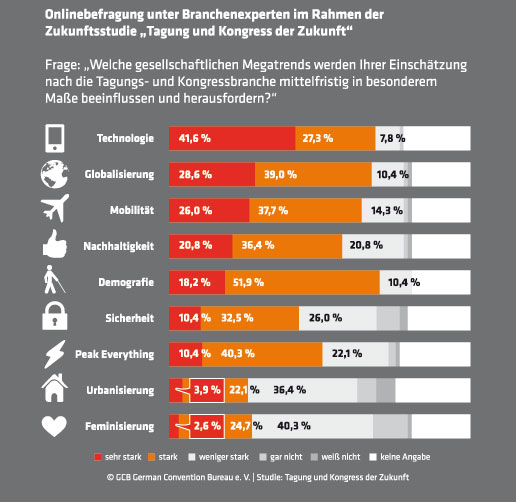
Over 40 percent of those surveyed assume that technologization will have a very strong influence on the meetings and conventions industry.Technization is progressingIn particular, the megatrend of advancing technologization will shape and challenge the event industry in a wide variety of areas up to 2030, including information and data security, new forms of knowledge transfer, virtual conference units and the networking of virtual spaces, increased participant participation and human-machine interfaces that must take human needs into account despite advancing technology.Growing need for networkingIn an increasingly globalized world, the ever-growing need and expense of networking represents a further technical challenge for all organizations involved in the transfer of information and knowledge, while globalization also requires those involved in the conference and congress industry to master several languages and expand their intercultural skills to an ever greater extent.Rising energy demandFuture mobility concepts will play a central role: With multimodal chains, in which the players in the meetings and conventions industry must position themselves as an active part, mobility will offer an answer to challenges such as rising energy requirements with increasing scarcity of resources as well as the desire for flexibility and the special needs of older travelers.

Travelers' needs are growing, which is why new furniture concepts are in demand for congresses and conferences.Sustainability remains relevantDemographic change will not only have an impact on mobility: The architecture of event buildings or services relating to conferences and congresses will also have to adapt to the associated changes in the future.Another result of the future study is that the topic of sustainability remains existentially relevant and that players in the industry should take this into account even more than before, for example when building and converting event venues and when offering multimodal transportation services.Securing Germany's leading position with roadmaps for the future"The German event industry now has a good basis with the study "Meetings and Congresses of the Future", from which the associations can jointly develop a roadmap for the industry," says Petra Hedorfer, Chairwoman of the Board of the German National Tourist Board (GNTB) and Chairwoman of the GCB Board of Directors, who is convinced that the study will provide the framework for this further development at the next "Meeting Experts Conference" (MEXCON) from June 11 to 13, 2014 in Berlin."Deriving individual strategies based on the study"The GCB and its partners are thus continuing the future study initiative that was launched at the first MEXCON in June 2012: The conference focused on the question of how meetings and congresses in the fields of business, science, technology and innovation will develop by 2030 and what conclusions can be drawn from this for the German events industry. "Based on the future study, all players in the industry can derive individual strategies and implement their own concrete measures," emphasizes Matthias Schultze, Managing Director of the GCB.Relevant trends are identified"The industry is made aware of relevant trends at an early stage and can prepare for them now - as a result, this serves to secure and further expand Germany's successful position as a conference and congress location," continued Schultze.Information on the "Conference and Congress of the Future" study and further details can be found on the Internet at www.gcb.de/zukunft.