
Job cuts at SRF take place in all departments
SRF will cut an additional 145 jobs by the end of 2023. It has now been announced that 75 of these cuts will be made across all departments. Three criteria will determine the number of cuts per department: the size of the organization, its structure, and its alignment with the «SRF 2024» strategy.


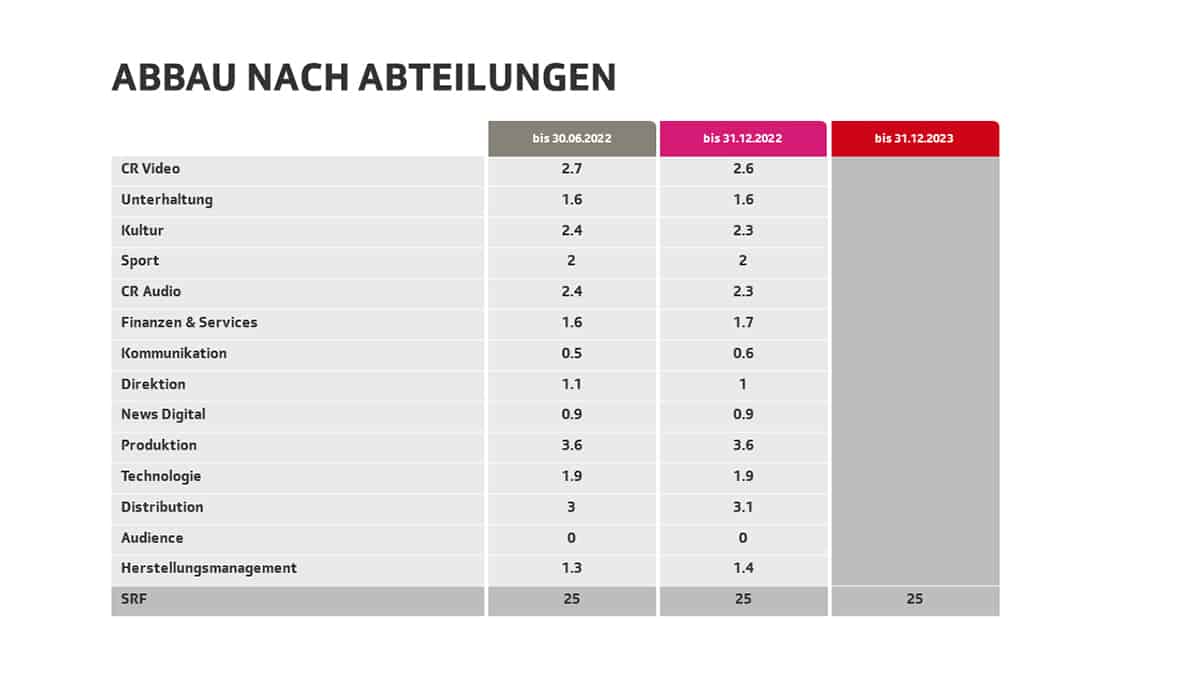
The 75 jobs will be cut in three phases via a so-called performance and program waiver. Layoffs will be made as early as this month, SRF announced Wednesday. There will be no layoffs in December.
The total number of layoffs is still open, as SRF writes in response to an inquiry from the Keystone-SDA news agency. The aim is to implement the job cuts as far as possible through natural fluctuation and early retirements.
Originally, the 145 jobs were to be cut by the end of this year. However, in the summer the management decided to stagger the reduction until the end of 2023. (Werbewoche.ch reported). The number of redundancies could be reduced by staging, SRF announced at the time.
The remaining 70 of the 145 jobs to be cut will be reduced through adjustments to the product range already communicated and by lowering production standards, according to the statement. This reduction will mainly take place in production, but also in other departments. To date, 88 full-time positions have already been cut, with 27 redundancies.
Job cuts noticeable in staff survey
Furthermore, Fehr Advice had conducted a staff survey at SRF in late summer 2021. The topics of the survey were employee identification and satisfaction, protection of personal integrity, and the "SRF 2024" strategy. 39 percent, or 1160 employees, took part in the survey.
According to the survey, the proportion of employees who identify strongly with SRF is high at 83 percent. This is particularly the case among 25-year-old and younger employees. There is clear potential to increase identification among 17 percent of employees.
Communication is criticized
Even though many employees would choose SRF again as an employer, satisfaction is only average: 54 percent of survey participants see SRF as a (very) attractive employer and 55 percent are (very) proud to work for SRF. The cultural diversity, family-friendliness and attractiveness for female employees are particularly appreciated. In addition, employees feel that they are generally fairly compensated and supported, which is also reflected in a good work-life balance.
Negative perceptions include equal treatment in development opportunities and communication of management decisions from executives to employees.
56 percent of employees are satisfied or very satisfied with their work, with independence, purpose and variety being particularly valued. The negative perception is that the work suffers from cost-cutting measures and is associated with a lot of pressure. The assessment of satisfaction with direct superiors varies: 43 percent are satisfied, 26 percent are not. The same applies to development options: 37 percent are dissatisfied, 28 percent satisfied.
Another topic of the survey is dealing with personal integrity, which includes physical and verbal sexual harassment, bullying, discrimination and abuse of power. Here, on the one hand, there is a very high level of willingness and awareness among the people surveyed to adhere to the defined principles of conduct. However, more clarity can be provided as to exactly what behavior is to be included under a principle of conduct.
With regard to achieving the goals of "SRF 2024," the survey results are heterogeneous. A majority believes that the strategy will strengthen the digital offering. There is skepticism about whether younger target groups can be reached better and whether the strategy will lead to flatter decision-making structures. In addition, most respondents feel that they are not sufficiently involved and that the strategy is not sufficiently exemplified in the company.
Measures are elaborated
Based on the survey results, SRF management identified and presented five starting points for measures, according to the statement: Role modeling by management and supervisors, strengthening the sense of community, improving the sharing of information/leadership, staff development and career paths, and developing a feedback culture. The HR & Change department will now develop measures for these topics together with the departments. (SDA/swi)


