How print service providers will survive in the future


PRINTING INDUSTRY The printing industry is going through a period of change: digital media, the internet and changing customer expectations are presenting the industry with major challenges. The "drupa Global Insights" report illustrates the serious changes in the industry, but also shows that most print service providers are not adapting adequately to the rapidly changing global market.

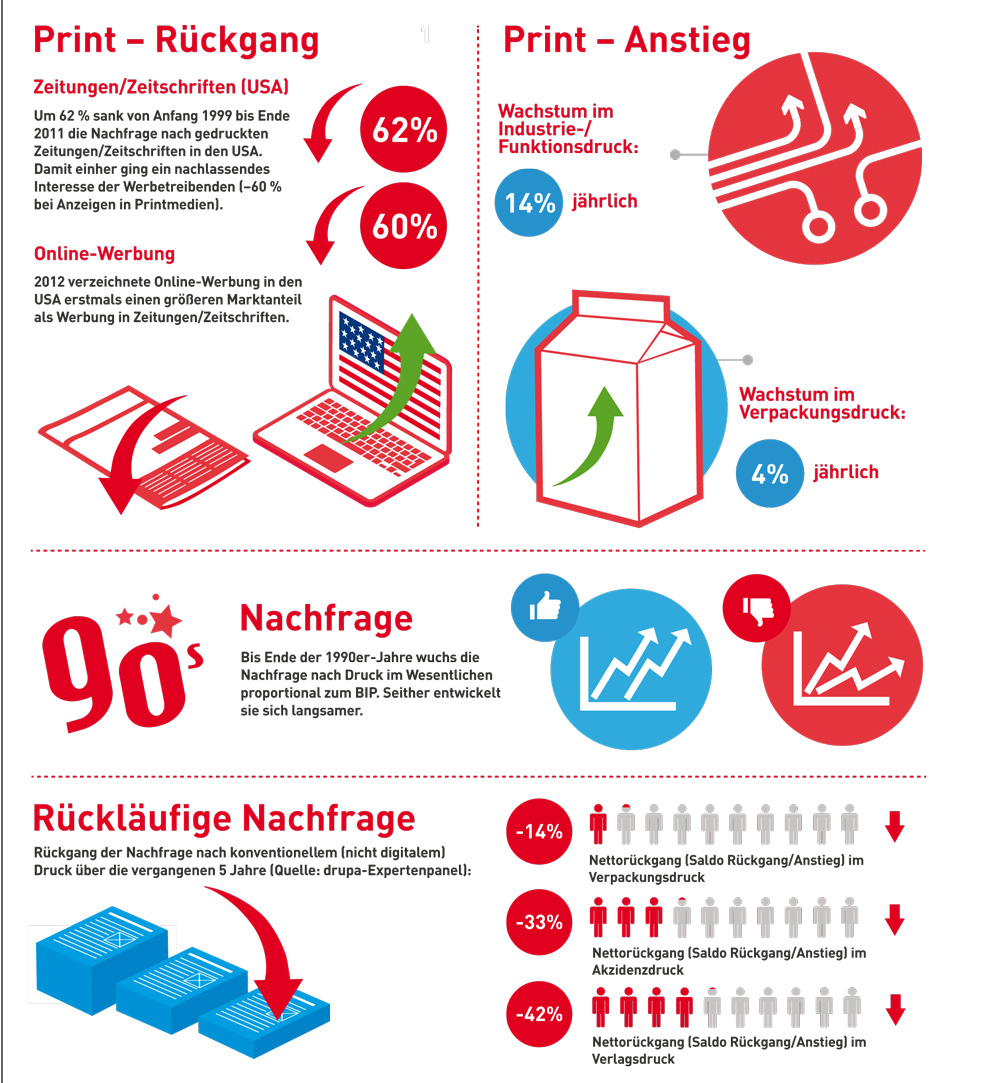
Digitization presents print shops with some major challenges. Until the mid-1990s, all communication took place via analog media such as print, radio and telephone. Print was considered the oldest medium in the world, and paper enjoyed strong and stable demand. In the last 15 years, the share of digital communication has steadily increased with the introduction of digital technology, and analog forms have been marginalized.In this context, it is important to take a closer look at the strategies of print service providers around the world in dealing with these challenges and to document what responses the printing industry has to this fundamental change.Decrease in demandFor example, 46 percent of the international drupa expert panel report a decline in demand for conventional, non-digitally printed products over the last five years. This contrasts with an increase in demand for conventional products at 21 percent. A more detailed analysis of the data by industry sector reveals that the packaging sector is the best performer, with only a significantly smaller proportion experiencing a decline of 14 percent, compared to 33 percent for commercial printers and 42 percent for publishing printers. A total of nine percent recorded a decline in demand for paper. This result contrasts with increases for paperboard, flexible materials, metal, glass and textile materials.Advertising generates the largest share of print spending, so the steady shift from print to digital forms of communication has particularly drastic consequences. The relative decline of print is not affecting all markets equally; some areas are particularly hard hit. Newspapers, for example: They suffered a 62 percent decline in the U.S. between 1999 and 2012. In the same period, demand for printed advertising fell by 60 percent, as the advertising industry increasingly relied on digital communication.By contrast, the packaging industry is predicted to grow by four percent a year until 2018. The reason is obvious: the Internet is not affecting the demand for packaging. Industrial and functional printing applications are also posting annual growth rates of around 13 percent, albeit from a lower level.The digital floodTo understand the dramatic change in communications, it is necessary to take a close look at the development of digital technologies over the past 25 years: Constant cost savings and the increasing performance of computer chips, ever faster networks with stronger bandwidth, and the rapid increase in interconnected users have caused the Internet to grow enormously in a very short time.If you also take mobile communications into account, it quickly becomes clear why digital technologies dominate the market and all other communication channels are in relative decline. In 2012, 35 percent of the world's population was already connected via the Internet. And in 2013, there were already 3.4 billion registered cell phone users worldwide, i.e. slightly less than half of the world's population.All this makes it clear: print is part of a multi-layered communications industry. Consequently, print service providers must increasingly turn to IT-based technologies. But the reality is - still - different: Only 23 percent of the drupa expert panel recorded an increase in their IT spending over the last five years, and virtually all decision-makers surveyed stated a shortage of IT specialists.The shift to digital communicationA number of factors can be used to explain the rapid shift to digital communication over the last 30 years:- Digital communication is fast.- Interactivity has great advantages.- Consumers have become accustomed to being online all the time - and on a wide variety of platforms.
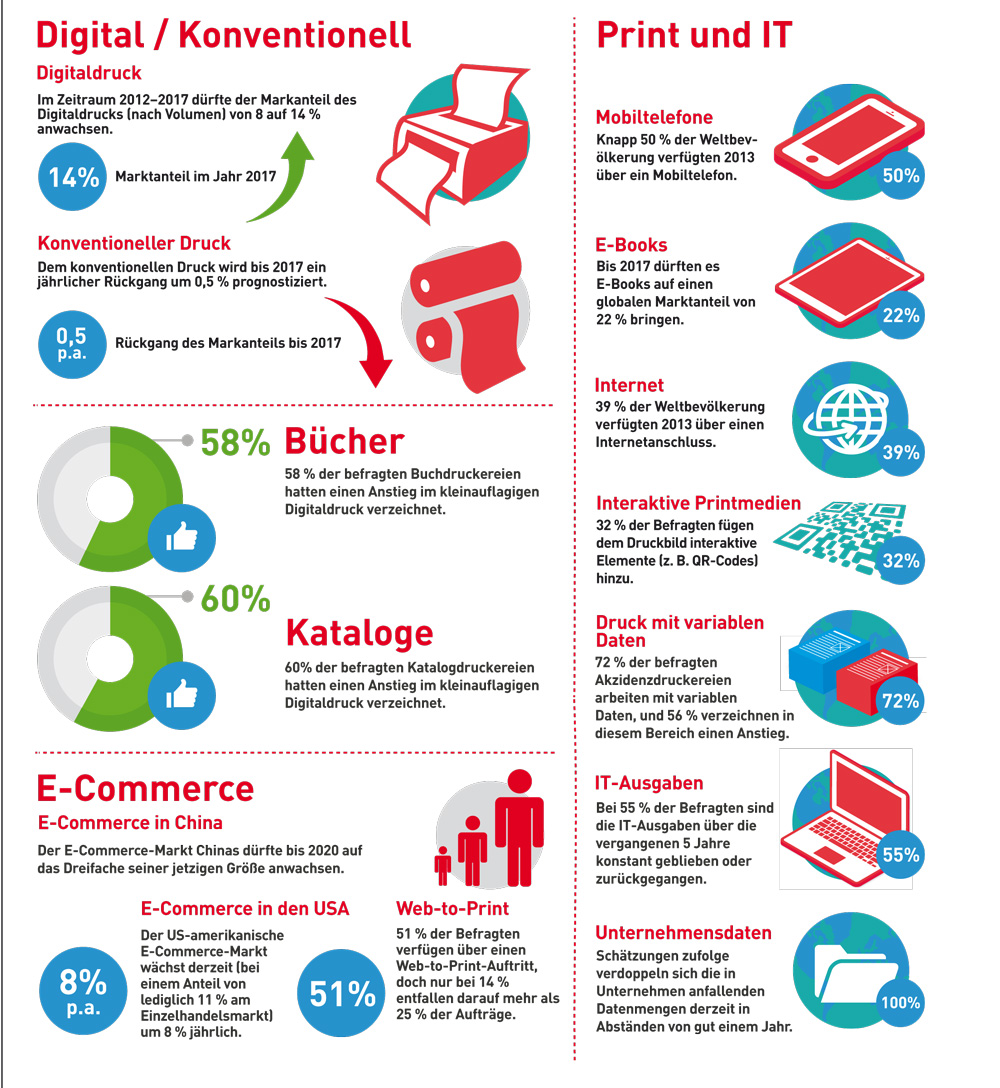
Marketing experts examine all available communication channels and finally decide on the format that best fits the budget and achieves the highest response rate. Print has an immense advantage in multichannel campaigns. The average response rate to postal mailings is reported to be 3.4 percent, whereas the response rate to e-mails is only 0.12 percent. An attractive, promising solution is therefore postal communication that leads consumers to digital channels via interactive elements.Search for additional sources of revenueHow are commercial printers in the drupa panel responding to this challenge?In general, they are looking for additional revenue streams by adding new services such as web-to-print (W2P), customer data management, digital asset management (DAM) and other Internet-based tools to their portfolios.Printers of newspapers, magazines and books are facing similarly dramatic competition from the Internet. In 2012, for example, online advertising sales in the U.S. were higher than total sales of printed advertising in newspapers and magazines combined. In this churn, newspaper publishers are definitely not among the beneficiaries. According to calculations, the profit for publishers from each digital advertisement is USD 1 - in contrast to a minus of USD 25 resulting from the migration of print advertising. But while revenues for magazine publishers are rising rapidly in the digital sector (especially for B2B products), it will be many years before revenues from print advertising and sales, currently still the most important source of income, dry up completely.Print-on-demand and digital printingIt's a similar story with books: Here, too, the printed book will remain the most important source of revenue for print shops for some years to come. But the sales structure for book publishers has been facing drastic changes for some time now, triggered by the current trends of eCommerce and the rapidly growing digital print-on-demand (PoD). Although the distribution of eBooks is increasing, it is more of a supplement to printed books and less of an alternative. Another aspect from the book sector: PoD means that books are no longer permanently out of print, but can be reissued again and again as part of so-called self-publishing models.The members of the drupa expert panel from publishing printing have met these challenges by offering print-on-demand or short-run digital printing, adapting to eCommerce process steps and offering a variety of new services, such as customer data management or adapting files to alternative output devices. While declining or, at best, stagnant sales figures are reported for book manufacturing, short-run digital printing reports a 59 percent growth and digital on-demand a 51 percent increase.Sustainability gains in importanceThe issue of sustainability is of increasing importance to publishers, marketers and consumers. The debate has evolved: Beyond polemical anti-paper slogans, there is increasing recognition of the environmental compatibility and benefits of digital infrastructures, which are now much more effectively adapted to their use, taking into account their sustainability, and linked to the appropriate media channels in each case. Against this backdrop, the expert panel identified a change in customer paper purchasing that is most evident in the increasing demand for products from eco-certified paper suppliers.The unchecked rise of eCommerceOver the past 20 years, eCommerce has evolved in many countries from a niche market to a gigantic business affecting virtually all industries and most consumers. The growth rates are impressive; even the largely saturated market in the USA is recording annual growth of eight percent. China is already setting out on an overtaking maneuver: By 2015, it will have overtaken the U.S. in online commerce, tripling its current volume by 2020. eCommerce offers many advantages that explain this boom. With an increase in Internet users via smartphone (mCommerce), this rapid growth will accelerate even further.The study underscores the already discernible, far-reaching consequences of eCommerce for the music industry, publishers, wholesalers and banks. But the print industry has not yet made sufficient efforts to exploit the great potential of this development for itself. While 51 percent of panel members have Web-to-print, only 14 percent say they use this service for more than 25 percent of their jobs. Commercial printers on the drupa panel offer a wide range of products for sale on the Internet, but apart from a few success stories, a recent study from the U.S. showed that only one in four W2P facilities in printing companies were rated as successful.In the area of catalog printing, 47 percent of the panel reported falling sales for conventional print products, while 15 percent recorded an increase - leaving an overall decline of 31 percent. There is good news for versioned catalogs: Here, 47 percent reported an increase, and 60 percent recorded an increase for very short runs. The reason is clear: advertising has recognized that printed catalogs boost online sales, so print is a valuable ally in eCommerce business when it is part of an integrated multichannel campaign.Customized mass production on the riseThe industry is experiencing a massive change: The trend is moving away from mass production of static print products to an ever-increasing proportion of smaller digital print jobs, right down to individual customer-specific copies. This development has been triggered by the spread of digital communication channels and highly complex data management and workflow processes.Variable data printing (VDP) is the most important prerequisite for being able to optimally meet the changing customer requirements. While static print products are forecast to decline slightly (by 2017: 0.5 percent per year), digital printing is expected to double its existing digital print volume to a total volume of 14 percent by 2017.72 percent of the commercial printers in the drupa panel offer VDP, of which 56 percent report slight to major growth, albeit with a small initial volume. For commercial printers, for example, the purchase of a digital electrographic cut-sheet printer in the fall of 2013 was their most significant investment. Another notable development is the rapidly growing market for interactive printing (QR codes, augmented reality). It opens up an important role for print in online commerce. It is therefore not surprising that 32 percent of the panel members offer at least one such service.Big data as a challengeThe most important driver of customized mass production is the constantly increasing volume of stored digital data - keyword Big Data. The volumes of data are so large that conventional analyses are reaching their limits. For online business data, for example, an annual increase of 40 percent is forecast. But only suitable software and the expertise needed to use it can enable highly targeted marketing, right down to the completely personalized - whether digital or print. Here lies a major opportunity for the print industry: managing and analyzing personal data for its customers.Along the packaging value chain, people have already responded with just-in-time and on-demand business models to reduce project times, cut costs and avoid waste. Technical problems such as precise color management have already been solved, and thanks to the increasing flexibility of production processes, the new market potential can be optimally exploited. It is therefore not surprising that 50 percent of experts from the packaging industry have at least one form of interactive printing in their portfolio: 43 percent implement variable data printing and 41 percent offer customized printing services - albeit with a currently still low proportion of SKUs (stock keeping units).Internet as a curse and a blessingThe Internet offers opportunities to go it alone, but it has also intensified competition for individual orders because customers no longer have to visit their print shop in person, and many more print companies are competing with each other on a global scale. In the wake of customized mass production, new products have been added to the standard range of business cards, stationery: Commercial printers now supply photo books and calendars, and industrial printers produce decorative items. More than 50 percent of the commercial printers in the drupa panel print customized products, even if this requires higher investments in special technologies and advertising measures, as is the case with photo books, for example. More than half of the commercial printers (51 percent) offer direct mail, and although the figures indicate a sharp decline in overall volume, there has been growth in targeted direct mail.In summary, the first step is for the printing industry to make greater efforts to get closer to the client and its customers. Only then can the potential of personalization or versioning of print products be tapped.Work with the InternetOne thing is certain: the Internet is an opportunity for print service providers and helps them to stay ahead of the competition. In the process, it has fundamentally changed sales and marketing structures. The drupa expert panel admitted that they have only insufficiently dealt with innovations such as customer data management (only 34 percent use this technology), website analysis (23 percent) and social media (25 percent), and only 17 percent use these options in integrated campaigns, which have been proven to be the best way to use these channels.Keyword "customer journey" across multiple channels and its effectiveness: How many print service providers have subjected the "customer journey" at their own company to an objective analysis? A large proportion of drupa panel members (84 percent) said they use FTP/ upload portals, but only 55 percent use automated preflight checking, 44 percent DAM. Surprisingly, only 47 percent use integrated estimating, job management and job tickets. Twenty-one percent use an automated system for order processing from inquiry to invoicing.Sixty-eight percent of the panel makes their purchases online, and 54 percent of companies that use MIS also use it with remote access. So far, so good - but less than half of the respondents use the Internet for training purposes, recruiting, improving business intelligence or for credit checks. The result is astonishing: only a small number of companies use the potential of these online services to increase their competitiveness and profitability.
The complete version of the study (in English) is available now at a price of 249.00 euros from Messe Düsseldorf (www.drupa.de/1131) available as PDF.