
Advertising impact of native ads: Attracting customers at the time of the purchase decision
In March 2017, the shopping list app «Bring!» ran a native advertising campaign with food manufacturer Kühne. This case study shows how the campaign performed and what advertisers need to keep in mind.


When the customer reaches out toward the product selection in the supermarket, the effectiveness of an advertising campaign is probably most evident. Of course, posters, radio spots and banner ads influence the perception of a brand, but at the moment of the purchase decision, the consumer is usually alone in front of the shelf. It's even better if the influenced decision already takes place during purchase planning - finds "Bring!", the app for purchase planning in its message. The aim is to make a conscious switch from impulse to rational buying.
Native advertising as a mobile format is the current choice for many advertisers. Whether in apps or browser banners, however, there is the crucial question of intrusiveness from the user's point of view. The traditional brand Kuehne has taken a new approach to the marketing of its Enjoy vegetable chips took a new approach to native advertising. Following the recommendation of its media agency Pilot, the Hamburg-based food manufacturer relied on sponsored products in the smart shopping list "Bring! The following case study shows how the campaign went and what advertising impact it was able to achieve with this specific type of native advertising.
Objective: Maximum conversion with minimum bounce rate
To increase the number of first-time purchases and awareness, Kühne decided to use the advertising opportunities offered by Germany's most successful shopping list app for its snack range, Enjoy vegetable chips. The decisive factor in choosing the "Bring!" app was the number of its monthly active users, which in Germany stands at 500,000 users on iOS and Android devices, smartphones, tablets and smartwatches.
Oliver Dambock, Manager Digital at Kühne: "For us, it is important to communicate appropriately with consumers on all relevant channels." Many consumers find striking advertising, for example intrusive interstitials even on their mobile devices, rather annoying. "Sponsored Products in the "Bring!" shopping list offer the opportunity to present products to customers directly in the purchase decision process. Maximum proximity to the point of interest has always been an important aspect for Kühne in campaign planning and implementation. Shopping apps are highly relevant for FMCG products," says Lefke Komar, Head of Media Consulting at the Pilot media agency.
Dominic Mehr, CCO of the Swiss app, knows from experience with other brand campaigns that "once vegetable chips are on the list, it's not far to the shopping cart."
Implementation: User journey from discovery to purchase decision
As an important sparring partner, Pilot Kühne provided the initial impetus for the native implementation within the "Bring!" app; conceptualization and implementation were then carried out together with the Zurich colleagues. Over a period of four weeks, Kühne's Enjoy vegetable chips were integrated into the nationwide shopping list catalog.
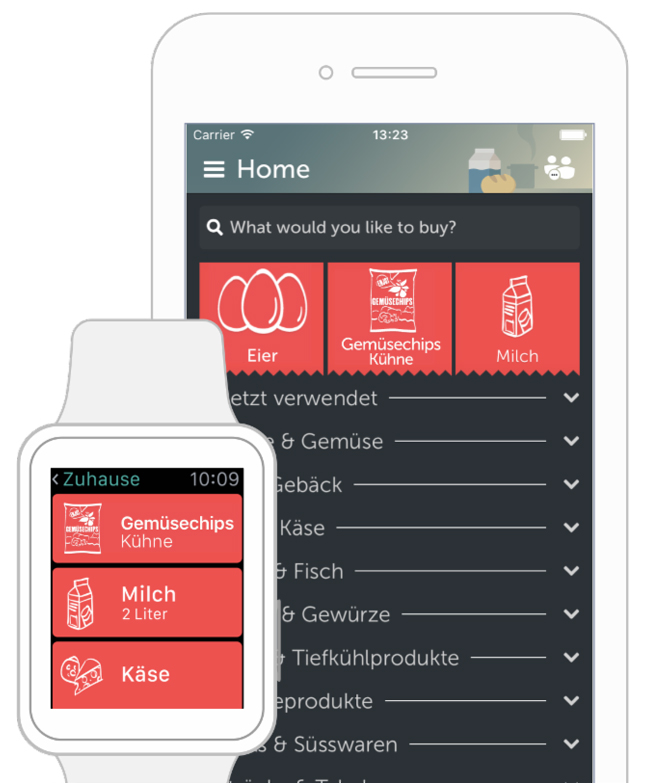
The Zurich-based app makers offer an unobtrusive type of ads for brands: In the same look that "Bring!" users already know from their lists, certain branded items, so-called sponsored products, appear as search results, for example. "We wanted to target users who were specifically looking for chips, but also direct those users to Kühnes Enjoy Vegetable Chips who were thinking of other snacks in the first step, for example. To do this, we worked with related keywords such as salt sticks, vegetables, snacks, cola or sweets," says Dominic Mehr.
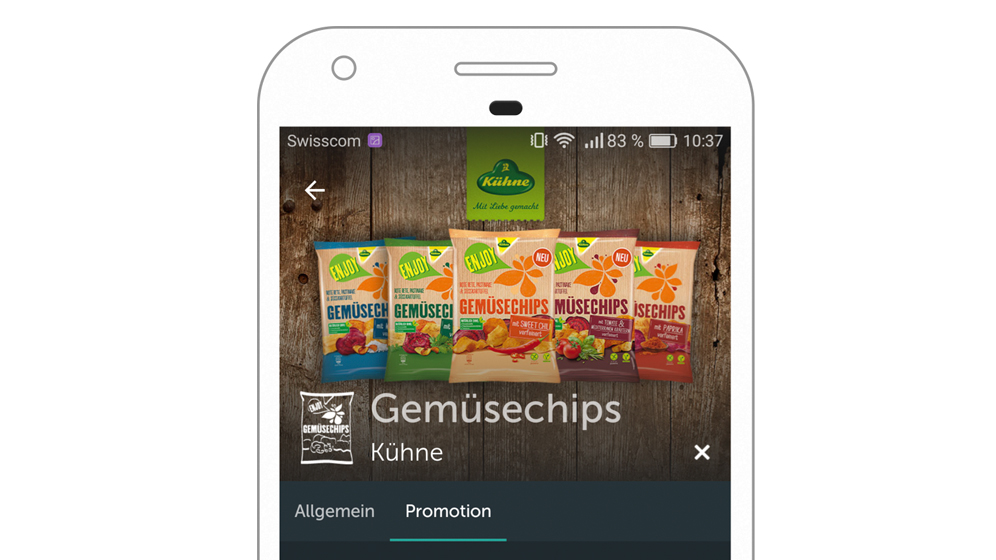
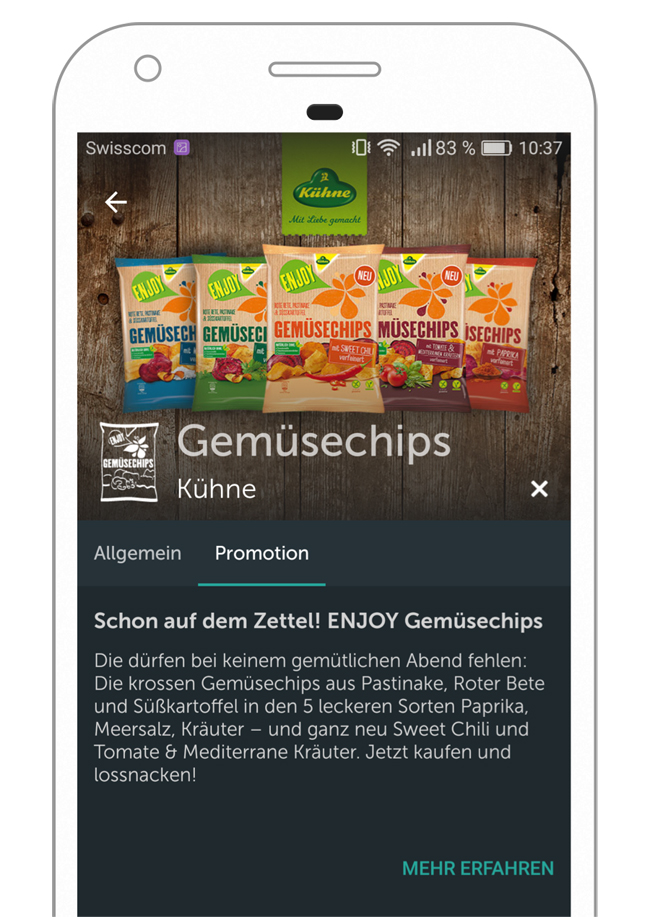
The result looked like this in the app: the Enjoy vegetable chips appeared next to other non-branded items in the snack category. Because the user's attention was drawn to the Kühne product at just the right moment, they were able to consciously choose the Enjoy vegetable chips decide and put them on his shopping list. The app's brand strategist: "A longer click on the brand icon took the user to further information including a product image and a link to the corresponding Enjoy Chips landing page - another step in the user journey. In front of the supermarket shelf, the digital discovery from the app and the recognition at the point of sale then converge and motivate the consumer to make a purchase decision."
Measurability: Quality vs. Quantity
Unlike a classic display campaign, the success of Sponsored Products cannot be read off from a click-through rate alone. In this respect, the "Bring!" marketers as providers of advertising space sometimes still have to do some convincing: "The number of page impressions, but also the actual reach, are of course of great importance to many of our customers. However, our engagement rates are much more meaningful as performance indicators. Since our sponsored products work differently than classic native ads, we often still have to sensitize advertisers to this."
A valuable statement for consumer goods brands is the proportion of branded items in a specific product category from the "Bring!" catalog. "The engagement rate provided an important KPI to assess the response of "Bring!" users to the advertising medium. The comparison with industry benchmarks, i.e. the entire "Bring!" chips segment, was important here," says Lefke Komar from the Pilot media agency.
Result/Tips: Openness to new channels in the marketing mix
The ad campaign successfully targeted snack-savvy "Bring!" users. In terms of advertising impact, the combination of mobile native ads at the moment of the purchase decision proved successful in the Kühne case: "The engagement rate of 0.6 to one percent is a complete success for us. The engagement even exceeded the benchmarks for the snacks sector," Dominic Mehr sums up and Lefke Komar adds: "Our goals were more than achieved with regard to the previously defined KPIs. With this implementation for Kühne, we were able to successfully execute an exciting first-mover placement."
Native advertising, such as in the form of sponsored products at "Bring!", is therefore part of a successful marketing mix. Oliver Dambock advises other brands to experiment: "It's important to try out new digital channels to find out which ones work for your brand. That's why we recommend trying out new things with a test budget and clearly defined KPIs. In online marketing, initial tests are often possible even with a smaller budget." (pd/hae)


