«From 32 to 57 percent»: What the new MACH study reveals about AI usage in Switzerland
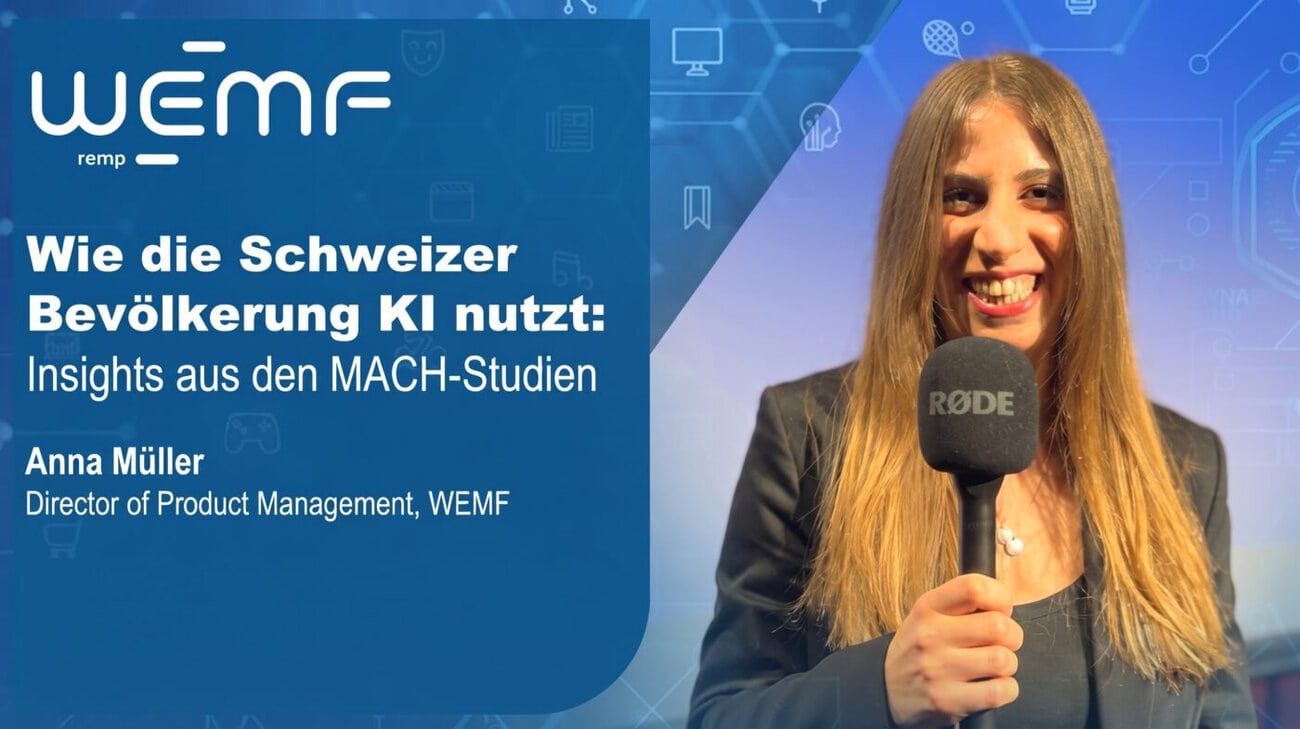
The Swiss resident population is adopting artificial intelligence at a record pace—with growth of nearly 80 percent in a single year, as documented in the latest MACH study. In the study, Anna Müller, Director of Product Management at WEMF, highlights how rapidly the technology is becoming established in everyday life and why this is opening up fundamental opportunities for the advertising and media industries.


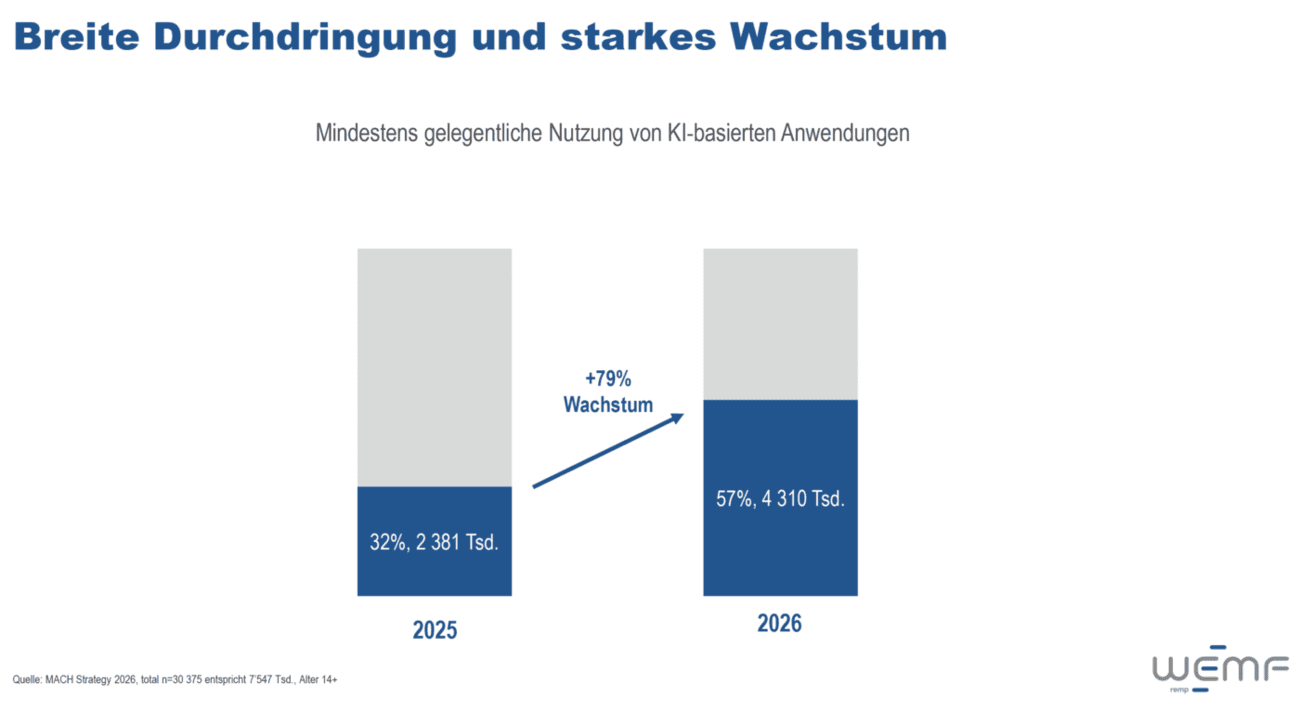
The figures from the latest MACH Strategy survey speak for themselves and mark a historic turning point for media consumption in Switzerland. While last year (2025) about 32 percent of the resident population aged 14 and older reported occasionally using AI-based applications, this figure soared to an impressive 57 percent in 2026. This corresponds to approximately 4.3 million people in absolute terms and a growth of nearly 80 percent in just twelve months. Anna Müller, Director of Product Management at WEMF, describes this finding as follows:
«The data shows a rapid adoption rate: from 32 percent last year to 57 percent today—artificial intelligence is firmly established in the daily lives of the Swiss population.»
A Jungle of Platforms and Clear Market Leaders
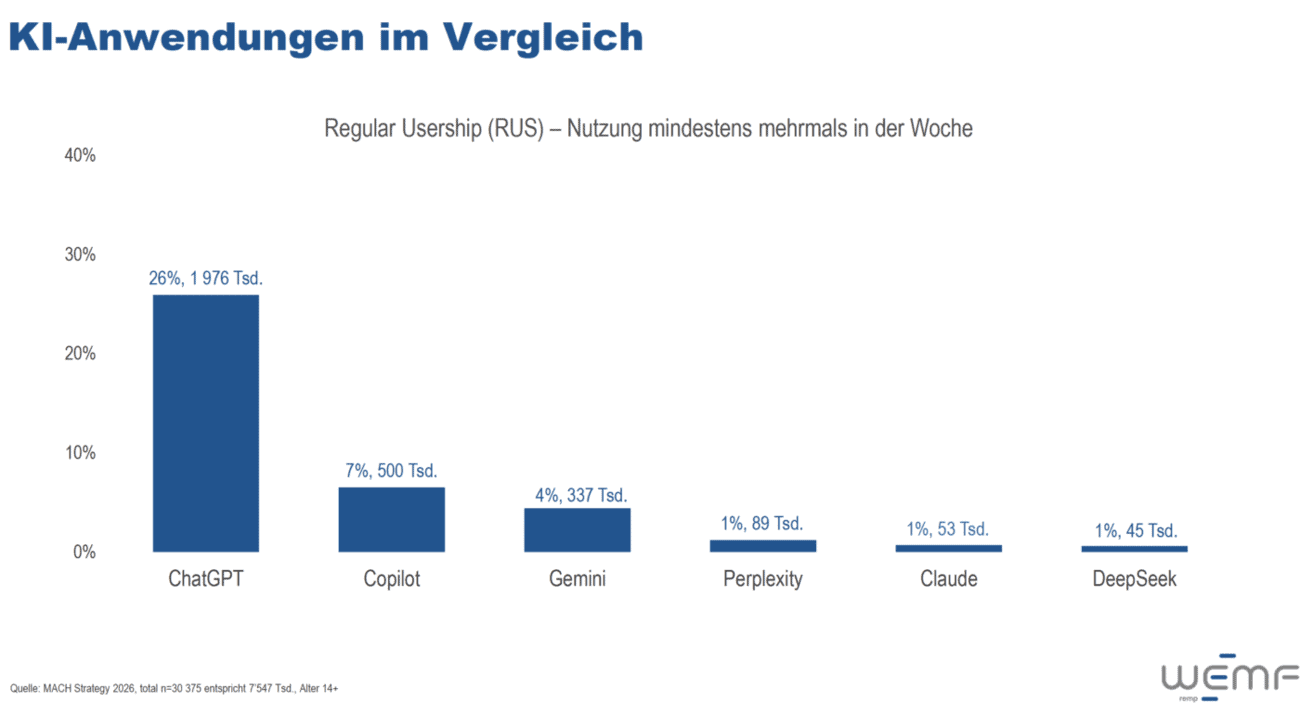
When examining the varied use of individual applications in the context of regular usage, one dominant frontrunner emerges. ChatGPT is the undisputed leader in the Swiss market, with a weekly regular user base of 26 percent, which corresponds to just under two million people. Trailing far behind are Microsoft Copilot, with 7 percent—or about half a million—regular users, and Google Gemini, with 4 percent. Other specialized applications, such as Perplexity, Claude, and DeepSeek, account for a single-digit percentage of the market and serve specific niches. A closer look reveals that the majority of ChatGPT users rely on the free version, while the paid versions are primarily used by heavy power users and professionals.
Demographic Contrasts and Sociocultural Patterns
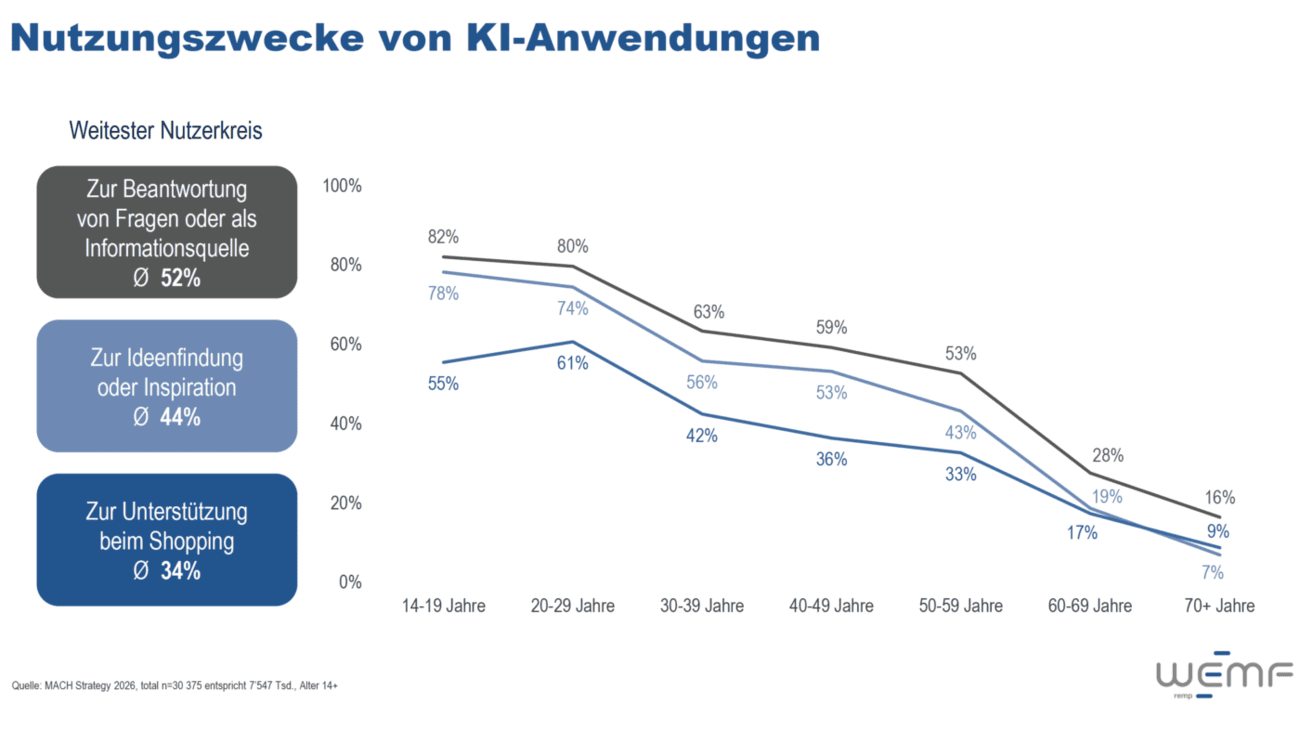
Upon closer examination, the nuanced picture painted by sociodemographic data reveals fascinating contrasts and clear usage patterns. Although AI permeates all age groups and segments of the population, the extent of its impact varies greatly. Younger age groups, between 14 and 19 years old, use smart assistants most frequently—at over 80 percent—while the usage curve naturally flattens out among older age groups, though it still shows strong growth across all segments. There are also subtle differences based on gender: Men use ChatGPT noticeably more often—about 26 percent—than women, who use it about 17 percent of the time. Nevertheless, it can be said that technology is no longer exclusively a phenomenon of men or young people, but has achieved broad social relevance across the general population.
From an Information Channel to the New Reality of the Advertising Arena
The shift in usage occasions is particularly significant for strategic media planning. The MACH data underscores that AI applications are primarily used to answer questions and as a source of information, with a 52 percent approval rating. Close behind are brainstorming and inspiration at 44 percent, as well as practical assistance with shopping at 34 percent. Topics such as consumer electronics, travel, and continuing education are taking on a completely new form of organic search thanks to AI.
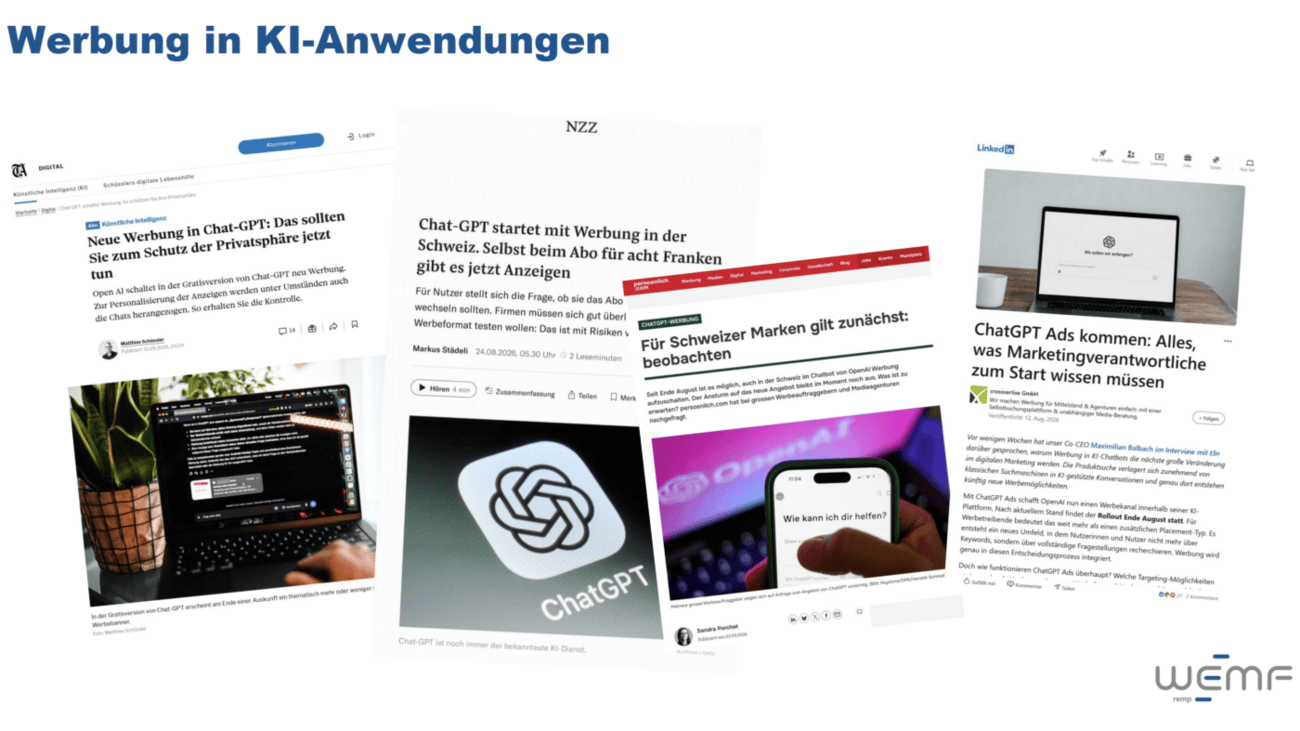
As OpenAI and other providers increasingly display and contextually integrate ads in their free versions, AI is evolving from a mere software application into a full-fledged advertising channel. Anna Müller highlights this paradigm shift:
«Artificial intelligence is no longer a niche topic; rather, it is rapidly evolving into a standalone advertising channel among many others.»
For marketing professionals, this means that future campaigns will no longer be driven solely by traditional keywords, but must be integrated into dialogue-based decision-making processes. This year's MACH Strategy Study thus provides the Swiss communications industry with the essential foundation for guiding this transformation in a data-driven manner and optimizing the media mix.
m&k Data Service: An Overview of the Key MACH Strategy Metrics
-
Total penetration: In 2026, 57 percent of the Swiss resident population aged 14 and older (about 4.3 million people) will use AI applications at least occasionally, representing a massive 79 percent increase compared to the previous year (32 percent / 2.38 million).
-
Platform Ranking (Regular Users): ChatGPT dominates the Swiss market with 26 percent (1.97 million users), followed by Microsoft Copilot with 7 percent (500,000 users) and Google Gemini with 4 percent (337,000 users). Perplexity, Claude, and DeepSeek each account for about 1 percent..
-
Age gap: The highest level of usage is seen among 14- to 19-year-olds, with a penetration rate of over 80 percent. Although older age groups have lower initial adoption rates, they are experiencing strong, steady growth across all age groups..
-
Gender-Specific Use: ChatGPT reveals significant differences between the sexes; about 26 percent of men use it regularly, compared with about 17 percent of women.
-
Paid vs. Free Version: About 16 percent of ChatGPT users in Switzerland use only the paid version, while 83 percent use the free version (which will include ads in the future).
-
Occasions for use: The use of AI focuses primarily on answering questions and gathering information (52 percent), followed by generating ideas and finding inspiration (44 percent) and providing practical assistance with online shopping (34 percent).