
Behavioral research and social science for content marketing


CONTENT MARKETING Martina Garcia* on the "Elaboration Likelihood Model" impact approach and its significance for content marketing.

The Elaboration Likelihood Model is an exciting approach in which involvement plays a crucial role.Before a company jumps into content marketing work, it should give some fundamental thought to how humans process information in the first place. Any content is of no use if it does not reach the brain in the right way. It is already known that information behavior has changed due to digitalization. Products and companies are rated, the ratings are read, consumers want more sophisticated and intelligent content, as well as flexibility in terms of personal media consumption.Why don't we take a step back into brain and advertising research and think fundamentally about how information is actually processed by humans and the related change in attitude? Joe Pulizzi sums up the answer appropriately: "Content marketing must work to enhance or change a behavior. If it doesn't, it's just content." There are advertising effectiveness approaches that focus primarily on the attention and interest phase, e.g., the AIDA model (Attention, Interest, Desire, Action). Involvement plays a decisive role in the processing of information, however.In order to get a well-founded picture of the probability of information processing, the Elaboration Likelihood Model (ELM) by Petty & Cacioppo an. It is considered a basic model for understanding the process of information processing and subsequent attitude change. Why do I consider this so important to write about? Well, are you generating the leads you want with your blog articles? Are enough and, more importantly, the right users getting to your website? Are you generating interactions with your target audience? If yes, then you have consciously or unconsciously chosen the right words in the content you publish to influence and cause an attitude. If no, then the Elaboration Likelihood Model serves as a basis for understanding in what form the content should be prepared appropriately for content marketing to influence with content.
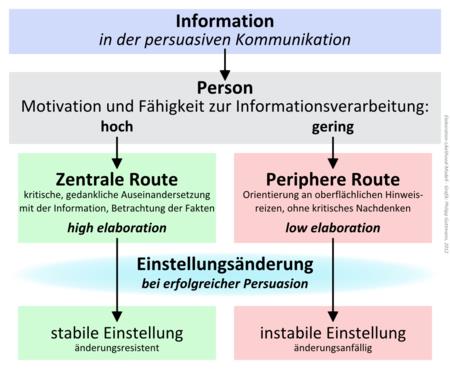
The Elaboration Likelihood Model (ELM)The ELM explains the two influence routes to attitude change: the central and peripheral routes. The latter assumes a low level of involvement. This means that information is perceived rather randomly and superficially and the person is not able to process a message adequately. The attitude towards the subject of opinion is determined by the attractiveness of the source and the design of the message. Here, therefore, secondary issues are the focus of interest and not the central message.If, on the other hand, the reader is motivated and capable of carefully and intensively processing and qualitatively evaluating the arguments offered, then the central route has been chosen. This results in a stable attitude toward the subject matter of the opinion.Interesting insights are provided by a Study of the CEB's Marketing Leadership Council which states that customers in the B2B sector do not contact providers until 57% of the purchasing process has already been completed. This means that interested parties first obtain most of their information themselves on the Internet, process information carefully, form an opinion, and contact the selected supplier company of their choice with a sound prior knowledge. The responsibility therefore lies with marketing to strategically influence this 57% of the buying process with content.Two factors that influence motivation are personal relevance and the need to mentally engage with information. And two factors that influence the ability to engage with information are distraction and pre-existing knowledge, which is important for acquiring new knowledge. Information is also better anchored if there are already links to existing knowledge in the brain.The ELM is well suited to capture the cognitive aspects of information processing to a large extent. However, the emotional stimuli are considered more casually, which could be of central importance for consumers. This interaction has not yet been explained in detail in the literature. An example of this would be when we carefully consider arguments from a reputable health insurance company, and we notice gaps that argue against switching. Then we have chosen the central path of processing and have critically dealt with relevant information. However, if we are distracted by reading a magazine and notice the logo of the health insurance company, we could be blinded by the positive image of the company. In the literature, the ELM is also linked to the effect of Internet communication, and this shows that less involved users tend to browse, while more involved users tend to search. Here it would also be conceivable that less involved users would ideally switch to searching via browsing and that involvement would suddenly become deeper.What does this mean for content marketing?The task now is to process the content accordingly. In central content processing, flawless, well-founded, understandable and convincing arguments play an important role in achieving a positive stable attitude. Weak arguments can generate counter-arguments, a so-called boomerang effect. The processing of the information takes place however evenly also besides, thus peripherally. In all respects, attention must be paid to an attractive design, the positive image of the company and the number of arguments.A number of social techniques have been researched or developed, which are recommended for the preparation of informative communication. In practice, consumer behavior is often influenced by gut feeling. Of course, content can be created from gut feeling with good knowledge and conscience. However, a little more knowledge never hurts anyone. Social engineering knowledge goes a long way toward building bridges between people and content. Persuasion researchers have found that source credibility is the most important ingredient for attitude change. Another characteristic to promote this is the expertise of the communicating company.Source credibility can be explained in terms of ELM, in which the message conveyed is readily accepted even if the peripheral route has been taken (cf. the health insurance example above).The approach of two-sided messages, which include supporting as well as refuting arguments, is relevant because it can increase the credibility and effectiveness of marketing communications. In the end, a certain opinion of the authors of the texts is clearly represented, which should convince the readers. The attitude change generated by this social technique is more stable and resistant to subsequent attempts to influence it in the opposite direction.Images are shots to the brain. Images are processed automatically and without mental effort. They allow for quick absorption and can trigger emotions. This is what behavioral researchers Kroeber-Riel and Esch say. This explains why content can also be easily perceived in images or in a combination of content and images, and why they are suitable as an influencing technique.Especially in Internet communication, climatic stimuli are used, i.e. an appealing and credible design, to generate acceptance for the offer.However, without determining the involvement of consumers, it is almost impossible to predict the effect of the techniques.Creating content from the gut with a portion of intuition may often be a good way, but in order to minimize risks and failures, it is worth taking this step back, asking yourself basic questions and taking the researched techniques that the literature offers us as an aid to hand.



