
Swiss cities on social media


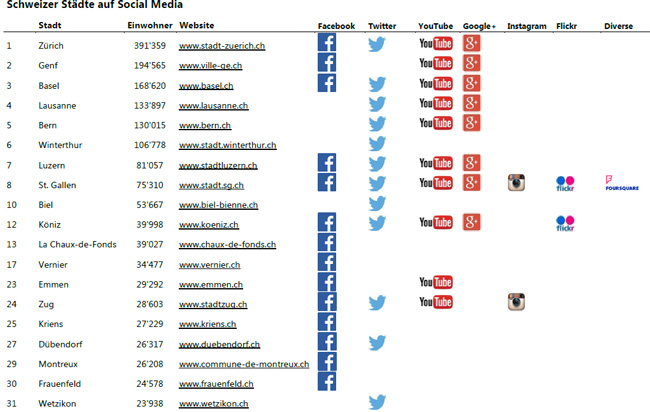
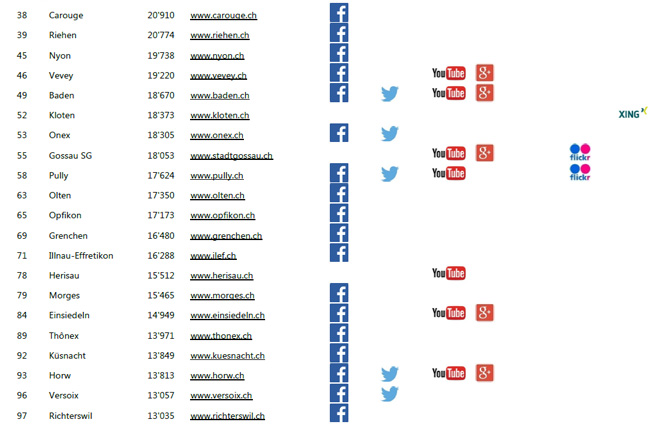
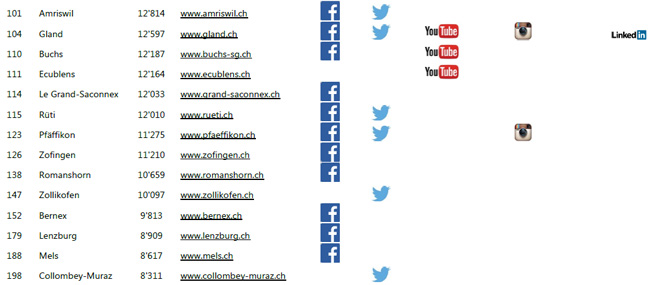
SOCIAL MEDIA Of the 100 largest cities in Switzerland, 40 are now officially active on social media, and the trend is rising. A survey of public administrations reveals the reasons why many do not have a Facebook page or a Twitter account.Municipal administrations that are currently holding back from social media most frequently cite a lack of personnel resources as the reason. That's the sound of it from Aarau, Adliswil, Bülach, Lyss, Muttenz, Reinach, Schaffhausen, Schlieren, Solothurn, Steffisburg, Uster and Worb, with the benefits also being questioned in isolated cases. Hansjörg Boll, town clerk from Solothurn, says that so far no one has been able to convince him of the advantages of a social media presence. In many places, there is also the opinion that important and substantial information from the city can be found on the website and that there is therefore no need for additional communication channels. In addition, there are various municipalities that are closely observing the development of social media and are planning a presence in the near future.municipalities that are present on social media generally express a positive opinion. For example, Godi Huber, head of communications for the municipality of Köniz, says that Facebook is a good and important addition to the other communication channels. "The number of users is increasing and the impact of the posts can be classified as good. What is also important is that people enjoy it. It creates a positive connection with the municipality of Köniz and we can communicate in a low-threshold way." Nikola Janevski, communications officer for Emmen, also explains that he receives a lot of very positive feedback about the municipality's Facebook presence. "Many people appreciate that they can access specific information quickly and easily. That way, they're always in the picture about what's important in Emmen right now." Andreas Anderegg, head of the Frauenfeld communications department, is also basically positive about the experience with Facebook, even though the Facebook profile was hacked for the first time these days.The effort required to manage social media seems feasible. Köniz (represented on Facebook, Twitter, Google+, YouTube and Flickr) estimates the effort at around 10 full-time equivalents, Emmen (on Facebook and YouTube) and Riehen (on Facebook) at around 5 full-time equivalents. The effort can be kept low if existing content is shared. If new content has to be created specifically for social media, the effort increases.Facebook most popularFacebook is by far the most popular social network. 32 cities (previous year: 27) inform their citizens via Facebook, with the authorities of La Chaux-de-Fonds, Kriens, Olten, Opfikon and Versoix now also doing so. On Twitter, 17 authorities of the 100 most populous cities in Switzerland are now active (previous year 2015). A further 17 city councils show videos on YouTube, Lausanne surprises there with a live stream from the Place de la Palud. Sometimes the municipalities also manage the networks Google+, Instagram, Flickr, Foursquare, Xing or LinkedIn. It is worth mentioning that quite a few cities with isolated services and departments are active mainly on Facebook. The Instagram presence of Zurich city police officer Patrick Jean is also noteworthy. He provides (mostly smiling) insights into his everyday work.CommentMany communities put their priority on maintaining the website. This is undoubtedly important. The Energy City label is prominently displayed on what feels like 90 percent of municipal websites, and the links to Facebook and Twitter are usually not visible at first glance, if at all. Communication behavior has changed rapidly in recent years. Many users spend time on Facebook, Twitter, Instagram or YouTube every day. Why shouldn't they also be informed about the activities of the municipalities there and not be able to enter into a dialog with the administration? Or why should citizens regularly visit the website of their municipality? Social media should be mandatory for larger municipalities. By disseminating information or conducting surveys on social networks, many citizens can be reached. The messages can be made visible, even to users who do not read the local paper. With transparent communication, sympathies can be won, it is a matter of image cultivation, of closeness to the citizens. The same advantages also apply to smaller municipalities; Pully or Horw set a good example. The effort required for professional management must be realistically estimated. A social media strategy and guidelines should be drawn up in advance. Quality before quantity is basically the motto, both in terms of the social media channels and the content. However, it is advisable not only to distribute media releases on the social networks. It should also be attempted to bring the diverse tasks and services of the municipality closer to the citizen as well as to express the messages visually.Experience shows that the creation of content for social media is the largest time-consuming item. Cities that are active in social networks report positive experiences, even if sometimes there is no measurable "return of investment". The fears that citizen inquiries could not be handled or that a shitstorm would result have not materialized. Looking ahead, social media will become more and more commonplace in a city's communications work. The number of city and municipal governments on Facebook, Twitter, YouTube and Instagram has increased in recent years and will continue to rise.
OVERVIEW
Author: Jürg Kobel, www.sozialemedien.ch





