Is Ringier really about saving money?
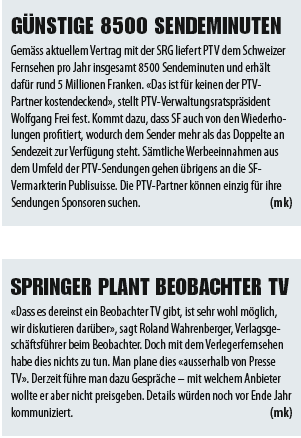
To cut costs, Ringier is pulling out of Presse TV as of the end of 2012. Doubts are already being raised: Perhaps the company is simply distancing itself from the SRG. Either way, other publishers are already considering filling the gap left by Ringier in the publisher-owned television sector.


This article comes from the current print edition the advertising week.
There's no question that Ringier had to contend with economic difficulties - in Germany, especially in the printing sector, and abroad, the euro crisis had a negative impact. In this light, it is not surprising that the media group announced last week that it intends to withdraw from the publisher's television station Presse TV at the end of the year - after 17 years of leading involvement. This withdrawal was made because the programs produced for PTV, "cash TV," "Gesundheit Sprechstunde," "Motor Show" and "SonntagsBlick Standpunkte," had been "loss-making for some time" and therefore had to be cross-subsidized, according to the press release. The future is open for 35 employees. And wherever inquiries were made, people in the industry were convinced that Ringier is in a bad way and that the PTV exit is being made to save money. But what is astonishing is that Ringier itself terminated the cooperation with PTV's partners at very short notice and is apparently in a hurry with the exit: Although the contract between PTV and SRG expires at the end of 2013, Ringier is making off a year before the official end.
Ringier terminates contracts with SRG
This is fueling speculation. Last Sunday, the newspaper Sonntag reported that Ringier's Schweizer Illustrierte had also terminated its media partnership with the SF program "Glanz und Gloria. Ringier spokesman Edi Estermann corrected this to Werbewoche: The contract was not terminated, but expired at the end of April - the cooperation had brought both sides less than hoped. Regardless, Sonntag interpreted the departure from PTV and the end of the partnership between SI and "g & g" as an indication that Ringier was cutting all contracts with SRF in order to be able to set up a TV station competing with SRF on a regional-language basis in the future with complete legal freedom. Accordingly, Ringier's motive would not be to save money, but to emancipate itself from SRG. All the more so since Ringier has been cooperating with SRF competitors for a long time: The Group has a stake in the advertising window of Sat.1 Switzerland, and last year it took over the marketing of TF1.
But Sonntag's speculations went even further: Ringier could be involved in the second channel 4plus planned by 3+ founder Dominik Kaiser. Kaiser, however, wants nothing to do with that. To Werbewoche, he updated a statement he has repeated mantra-like before: "We have never negotiated with Ringier and are not doing so at the moment." However, he confirmed his interest in a second channel. "That's why we had made an offer for TeleZüri last summer." In vain, admittedly; the contract was awarded to AZ Medien. There is therefore nothing new on this topic, Kaiser continued. As for 4plus.tv, he said only this much: he had already registered this name six years ago - even before the launch of 3+.
More television means more money
Back to Ringier: The exit from the regional language PTV is somewhat at odds with Ringier's repeatedly expressed intention to expand its German-speaking Swiss TV activities and even to be interested in a (regional language) TV channel. But Estermann counters that "the interest in a TV channel of our own and the production of formats for a window on SF's channels are not directly related." In any case, the closure of the formats produced for PTV is - as reported - due to business considerations. Nevertheless, he clarifies: "Television remains a topic of strategic importance for Ringier. "
The only question is how. Because it would require more investment and would result in larger deficits than at PTV, at least at the beginning. This is also known internally at Ringier. "I still believe that in Switzerland, a full regional language program in competition with SRG cannot be financed by advertising alone; it also needs niches and cooperations," says Hans Jürg Deutsch, Managing Director of PTV. In addition, the old TV hand also points to the rule of thumb according to which a station must achieve at least a 5 percent market share in order to break even. "But each percentage point requires an investment of 10 million francs," warns Deutsch.
German remains with PTV
By the way: Despite Ringier's imminent departure, Ringier man Hans Jürg Deutsch has been appointed by PTV to manage the company until the end of 2013. Deutsch says that Ringier CEO Marc Walder has also given his consent. His task now is to find a solution with SRG for the Ringier broadcasts that will be eliminated from 2013. However, the PTV board of directors has yet to decide whether to seek a contract extension with SRG after that. "What is clear is that things can't go on as they are, PTV would need new broadcasting slots and more money," says Deutsch. Some kind of bonus for those programs that reach more than the previously defined audience figures would also have to be considered in a binding manner.
So for the time being, only Ringier's resignation at the end of the year is certain. "Legally, the termination has no problems at all; Ringier has met all contractual deadlines," says Wolfgang Frei, Head of New Media at the NZZ and Chairman of the Board of PTV. Frei expresses understanding for Ringier's cost-cutting measures, but is surprised "that Ringier threw in the towel right away" and that no discussions about alternative models took place.
Roland Wahrenberger, who represents Axel Springer Switzerland on the PTV Board of Directors, also greatly regrets Ringier's move. He understands that Ringier is scaling back its TV activities as part of a cost-cutting program. "But the fact that they are pulling out of PTV altogether is a great pity." In any case, the remaining partners are determined to continue, he said. "We're thinking hard about which brands we could produce which formats with at a reasonable cost in order to take advantage of the available broadcast slots." It is also possible that new partners will be added.
Other publishers sense an opportunity
The latter is not entirely out of the air. In any case, several publishers approached by Werbewoche are cautiously interested in PTV membership. "We are currently examining this question internally. It is therefore too early to make a concrete statement," said Andrea Masüger, CEO of Südostschweiz Medien. And Claudia Bossert, Managing Director of the TV station family TeleZüri, Tele M1 and TeleBärn at AZ Medien, stated: "We are basically open to meaningful cooperations. However, we have not yet received a request to participate in the national PTV. "
Even for the Mengis media house in the Valais (Walliser Bote), membership of PTV is not considered completely out of the question. "TV is certainly a (future) topic for Mengis," writes Managing Director Kurt Hasen. He adds that they are always discussing whether to take an active role in this area. "Here I expect a strategic direction from the BoD still in the first half of 2012." In his view, however, involvement in PTV would only make sense if Valais Tourism, the Matterhorn Gotthard Railway or the Valais business associations were also involved. In any case, such a cooperation would offer Valais a "very good opportunity" to make itself better known in the urban centers of German-speaking Switzerland. Only Tamedia, which has just sold its electronic media, showed no interest in PTV. And no reactions were available from Biel-based Gassmann AG (Tele Bielingue) and Ticino-based Timedia (Tele Ticino). Markus Knöpfli