
The Corona crisis is changing food retailing
A study by the Institute of Brand Logic shows that the food industry expects the crisis to last 7.3 months. Changes in consumer behavior are cited as the most important consequence, as are concerns about increased price sensitivity among customers.


200 decision-makers in German-speaking food retailing (LEH) were asked for their assessments of the corona crisis and its impact on the industry. The scenario study shows: Most companies expect the consequences of the pandemic on their business to continue for several months and, in some cases, to have a long-term impact. Strict hygiene regulations, restrictions on store opening hours and changes in customer behavior pose particular challenges for the food retail sector.
Homogeneous opinion regarding duration and effect
"Overall, our survey shows a relatively homogeneous opinion among the 200 companies surveyed with regard to the challenges caused by the crisis," analyzes study author Markus Webhofer, founder and CEO of the Institute of Brand Logic. For the food retail industry, the duration and intensity of the crisis in particular would determine the economic and operational impact for the sector. "The scenario with the absolute greatest probability is the one with a short duration but intensive impact. Retailers will experience clearly noticeable changes for the foreseeable future, but according to the survey, the majority consider them to be manageable," says Webhofer. On average, respondents expect the crisis to last 7.3 months. However, as many as a quarter expect it to take more than a year for the situation to return to normal.
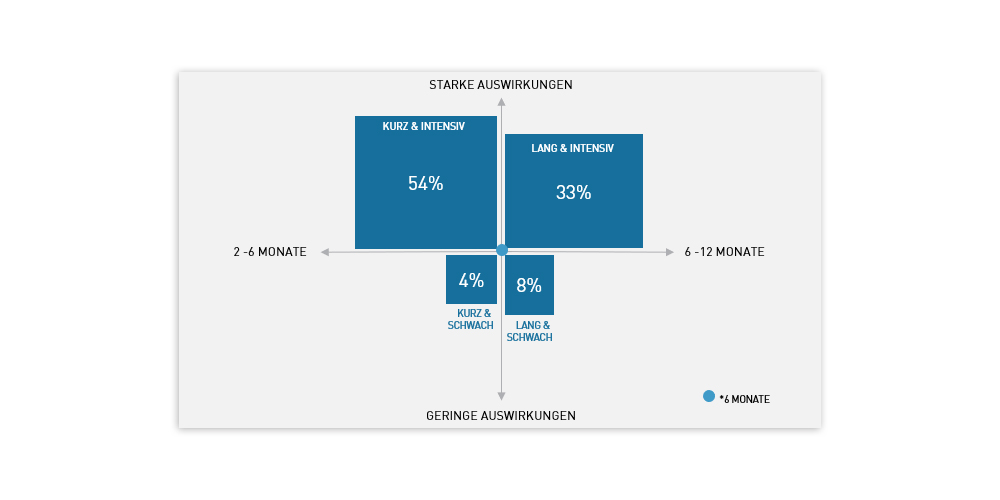
Source: Institute of Brand Logic
Almost all companies surveyed expect strict hygiene regulations to be in place for the entire duration of the crisis. "The high risk of infection from the coronavirus is forcing retailers to take extensive measures to protect customers and employees from infection," says Webhofer. "On the one hand, this causes noticeably higher costs for the companies, but on the other hand, it also has positive effects on the health of the employees - sickness rates are low at the moment as a result."
Changing consumer behavior
80% of the food retailers surveyed state that online demand has increased sharply since the start of the crisis - resulting in massive congestion in online delivery logistics. In the longer term, too, clear consumer trends seem to have emerged that have triggered or intensified the crisis: 64% of the study participants expect weekly shopping to gain in importance, while 55% see the shortest possible travel distances as a trend. In terms of product selection, regional products (65%) and healthy eating (59%) are likely to become even more of a focus for consumers than before.
Increased savings behavior
One concern of most respondents: the crisis is likely to lead to increased savings among consumers and reduce the proportion of disposable household income spent on food. "This will play into the hands of price-aggressive suppliers," says Webhofer. "Companies will have to adapt to increased competition and respond with new strategies." The study results prove that a majority of respondents are already planning to expand e-commerce with omni-channel solutions (74%) and strengthen online marketing (69%). In order to save costs, 78% also want to automate warehouse and logistics processes, and 67% want to enter into cooperative ventures in the supply chain.
Those who use change for their own benefit will profit in the long term
The need to better prepare their own organization for future crises is the order of the day: around three quarters of respondents say they want to be particularly active in this area and establish an efficient crisis management system, introduce digital solutions for more flexible working structures and develop crisis PR strategies. Despite all the Corona-related problems, there is also a positive effect for study author Webhofer: "The crisis has triggered or accelerated changes in companies that will have an impact far beyond the current phase. Those who take advantage of the change and draw the right conclusions for their structures and processes will benefit from it in the long term."
The Institute of Brand Logic is the consulting boutique with offices in Munich, Innsbruck and Vienna. For over 20 years, Brand Logic has accompanied food retailers and established leading retail formats on the market. Brand Logic's clients include Spar Group Austria, DM Drogeriemarkt, Mpreis and others.
The study results are available on the Homepage of the Institute of Brand Logic retrievable.


