When the pictures learned to speak
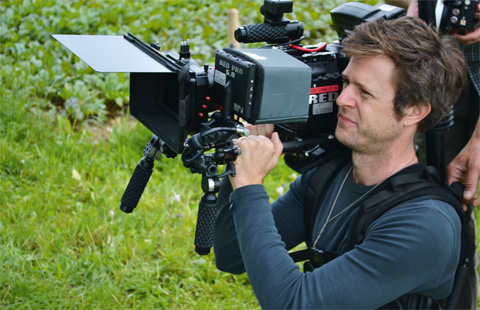
Filip Zumbrunn is a passionate commercial filmmaker and works for feature films at the same time. The cameraman never attended film school. Nevertheless, he has already made it into the film lexicon with over six major cinema works.


The "intense moviegoer" was already making Super 8 films at secondary school. He won the main prize at the Swiss Youth Film Festival in 1987 with his work "Timeless". "It was a surrealist film in the style of Bunûel," Zumbrunn recalls. He was completely out of the ordinary because most of his competitors at the time "somehow wanted to imitate Derrick". Filip's talent was also encouraged early on by his father. He was an advertising and fashion photographer in the 1970s, before achieving international renown with his books and photos of cars. Filip repeatedly assisted his father "voluntarily and with great passion". After graduating from high school, he made a career out of being an "assistant" and continuously "worked his way up from lighting to camera". Filip Zumbrunn then worked as a first assistant for more than ten years. For example, he assisted Renato Berta on "Beresina" by Daniel Schmid. He worked with Pio Corradi on "Vollmond" by Fredi Murer and "Gripsholm" by Xavier Koller. Then came the moment when he wanted to do it himself. "As a regularly employed assistant, that wasn't so easy. The roles are distributed. And who trusts you to be able to produce the required images yourself?" Filip Zumbrunn, who chose "learning by doing" as his path, sees this as probably the only disadvantage compared to film school graduates. "At film school, directors and technicians mature into the professional world together and develop corresponding networks. As an assistant, I also don't have a graduation film to show for it." During this phase, the filmmaker took a creative break. Zumbrunn founded the "Acapulco" bar on Zurich's Neugasse with friends and waited for jobs as a cameraman while serving. The opportunity came from Dschoint Ventschr. Samir's film production company entrusted him with the camera for "Strähl" in 2004, for which Zumbrunn immediately won a special award for camera and lighting at the Swiss Film Awards. His style, in which almost everything was filmed "handheld", was convincing. This technique gave director Manuel Flurin Hendry's film a very dynamic look, making the cops movie look rather un-Swiss and more like an independent movie from New York. Accordingly, in addition to the Swiss Film Award for "Best Actor" Roeland Wiesnekker and Johanna Bantzer, it also won an acting award at the Max Ophüls Film Festival in Saarbrücken as well as directing awards in Schwerin and Hamburg.
Night Train to Hollywood
All these palmarès also got Zumbrunn's "talking pictures" up and running. The requests became more and more interesting. Last year, for example, Filip Zumbrunn was Director of Photography and responsible for the entire camera technology for the first Swiss 3D film "One Way Trip" by HesseGreutert Film. More for a wider audience was "Giulias Verschwinden", a comedy film about growing old based on a book by Martin Suter. This film by Christoph Schaub won the Audience Award in Locarno in 2009 and was also honored with the Zurich Film Prize in the same year. Zumbrunn was once again able to film with Bruno Ganz in Lisbon from March to May this year. In "Night Train to Lisbon", Jeremy Irons, Mélanie Laurent, Jack Huston, Martina Gedeck, August Diehl, Lena Olin, Christopher Lee and Charlotte Rampling also appeared in front of his camera.
Zumbrunn's most expensive film to date is a co-production of Studio Hamburg and Zurich-based C-Films, based on the bestseller by Pascal Mercier. It is directed by Bille August. He has also worked with Meryl Streep and Antonio Banderas in his "The House of Spirits" and with Max von Sidow in "Pelle the Conquerer", for which he won an Oscar in 1989. What impressed Filip Zumbrunn about working with such international names was the way they showed no airs and graces at all. "One difference to Swiss productions, on the other hand, was that the stars were much more protected from the technology." They wait in their caravans and only come onto the set when the director can call for "action". "This allows the actors to concentrate fully on their feelings in the art of acting." And now? After his journeyman's piece with international stars, will Zumbrunn also be one step closer to Hollywood? "I like working in Switzerland," he laughs. But the Zurich native is a little proud that Bille August might also want to take him along on his next project. For the time being, however, the Zumbrunn Wiederkehr family are not packing their bags for overseas just yet.
Andreas Panzeri