When is NLP finally coming?
Has the machine already deciphered human language? Where natural language processing is used today—and what it will be capable of tomorrow.



Who wouldn't want that: quickly say a few ideas on your smartphone, the app recognizes what you've said and writes it down word for word. Google's Voice Assistant already achieves good results with English speakers. The results in German are not yet impressive.
Or: You talk to your smartphone, it gives meaningful answers - a lively dialog develops. A check with Siri shows how far away we still are from this.
Today, chatbots can be found on various websites that support users with their inquiries about products and services. They do not always provide a good customer experience.
There are still no reliable apps that are up to the challenge of accurately establishing the context for a specific question. But it won't be long before Natural Language Processing (NLP) is able to decode the linguistic pitfalls and put spoken language into the right context.
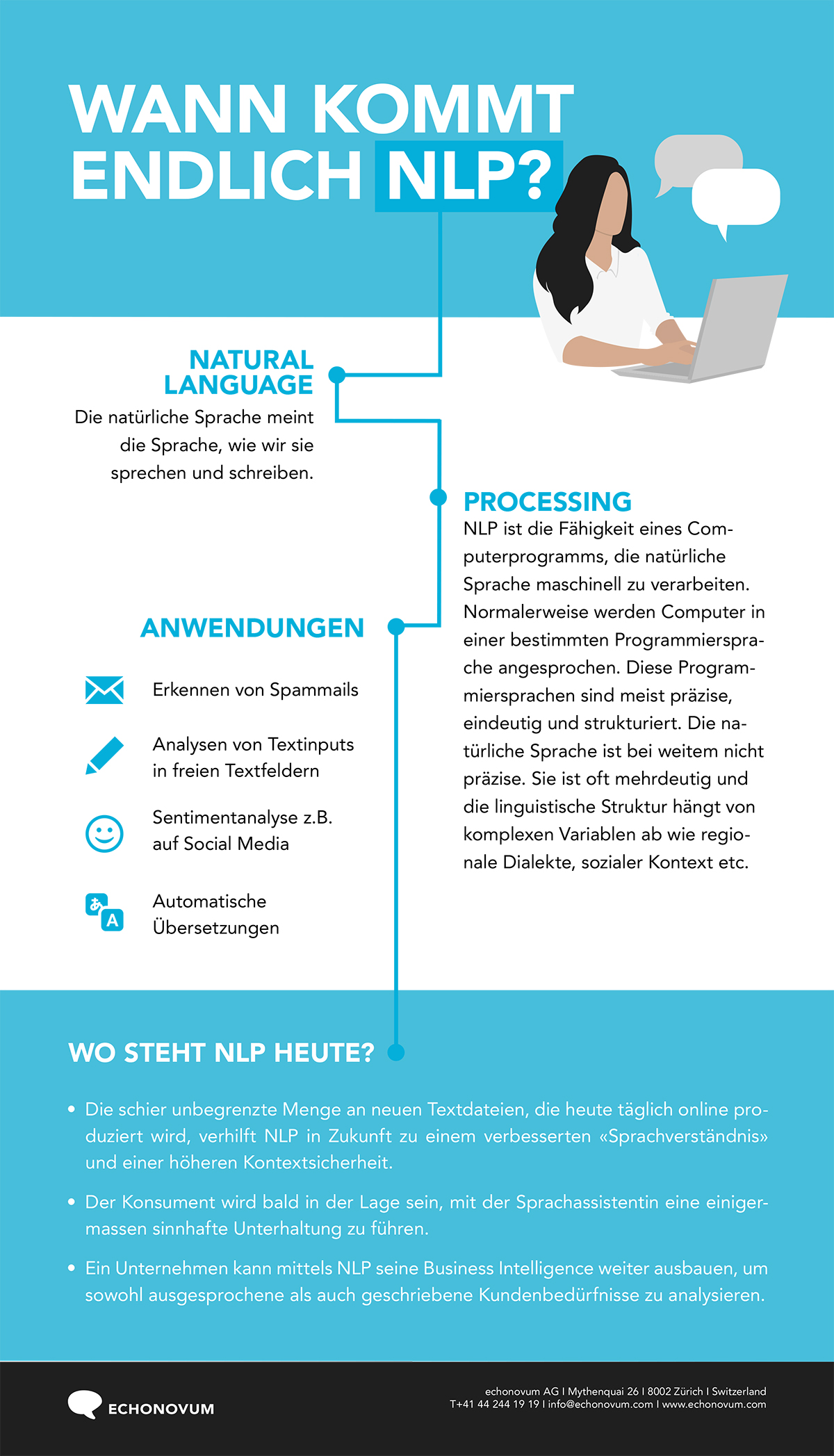
NLP is the ability of a computer program to understand natural language exactly as it is spoken or written. It processes text and speech automatically. It is used in the context of AI (artificial intelligence) technology. One of the oldest and simplest NLP applications is the recognition of spam. A computer program decides whether an email is spam or not based on the subject line and text. This is based on a rule-based approach in which algorithms are told which words, phrases or sentences in a text should be searched for. Current NLP approaches are based on machine learning or deep learning: a computer acts on the basis of pre-trained models. Based on countless examples, the machine itself recognizes the meaning of a text. The idea behind this is that a computer program learns the language almost like a child.
NLP applications face the challenge that computers are normally addressed in a specific programming language. Programming languages are precise, unambiguous and structured. Natural language is far from precise. It is often ambiguous, and the linguistic structure depends on complex variables such as regional dialects, social context, slang or a particular subject or field.
The processing of human language often involves search queries. People are used to obtaining information in a certain way: They ask a question. They also want to query data records from computers in the same way - they enter a question, the computer recognizes the most important elements of the question sentence, assigns them to certain characteristics of an existing data record - and displays the results found. In technical jargon, this is called tokenization.
One example:
Someone searches on Google: When is the next flight from Zurich to Amsterdam? Tokenization now sets a process in motion in which the given text is divided and segmented into smaller elements such as whole sentences or words.
In the above example, it is recognized that:
- When = should be a date
- Airplane = airplane is
- Zurich, Amsterdam = airports are
The database query now searches for flights from Zurich to Amsterdam in the near future and displays the results.
However, NLP can also be used to interpret free text in order to make it analyzable. For example, free text fields are important in surveys in order to capture specific suggestions for improvement or individual opinions. Before deep learning, these text files could neither be computerized nor systematically analyzed. Each individual response had to be read and evaluated. With NLP, an unlimited number of text responses can now be searched for relevant information and analyzed or classified. Today, intelligent insights platforms use this advantage for surveys and use NLP for text analysis. Sentiment analysis (sentiment mining) shows, for example, which comments reflect positive, neutral or negative opinions and moods.
In the IoT (Internet of Things) sector, voice assistants are used to trigger an action in response to a precise, spoken command: The oven is switched on to 200 degrees, the shutters are lowered, the heating is set to 21 degrees.
Automatic translation functions from Google or DeepL also use NLP and deep learning. The machine interprets the meaning of texts and translates them into another language.
The sheer unlimited amount of new text files that are produced online every day today will help NLP to improve "language understanding" and contextual accuracy in the future. The user will soon be able to have a reasonably meaningful conversation with the language assistant. And perhaps one day a mental and fitness coach will take care of the user's physical and mental health.
There are a number of new or improved applications for companies: A digital voice assistant accompanies sales to customers, listens in on meetings, records them and stores them in the CRM. It coaches the acquisition of new customers and signals which questions and tone of voice elicit positive reactions. Chatbots take customer calls, answer questions or forward customers. They write articles on specific specialist topics, translate product catalogs, correct company texts and presentations. Internally, NLP helps to save a huge amount of time when searching for information. With NLP applications on the intranet, in enterprise search or even on the Internet, employees can ask W questions to find the information they need.
NLP enables companies to continuously improve their customer approach and customer experience. They will be able to analyze a wide range of different data sources and use predictive analytics to forecast the probable future and trends. This allows tendencies to be recognized at an early stage and appropriate developments to be initiated.
The author: Nicole Schnetzer, Head of Marketing, Echonovum. Echonovum is a young Swiss software company for intelligent, digital solutions for insights-driven leadership.