"The tech industry has done a lot of good in the pandemic"
Petra Jenner has been Salesforce's head of Switzerland since February 2021 - and had to familiarize herself "remotely" due to the pandemic. In an interview with Werbewoche.ch, she reveals what difficulties this entails - and what Corona has meant for digitization.


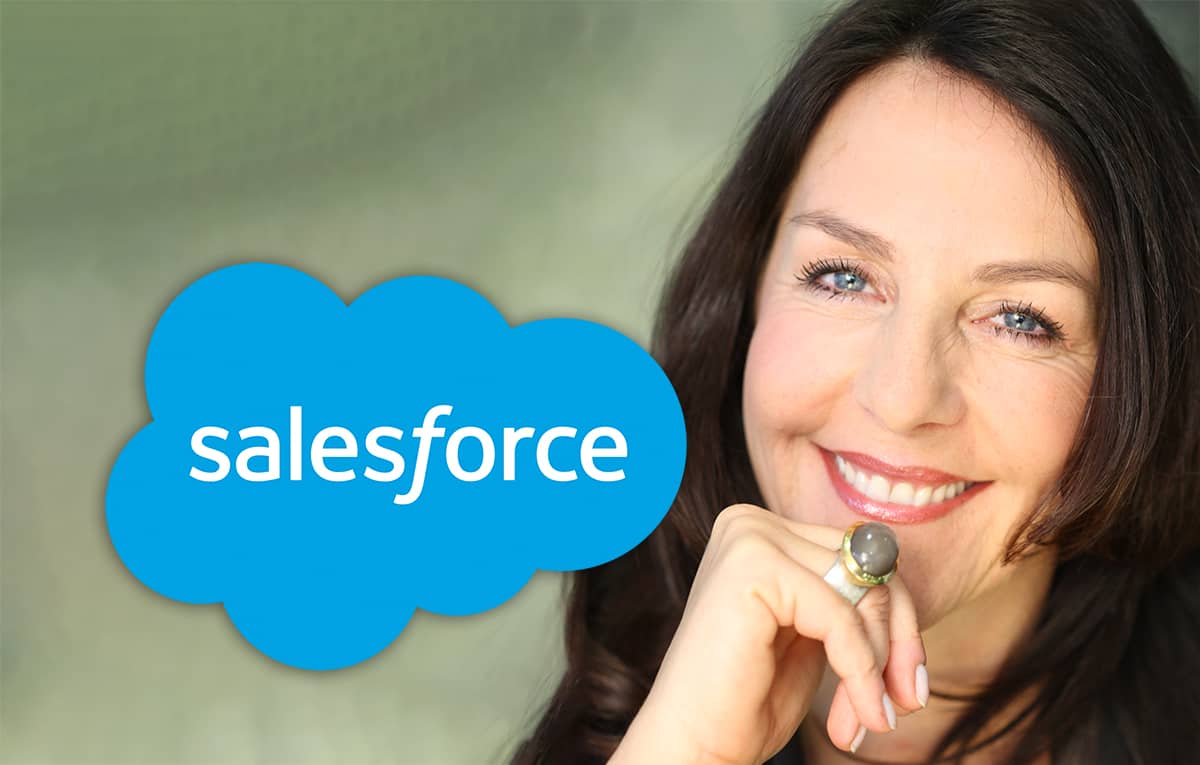 Advertisingweek.ch: Petra JennerYou have been Salesforce's General Manager & Senior Vice President Switzerland and Eastern Europe since February. Currently, however, you still have to do your job from Munich because of Corona...
Petra Jenner: You are right, I can't move to Switzerland at the moment. That's really hard to organize at the moment. I hope it will get better towards the middle of the year - our two Swiss offices are still closed at the moment, so I can't meet the staff anyway. And customers also tend to be very cautious about physical meetings at the moment. So I'm primarily on the road digitally. Of course, that's not nice in the long run, especially when you've taken on a new position.
The training for such a responsible position should be particularly complex "remotely"?
Well, that's a challenge because, of course, I don't know every employee personally yet, although that would be my aspiration: to have seen everyone at least once. I have tried to schedule virtual meetings where I can get to know people - but that adds up to quite a number, and I can only work ten to twelve hours a day (laughs). If I had been able to meet employees in the offices right away, it would have been faster. I think it takes more time to build relationships today than before the pandemic.
An interesting statement. Many managers say they would rather save time - because they have to travel less?
Of course, I also find it very pleasant to be responsible for 22 countries and not have to travel somewhere every day. Especially now, with all these requirements in the context of the whole Covid prevention, traveling is anything but fun. But is the time you save on trips to the airport really gained? Or does it just shift to a more tightly scheduled agenda with more zoom calls? I think the latter. Those "in-between times" on the airport train, those have also been recovery breaks for me. You shouldn't underestimate that either. I read a lot more back then. I think we all work more today.
You used to spend an average of 150 days a year on the road. Is this kind of life and career management coming back?
A good question: Will we really have a different "New Normal," as they say? Or will it be that people will travel a lot more for now because they've missed it so much? I'm curious. I have a feeling that there will be lasting changes already. I think we will all stop traveling so much, and travel more consciously, because people have realized that they don't have to be physically present for every conversation.
Speaking of changes - as a profound connoisseur of the tech industry, perhaps you can say something about an observation that could be made during the pandemic. Namely, that companies like Salesforce or Microsoft have shown themselves to be even stronger corporate citizens. Or is this impression deceptive?
I also believe that the tech industry did a lot of good during the pandemic. With Salesforce, for example, we've adapted the "success from anywhere" theme: How can we ensure successful working from home in the first place? We advised many companies on this in a very short time; there was a lot of knowledge transfer. And we participated in vaccination and mask campaigns, as did many of our market competitors. We had our challenges, of course, but compared to many companies, we always had enough work; were able to create work and give work. And then it is our duty to get involved for those who are less well off.
Was the pandemic also a window of opportunity for digitization?
I was talking to a Swiss CEO the other day who summed it up very well: he said, "You know, Ms. Jenner, all my life I've always had to argue why we invest in IT. Since Covid, I don't have to anymore, because it's become clear to everybody that without certain investments, we wouldn't be able to work." And I think that's important, too: Covid and the undoubtedly dire circumstances ended up helping a lot of companies modernize.
So it's an exciting moment for you as a Switzerland GM to work the market here?
Yes, it was a good market before, but now it's even more exciting. What particularly moves me are the many great medium-sized companies that exist in Switzerland. People often associate Switzerland with global corporations, which are very important for the location. But there are so many brilliant, medium-sized entrepreneurs here who have certainly already taken the topic of digitization seriously, but are now simply pushing it harder. And that's where I would definitely like us as Salesforce to make a contribution.
Is that what you want to focus on?
Yes, that is a very big concern for me. The way I see it, Salesforce is a solution that is suitable for any company of any size. But it's also important to be able to support these companies. And I think we can do even better in Switzerland. We are perhaps not yet as strong in the SME sector as we should and could be, and I see that as great potential for us.
Who will be more important as a point of contact - the chief marketing officers or the chief information officers?
The Chief Marketing Officers and Chief Digital Officers have actually received a lot of attention in recent years, and the Chief Information Officers - insofar as all three functions existed in parallel in a company - have had to redefine their role in the meantime. In the meantime, it has been recognized that all competencies are needed. After all, the pandemic has changed the working world for everyone: The CMO was confronted overnight with having to work exclusively digitally, only being able to do online events. Were you prepared for this, did you have sufficient digital skills? I have also experienced this in our company, everything had to be changed. And then questions arise like: How far can you go? How do you stay innovative? What are the technologies? And the more marketing also had to deal with technologies, the more the CIO suddenly came back into play. You know: the role of the CIO has always been important. It was just perhaps no longer as present in the public perception. Today, if you have a good CMO and a good CIO, you are well equipped for the future.
Salesforce has long been the agile aggressor, taking market share from SAP, Adobe, and other competitors with speed and innovation. Now you're so successful that you've become the "hunted" yourself. So does success actually make the job harder?
I think it's equally challenging for any company to succeed in this environment today. I think the challenge for us is simply to make sure that our customers are really successful in using our solutions. And that, of course, becomes more demanding with increased expectations, increased requirements. That's quite clear. Competition is a good sign, because it shows that demand is there on the one hand. But it also shows that we have been working on an important topic for over twenty years. I make sure that our customers are satisfied. Because when customers are satisfied and employees are satisfied, growth comes naturally. That is crucial for me. And I think the work is only different in that the team is getting bigger. But otherwise, the job remains just as demanding or challenging as it was three, four, five years ago. Nothing has changed in that respect.
In Switzerland, Salesforce is very committed to equality - for example, with the "Bring Women Back To Work" initiative. Is this also an affair of the heart for you?
Yes, I think the idea is quite fantastic. I can also explain it simply: I've seen a lot of careers stopped, due to family backgrounds, and then after two to three years, the women haven't found their way back. That's why it's insanely clever of my colleague Vanessa Gentile to have launched "Bring Women Back To Work"; to say: we recruit talented, excellently trained female academics who simply have less work experience or didn't stay in their professions because maybe it wasn't compatible. Or simply because they had to go to another country and now want to start over again. They should be addressed. In my view, this is one of the most innovative ideas I have seen in recent years.
Petra Jenner has more than 25 years of experience in the IT industry: Before joining tech giant Salesforce in 2016 as Vice President Innovation & Transformation Europe, she was, among other things, Country CEO and General Manager of Microsoft Switzerland. In her spare time, the graduate in business administration and business informatics writes books; most recently, she published the title "Mit Verstand und Herz - Authentisch und erfolgreich: Führungskraft ist weiblich.