
These are the key success factors in e-commerce


E-COMMERCE The E-Commerce Report 2016 shows that customer proximity is the most important success factor. Growth in Swiss online retail was rather modest. However, two online department stores are on the rise.

The 2016 E-Commerce Report shows that creating channels to reach customers is becoming increasingly crucial.Since 2009, the Swiss E-Commerce Report has been examining the significance, changes, and trends in Swiss online retail—the only study to do so from the perspective of providers. The survey is conducted by the online payment processor Datatrans and the University of Applied Sciences and Arts Northwestern Switzerland (FHNW). The survey respondents were 36 online and multichannel providers with the potential to shape the market of consumer goods and services based in Switzerland. Together, they account for an e-commerce volume of over 4.5 billion CHFA Challenging Situation in Swiss E-CommerceEven though online retail grew by another 10 % in 2015, it was a difficult year for some retailers. The growth rates of the study participants were lower than in previous years. About one-third even saw a decline in sales. One reason for this is fierce competition, particularly from abroad. The market share of foreign e-commerce providers grew by two percentage points in 2015 to a remarkable 20 %—though there are significant differences between industries.Adjustments to business models can also initially lead to a decline in revenue. «Profitability and sustainability have become more important,» explains study author Wölfle. «Swiss companies are no longer blindly focusing on growth in e-commerce.»

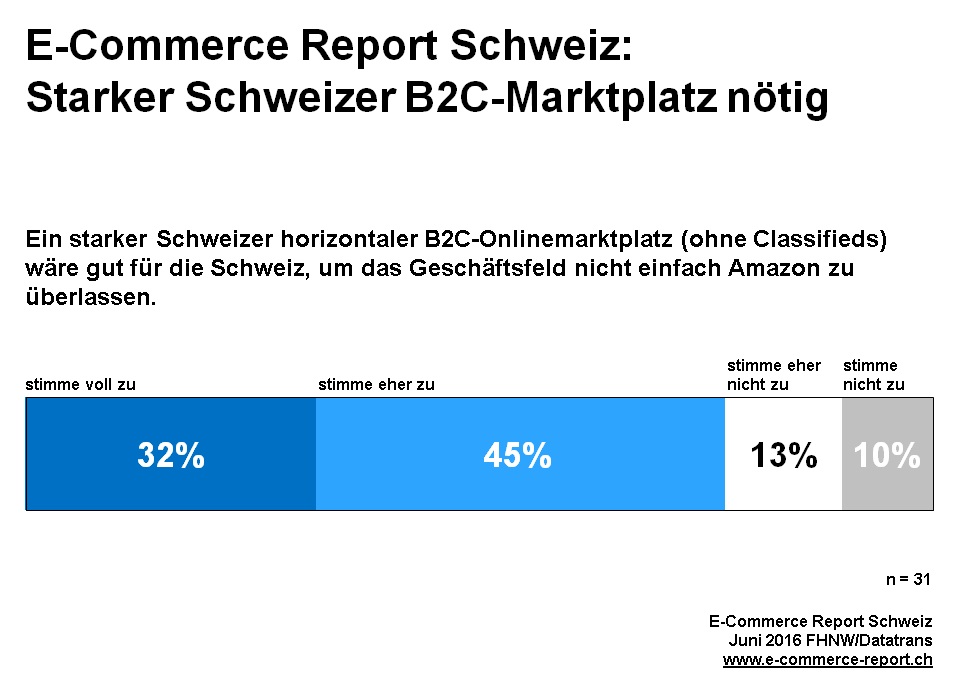
Cross-channel business concepts remain highly importantRetailers that have the opportunity to do so are driving multichannel strategies forward. The proximity to customers offered by brick-and-mortar locations is also being leveraged as an advantage in the context of e-commerce. More so than in previous years, pure-players are also embracing brick-and-mortar concepts. They aim to achieve greater visibility and establish local services such as pickup locations or service points. Not least due to the massive rollout of 290 PickMup pickup stations by the Migros Group, 80 % of the study participants now believe that pickup solutions will become established in the market. Some providers are attempting to expand the limited product ranges in their stores by offering access to online product ranges.Logistics as a Competitive AdvantageSwiss providers also want to capitalize on their physical proximity to customers in logistics: They can deliver faster than foreign competitors and set up pickup options more easily. Many providers are investing heavily in logistics. Now that delivery times have been shortened, the focus is shifting to giving customers the ability to specify their preferred delivery time and location. The integration of various modular services and partners—such as for assembly, commissioning, and disposal—offers customers personalized options.A New Boost in PaymentsAn order placed by a customer ready to make a purchase must not be jeopardized by a barrier during the payment process. This is the most important requirement for payment solutions. Next comes the demand for greater simplicity—including on smartphones—and lower fees for providers. While the retail sector has largely remained stuck with its aging solutions, service industries such as public transportation have made great strides. The public transportation sector has been extremely successful with mobile ticket sales solutions and automated payment processes: «Buy a ticket with two clicks on your smartphone.»Amazon as a Catalyst for the Will to Assert OneselfIn many countries, Amazon is the go-to destination for online shopping. Its selection is vast, and its logistics capabilities are spectacular. Switzerland still lacks a comparable counterpart: As B2C marketplaces, ricardo.ch and siroop are, so to speak, in their infancy. siroop—perhaps the most exciting e-commerce project in Switzerland right now—is setting a remarkable pace as a startup. Amazon is feared: What could Swiss providers offer to counter Amazon? A three-quarters majority of the study panel believes that a strong Swiss B2C online marketplace would be good for Switzerland, so as not to simply leave the market to Amazon.
Two Online Retail Giants on the RiseDigitec Galaxus generated sales of nearly 700 million Swiss francs in 2015 and has been Switzerland’s largest e-commerce provider of consumer goods ever since. In addition to Galaxus, Brack.ch can also be described as an online department store due to its wide-ranging product selection. Both are believed to be capable of holding their own even in the face of intensified competition from Amazon. However, beyond their own potential, they do not provide Swiss e-commerce with the leverage needed to counter Amazon—after all, they are not online marketplaces.Brand manufacturers are taking the initiativeBrand manufacturers are seeking a more active role in their relationships with end customers. They have no choice but to do so: Traditional retail is losing ground, and brand fans are demanding direct access. Brand manufacturers want to expand their brand universe beyond traditional distribution channels. Conflicts with retailers are inevitable, but not unavoidable. The division of labor must be reevaluated. However, there is no alternative to accepting the diversity of customer demands and the coexistence of different purchasing channels.Retail will continue to be needed in the futureEven as brands become more involved in direct-to-consumer sales, retailers will remain an indispensable partner for most of them in the future. Manufacturers need a strong retail sector that draws attention to their products within its customer segment (reach), promotes their products in an appropriate manner (promotion), does not undermine brand policy, and, when necessary, communicates with customers on behalf of the brand and addresses their concerns (service). By far the most important asset a retailer has is its access to consumers. «Almost all products and services are available from multiple sources at the same time,» says study author Wölfle. «The decisive factor for sales will be who has access to the customers.» The study is available free of charge at: www.e-commerce-report.ch/bestellungen


