Blocker and club
The editorial by Werbewoche Editor-in-Chief Anne-Friederike Heinrich from issue 18/2016 of November 4, 2016.


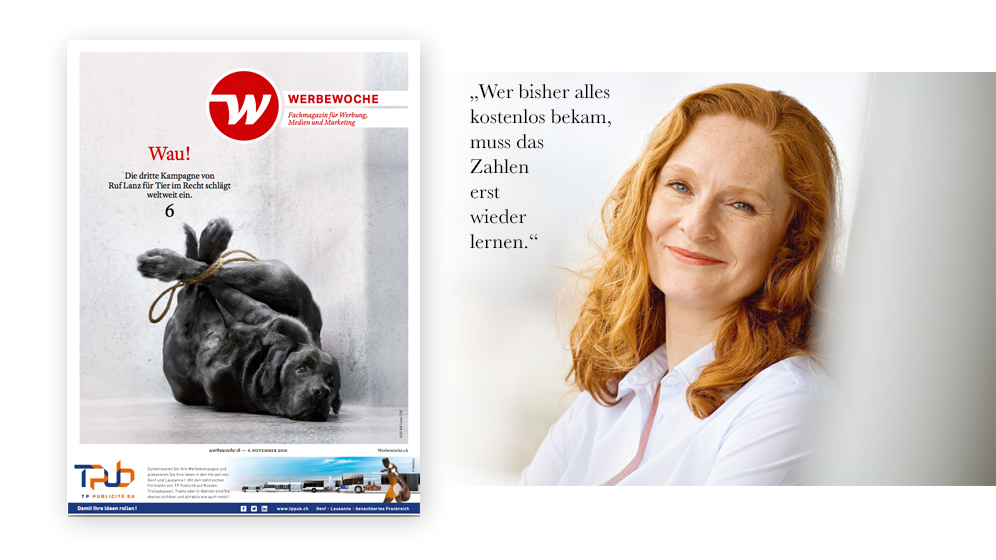
Those who surf with an adblocker are not popular with everyone - and are similar to parents of small children and dog owners. Media companies in particular have problems with adblocker users - after all, they finance their journalistic offerings largely through advertising. If they can't play them out to potential consumers, even the last advertising revenues will soon be perdù.
While families with small children and dogs with their owners can be given a wide berth, dealing with adblocker users is difficult for media companies. It's true that for almost as long as software has been available to suppress online advertising, there have also been technical countermeasures to block adblocker users from offers. But who wants to treat their customers, their readers, this way? IAB Switzerland and Adello still consider the situation in Switzerland to be unproblematic. But if readers continue to behave like children who take sweets from the shelves in the supermarket straight into their mouths without a thought that you have to pay for them first, things could change quickly.
Since last week, the Süddeutsche Zeitung has been using an anti-adblock measure on its website: Anyone who wants to read an article on Sueddeutsche.de can either switch off their adblocker, sign up for a subscription or create a free account; those who register for free can use the website with their adblocker switched on - but in doing so presumably open the door to marketing measures. Bild.de and Gruner + Jahr, Europe's second-largest printing and publishing house with publications such as Geo, Stern and Brigitte, as well as Eltern (!) and Dogs (!), have also already introduced an adblock ban. But the blocker ban is spreading bad vibes between reading material producers and readers. Is there no other way?
In the summer, the Financial Times tried to unite with its readers with advertising antipathy. To do this, the business newspaper divided its registered users into three groups: For one group of adblocker users, individual words were omitted from the texts to illustrate how important advertising revenues are for the production of a complete journalistic offering. The second group was made aware of the importance of advertising for funding, but could continue to use the website without restriction. The adblocker users in the third group were completely locked out and were shown a notice explaining what was going on.
The results of the experiment are astonishing and encouraging: 47 percent of the users for whom individual words were missing from articles put the "Financial Times" website on their whitelist. 40 percent of users who were able to use the site without restriction, but who had to read an appeal, deactivated their adblocker. And of the users who were completely blocked out, an impressive 69 percent deactivated their adblocker. At Bild.de, too, the results of the adblocker blockade were positive. Two-thirds of the affected users had switched off their adblockers and were thus once again accessible for advertising on Bild.de, said Axel Springer CEO Mathias Döpfner at a press conference.
So the club after all? That's something every medium and every publishing house must first decide for itself: What suits the product? What is our style? What can we afford? What can we finance? Once their own line is clear, media providers should cooperate: in sales, marketing, market research and technology.
The important thing is to realize that we have to get our readers on board; we have to make them understand the importance of subscriptions and advertising for the stuff they want to read. Those who used to get everything for free must first learn to pay again. And those who pay nothing cannot expect a completely satisfactory service. That's not just the case in journalism.
Anne-Friederike Heinrich, Editor in Chief