The WEMF's new Sports & Culture module provides a comprehensive database on the Swiss population's interests in sports and culture, as well as their attendance at events.
Anna Müller
-
May 28, 2026
Figure 1: Interest in sports by age and gender. Population of Switzerland and the Principality of Liechtenstein, age 14 and older, n = 30,378. The size of the bubbles corresponds to the percentage of people interested in the sport. Source: Sports & Culture 2025 module (unpublished data) Illustration: zVg
The year 2026 is a year of major sporting events. The Winter Olympics, the Ice Hockey World Championship, and the Soccer World Cup not only bring sports with large audiences into the spotlight but also raise the question of the right advertising platforms. In line with this, WEMF AG for Advertising Media Research is releasing a new data package this year as part of the MACH studies: the Sports & Culture module. It provides representative and reliable data on the interests and attendance patterns of the Swiss population in the sports and culture sectors.
In addition, the study examines how people volunteer in sports and culture. The data can be combined with other established WEMF studies, such as MACH Consumer or MACH Strategy. This results in detailed target audience profiles that also include media usage as well as consumption and purchasing behavior.
Identifying Opportunities in the Advertising and Media Market
Advertisers, event organizers, agencies, marketers, and media companies can use the data from the new module to specifically improve their sponsorship, marketing, and commercialization strategies. It supports the selection of suitable platforms and partners, precise target audience analyses, market potential assessments, as well as benchmark comparisons and efficiency evaluations. At the same time, it provides well-founded arguments for sponsor acquisition, editorial direction, and user marketing, and complements existing market research and corporate data. The insights into sports and culture are also of interest to associations, government agencies, and other stakeholders involved with sports and cultural data.
Use of Data to Evaluate Events and Target Audiences
The strength of the data lies, in particular, in its practical applicability. A concrete example is the analysis of interest in sports by age and gender (see Figure 1). The module lists over 40 different sports.
«The strength of the data lies, in particular, in its practical applicability.»
The data show, for example, that alpine skiing attracts the most interest among the Swiss population. It is followed by soccer, which has the second-largest share of interested people; however, compared to alpine skiing, the average age is closer to the Swiss average, and men are overrepresented in this sport. Smaller sports such as figure skating, which appeals particularly to women, and bobsledding, which has a slightly older, more male-dominated audience, are also represented in the study.
Two Sports Under the Microscope: Ball or Puck?
For example, if advertisers want to choose between soccer and ice hockey as a sponsorship platform, the Sports & Culture module provides helpful information and thus a solid basis for decision-making. The suitability of a particular sport depends heavily on the communication goals being pursued or the target audiences to be reached. Overall, 38 % of the Swiss population is interested in soccer and 26 % in ice hockey, enabling a high reach in the Swiss market.
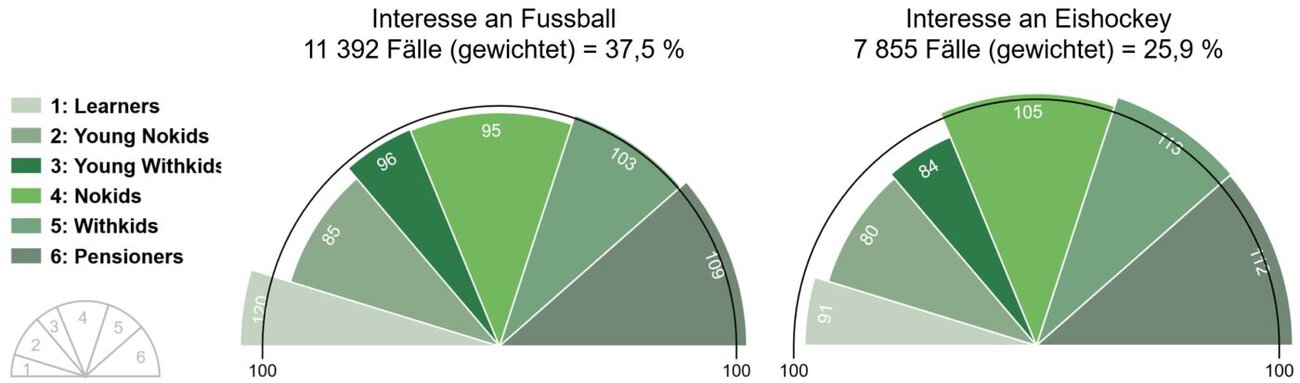
At first glance, both sports appear similar, with a predominantly male following and an age group slightly above average. Soccer, however, is particularly popular among 14- to 19-year-olds, which is not the case with ice hockey (see Figure 2). Ice hockey fans are, on average, slightly older and, accordingly, more likely to have a higher income. In both groups, an above-average proportion holds leadership positions. Similarities are also evident in leisure activities: Both groups volunteer more frequently than average, both in sports and in politics, and also enjoy following other sports. For example, 71 % of ice hockey fans are also interested in alpine skiing, and 39 % in cycling. Soccer fans also show a strong interest in alpine skiing (61 %) and tennis (39 %). These overlaps show that cross-sport sponsorship can be effective for reaching specific target groups more intensively or for appealing to a broader audience.
Figure 2: Interest in soccer and ice hockey by lifestyle. Population of Switzerland and the Principality of Liechtenstein, age 14 and older, n = 30,378, Source: Sports & Culture 2025 module (unpublished data)
From Interests to Purchasing Behavior and Brand Loyalty
Another benefit of the module is that it links interests to consumer behavior. The data shows that people interested in soccer and ice hockey are not just spectators; they also participate in sports at an above-average rate and spend more than average on sporting goods—with ice hockey fans spending even slightly more than soccer fans. Both groups pay particularly close attention to advertising, perceive it as less intrusive, and view it as a useful source of information. This significantly increases the effectiveness of sponsorship initiatives. Both soccer and ice hockey reach a very large number of people in Switzerland, although soccer, as a mass sport, appeals to a broader and more diverse audience and can provide a brand with a wide reach. In ice hockey, on the other hand, the target audience is slightly older and has greater purchasing power, which offers advantages for a more targeted brand approach.
In addition to the sociodemographic data, interests, and affinities mentioned above, WEMF also tracks over 500 brands, which enables a direct link between target groups and specific brand ownership.
Know More, Make Better Decisions
The Sports & Culture module represents a significant advance in the data-driven analysis of sports and cultural target audiences. By combining interest, behavioral, and consumption data and linking them to sociodemographic, geographic, and media usage data, new opportunities arise for strategic decision-making in sponsorship and event marketing. Companies, event organizers, agencies, marketers, and media companies benefit from a solid data foundation that enables them to better understand target audiences, plan marketing initiatives efficiently, and tap into new potential in the sports and culture sectors.
Sports & Culture
The module includes, among other things, the following data
Interest in 45 different sports
Interest in 27 different cultural activities
Attendance and Intention to Attend 42 Sporting Events
Visits to and Intention to Visit 52 Cultural Attractions and Events
Can be linked to over 10,000 demographic, consumer, and media characteristics.
wemf.ch/sports-culture
In the movie theater, everyone's undivided attention is focused on the screen
How relevant is the movie theater in the age of streaming and always-on connectivity? More relevant than ever. Because this medium offers something others don’t: It’s an experience we consciously choose—with our undivided attention. Brands benefit from this, too.
Julia Gundelach
-
May 28, 2026
Image: Unsplash.com / Tyson Moultrie
This film wasn’t exactly light viewing: Nurse Flora rushes through the hallways at a run, a patient waits for his diagnosis, someone complains—and the phone is always ringing somewhere. Nevertheless, the relentless daily grind of the protagonist in the Swiss film «Heldin» drew more than 207,000 people to the theaters, moved audiences to tears, gave them goosebumps, and even provided a few humorous moments. For this, the film even received an award that had never been given before: «Heldin» was the first film to win the Box Office Quartz, an award presented by the Swiss Film Academy and the Federal Office of Culture (BAK) to honor works that, through gripping stories and dedication, inspire a broad audience to appreciate Swiss cinema.
The award strikes a chord. That’s because productions like «Heldin» are seen as growth drivers for the Swiss film market. They reach target audiences that are often harder to attract with Hollywood blockbusters and create genuine cultural relevance. This is also reflected in the figures, which initially did not bring good news at the start of the year: According to the film and cinema statistics from the Federal Statistical Office (FSO), published in mid-March 2026, Swiss movie theaters recorded fewer than 10 million admissions (9.47 million) in 2025, selling 8 percent fewer tickets than the previous year. Excluding the Covid-19 years, this is the lowest number of moviegoers in fifty years. But it wouldn’t be cinema without an exciting twist: While the market share of American films is declining, European and Swiss films are enjoying growing popularity. According to Procinema, Swiss films recorded 914,318 admissions, representing a market share of 9.25 percent—an increase of 2.74 percent.
The Movie Theater as a Total Experience
It’s not just local productions that are trending: Attendance for 3D films also rose by more than 25 percent, with 647,840 admissions. With high-quality technology, state-of-the-art seats, and greater comfort, service, and format add-ons—or 4D—the movie-going experience is being enhanced and is increasingly setting itself apart from a streaming night at home on the couch. Going to the movies is becoming a total experience that’s about much more than just a movie.
Brands that showcase themselves in this environment also benefit. After all, what counts in marketing today is no longer just reach. That was also a key takeaway from the SWA Summit in March: What strong brands need today is genuine impact. Advertising must deliver—and the big screen provides the perfect setting for that. A study by Lumen Research commissioned by the cinema marketer Weischer shows that movie theaters are the medium that captures the most attention and is also the most efficient in the entire media mix. Eye-tracking was used to measure how long people look at the screen during a commercial—whether on TV, a laptop, a smartphone screen, or the big screen. The results showed that cinema generates up to four times more attention than all other moving-image channels. A study by the market research institute September Strategie & Forschung demonstrated that cinema advertising also appeals to audiences on an emotional level much more intensely than TV or online video—which also influences purchasing decisions.
Advertising as Part of the Program
Movie theater advertising benefits from high levels of attention, positive perception, and significantly fewer distractions than elsewhere. «It’s the only medium where advertising doesn’t interrupt the program—it’s part of it,» explains Christof Kaufmann, CEO of Weischer Cinema. «This undivided attention is extremely valuable—and almost unique in today’s media landscape. This makes the movie theater a kind of island: a place where communication truly resonates. It also enables brands to tell stories.»
And it is precisely these «islands» that matter today—at a time when consumers are inundated with advertising every day, content can be skipped every second, and genuine attention is scarce. «In a fragmented media landscape, attention is becoming the scarcest currency—and this is exactly where cinema advertising plays to its greatest strength,» says Juliane Fankhauser-Merz, Director of Sales at Weischer Cinema Switzerland. Companies recognize this as well: In 2024, companies invested 26 million Swiss francs in cinema advertising—a 3 percent increase over the previous year. This makes it, alongside outdoor advertising, one of the only advertising formats that managed to grow at all in a stagnant market. And as a counterpoint to quick clicks and performance-driven campaigns, it particularly shines in branding: «Cinema isn’t a reach medium in the traditional sense, but rather an impact medium. It amplifies campaigns precisely where impact and brand-building matter,» explains Juliane Fankhauser-Merz. “It creates a setting that no other medium can replicate: a large screen, a shared experience, and a high level of emotional receptivity. Advertising here benefits directly from the quality of the environment. In Switzerland in particular, there is continuous investment in state-of-the-art visual and audio technology, which clearly sets the cinema experience apart from home entertainment.”
Movies as the icing on the cake
In the media mix, cinema is still often considered the «icing on the cake»—something clients add if there’s budget left over. Weischer CEO Kaufmann believes this is a mistake. «Cinema should be strategically considered from the very beginning, as an integral part of the moving-image mix.» And the medium offers more than just impressive ads on the big screen: DOOH screens in the lobby ensure that advertising is seen on the way to the theater, and other approaches are also possible—such as advertising on popcorn bags or product placements directly in the film. They showcase products in a native way—thematically appropriate and emotionally engaging. Stairlift provider Lifta demonstrated just how creative this can be in the new film by director and screenwriter Simon Verhoeven, «Oh, That Gap, That Horrible Gap»: In it, Particibrand—an agency specializing in product placement and branded content—places the brand’s stairlift right in the middle of the protagonist’s parents’ home, enabling them to use the upper floor of their villa independently.
Gamification on the Big Screen
A few years ago, Lego also demonstrated that cinema can be reimagined as a brand and leveraged to one’s advantage through an exciting blend of cinema and gamification: The movie theater was transformed into an interactive play area, and audience members could participate live via their smartphones and collectively influence the content on the screen. Eighty percent of moviegoers joined in—engagement rates that are rarely seen elsewhere. Rolex runs elaborately produced commercials featuring Zendaya in the lead-up to films in which the actress plays a leading role. This, too, generates high levels of engagement and enormous attention—the kind that only the movie theater can offer in this form. And it demonstrates once again: The movie theater is more than just the «icing on the cake.» It’s a slice of the cake in its own right within the media mix. Perhaps not the biggest slice. But one that makes an impact.
«Movies are more than just the «icing on the cake.» They're a slice of the cake in their own right within the media mix.»
An Interview with Christof Kaufmann, CEO of Weischer Cinema
«Anyone who uses cinema should do so strategically»
m&k Mr. Kaufmann, we’re currently talking a lot about the impact of advertising. What role does cinema play in this?
Christof Kaufmann For marketers today, the main question is: Where can I even get genuine attention anymore? On many channels, ads are clicked away or consumed as an afterthought. It’s different at the movies—there’s no second screen, no distractions. People are completely immersed. This undivided attention is the medium’s greatest strength.
Nevertheless, cinema is often viewed merely as a supplementary element in the media mix. Is that fair?
Although it is often used as a supplementary medium that is booked «on top,» it should actually be considered from the very beginning. Movie theaters aren’t just the «icing on the cake»—they’re an effective component of the moving-image mix.
What can cinema do that other media cannot?
The movie theater is a premium environment. Advertising doesn’t interrupt anything; rather, it’s part of the experience. We’re also seeing that commercials are getting longer again—because brands can tell real stories here. Studies even show that the impact of a movie theater ad can be many times greater than elsewhere.
How is the film industry evolving overall?
Although attendance figures are still below pre-pandemic levels, there is another crucial factor: Successful domestic films can drive entire markets. When there are strong local productions, attendance figures rise as well.
What does this mean for advertisers?
Anyone who uses cinema advertising should do so strategically—not just when there’s money left over in the budget. Especially for brands that focus on image, quality, and emotion, cinema offers an environment that hardly any other medium can match.
Christof Kaufmann, CEO of Weischer Cinema.
Advertiser of the Year: At the Last Minute
Does pressure really create diamonds, or just a pile of junk? Jan Kempter, the current Advertiser of the Year, gives m&k a glimpse into the mind of a stressed-out creative in a sort of self-experiment.
Jan Kempter
-
May 28, 2026
I guess I should probably get started soon. Maybe.
As an advertising professional, you often find yourself in a situation where a concept presentation or some other deadline is really just around the corner, and you have little to show—or even want to show. Sometimes this is through no fault of your own, but often (probably even most of the time) you put yourself in this position. Through masterful procrastination, through the comforting feeling that you still have time—until you don’t. But whether it’s your own fault or not: at a moment like that, you have no choice but to sit down and get started. Slightly panicked.
Seriously, now. Come on, come on, come on!
To describe as credibly and authentically as possible what goes through the mind of a stressed-out creative in a situation like this, I had the brilliant idea to write this article at the very, very, very last moment on the evening of the deadline. Five minutes to midnight, so to speak. (Although the actual time is 10:53 p.m.) Funny, isn’t it? At least I thought it was an interesting experiment on myself—and actually pretty brilliant. Because even if the text turned out to be a total disaster, I’d have a good excuse ready. Now (10:54 p.m.), I find it a little less brilliant.
So: What's going on inside me?
First, the physical aspect. I don’t know if this is a universal experience, but for me, at least, stress always feels like a fist clenching inside my chest and squeezing everything together. (Maybe I should get that checked out sometime.) A glance at my Garmin, however, shows a relaxed 71 heartbeats per minute. Apparently, the stress isn’t that bad yet. Medically speaking, I could even start later. But there’s no need to overdo it.
Now, a few notes from my inner world. The prevailing emotion is anger—at myself, of course. After all, I could just as easily have written this piece over the weekend. After all, we’re always pretending to be authentic in advertising anyway. And isn’t the topic of this post silly to begin with, and the stressed-out ad executive just a clichéd, overused image? And couldn’t I just have an AI write the article? I realize right now that I’m falling into a negative spiral. When that happens, getting some fresh air usually helps me clear my head for a moment. In the past, I would have smoked a cigarette right now. But luckily, I’ve been smoke-free for four years. (Although today might actually be a good day to start again.)
You might be wondering how realistic the scenario is that I’ve voluntarily maneuvered myself into here. If any of my clients are reading this: Don’t worry. None of us are just sitting around idly, waiting for the deadline to roll around before we even start. But it’s actually not that uncommon to still have a large portion of the work left to do right before the deadline. There are three reasons for this.
Firstly
Ideas need a little time to simmer. At first, you tend to overestimate new ideas. It helps to let them sit for a while, then dig them out later and tinker with them. If you still like them then, there’s almost certainly something to them. Sounds like a LinkedIn cliché. But it’s still true.
Secondly
As long as you don’t get started, anything is possible. That very vague thought for a campaign, that hint of a film idea—as long as you don’t write it down, it could be the best idea ever. But once you start fleshing it out, disillusionment may set in. That’s why people sometimes like to put it off just a little longer. (Some would probably call this self-deception.).
Third,
Pressure can help. Unfortunately. Some of the best work of my career has come about that way. Not because pressure fosters creativity—in fact, the opposite is probably true—but because it forces you to make decisions, to focus, and it doesn’t give you time to second-guess everything. At some point, you simply have no choice but to be good. And you just do it.
But if you’re now toying with the idea of simply putting all creative people under constant pressure, I’d advise against it. Pressure only works up to a certain point. After that, your mind just gets cramped—in the truest sense of the word. Your thoughts go in circles, and you end up settling for the first solutions that come to mind. The main thing is that there’s something there.
So too much pressure isn't good. Neither is too little. What's the answer, then?! How do creative people come up with ideas?
That’s a question I’m often asked as an advertiser. I usually just give a mysterious smile and mumble something about process, research, and a strategic framework. The honest answer is: I have no idea. Even after 15 years in the profession and as Advertiser of the Year (I have to show off my title somewhere), I still can’t explain it exactly. David Ogilvy once put it this way: «Great ideas come from the unconscious.» I think what he was saying—in a slightly more poetic way—is that he doesn’t know either. And while neuroscientists can tell us which regions of the brain are activated during the creative process, even they don’t know where the ideas actually come from.
And unfortunately, you don’t really know exactly when they’ll come. But you can make sure they surface faster. Tease them out. For example, by formulating a clear problem that needs to be solved. Or by reducing distractions. Or by briefly distracting yourself with something else. Or by talking to someone about the fragments of thoughts you’ve had so far. Or by not thinking too much about the fact that time is really running out.
With the right setting, enough experience, and a little luck, you can come up with good ideas even under intense time pressure. Sometimes even very good ones. But the pressure itself is almost certainly not the reason for that. Rather, it’s the deadline that keeps you from overthinking the idea and ruining it—and saves you from your own vanity.
«Diamonds aren't formed under pressure. You just decide to get one faster.»
And maybe that’s the most honest answer: Diamonds aren’t formed under pressure. You just decide on one more quickly. Or on something that looks a little like one in the right light. If you squint your eyes a little. Or even close one eye completely.
11:41 p.m. I guess I should probably call it a night.
Guido Schilling: «There’s a bottleneck in the system»
In an interview with m&k, Guido Schilling explains why the growth curve for the proportion of women in executive management is leveling off. He sees structural issues in talent development at the middle management level.
Anna Kohler
-
May 27, 2026
Face-to-face interviews are important to him in order to fully assess how well a candidate's qualifications match the position.
m&k The proportion of women in executive management has stagnated at 22 %—what exactly is causing this momentum to level off after years of growth?
Guido Schilling I already noticed last year that growth was slowing down. We analyze the gender diversity pipeline among the 250 leading Swiss employers, which measures the trend in the proportion of women across all management levels. Our findings show that many companies place a strong emphasis on meeting government requirements at the top, but at the same time are making significantly less progress in developing female talent at the levels below. I do not interpret this trend as a step backward, but rather as an indication that the talent pool has largely been exhausted. In recent years, the proportion of women on executive boards has risen from around 4 % to over 20 %—driven by regulation, social pressure, and increased attention from boards of directors. This progress is substantial, but it is now increasingly encountering structural limits. A closer look reveals several causes. For one thing, the pool of women with extensive operational experience remains limited. For another, the demands placed on executive leadership roles have risen significantly in recent years. Geopolitical uncertainties, technological transformations, and increasing regulatory complexity now require a higher degree of experience and maturity. Consequently, new executive board members are, on average, older than in the past, which slows down the overall pace of renewal. Added to this is a structural imbalance in the talent pipeline. While the proportion of women in middle management has grown, systematic development across all leadership levels has often remained insufficient. The strong focus on achieving a target figure at the top has, in some cases, come at the expense of sustainable talent development. To put it bluntly: Only what is measured is managed consistently. The clear focus on greater diversity in executive boards has not always been accompanied by corresponding development programs that specifically cultivate the next generation of leaders across all levels. Many companies are currently in the process of establishing such measures, but their impact will naturally not be evident in the short term.
You say that companies have focused heavily on meeting targets—have many firms simply «checked off» gender diversity rather than embedding it in a sustainable way?
Over the past 20 years, there have been enormous changes in the composition of executive boards. When I published the data for the first Schilling Report in 2006, one of the roughly 20 journalists in attendance asked me why the proportion of women on executive boards was only 4 %. It took nearly an entire generation for Switzerland to recognize the added value of greater diversity in leadership teams. Many CEOs and board chairs first had to learn from their own experience that diverse teams lead to more robust decisions and a more balanced assessment of risk, thereby giving companies access to a significantly larger pool of well-educated women. At the same time, regulatory pressure led many companies to focus heavily on meeting formal targets. It was not uncommon for companies to recruit women externally on a short-term basis rather than developing talent within the company over the long term. Once the target figures were met, there was occasionally a sense that the mission had been accomplished—an attitude that falls short of the mark. Diversity must start early and be understood as a developmental process. I was impressed by a mechanical engineering company that increased the proportion of women in leadership positions from 12 % to over 20 % within 10 years, in part through mentoring programs and platforms for networking and visibility. Short-term solutions such as external recruitment have generated momentum, but have not always led to sustainable integration. The true value of gender diversity arises only through influence, participation, and cultural embedding. This is where the differentiation begins today: Companies that view diversity strategically invest specifically in talent pipelines, succession planning, and culture. Others risk losing their appeal in the competition for young, ambitious women.
The percentage of newly appointed women on executive boards has fallen to 21 %, the lowest level since 2020—are we already seeing a reversal here?
This slowdown is often hastily interpreted as a backlash. A more plausible interpretation is that it marks a transition to a more mature phase of gender diversity. The focus is shifting from speed to sustainability. Companies that build diversity from within are successful: identifying talent early, developing it strategically, and entrusting it with operational responsibility. Leadership culture is equally crucial. Diversity thrives where performance, trust, and values matter—rather than mere presence or power dynamics. The slowdown is therefore less a warning sign than a sign of maturity. I am impressed by companies that keep a close eye on their talent pipeline across all leadership levels. Only those who systematically develop talent from the bottom up and attach equal importance to every level achieve sustainable success. Accordingly, successful companies invest in forward-looking talent planning, for example, based on the «grandfather» principle: The direct supervisor is supported by a sparring partner from the next higher management level to ensure a well-founded assessment of potential. Successes in internal development motivate everyone involved and strengthen long-term commitment.
At the same time, an unusually large number of women are leaving executive positions—do we know why these departures are so high?
This increased turnover is not an indication of a lack of suitability, but rather a stress test for existing leadership systems. Women are appointed to executive roles from outside the company at a higher-than-average rate, often with less established networks and a short probationary period, while at the same time facing very high expectations regarding impact and performance. Added to this is their high market value, which further encourages them to seek new opportunities. Many of these departures are therefore not involuntary but rather conscious decisions. When culture, governance, or institutional support are not aligned, high-performing women draw their own conclusions. From an overall perspective, therefore, it is often not the women who are too volatile, but the structures they enter. This presents a key challenge for many companies. Anyone seeking to achieve a breakthrough in the sustainable integration of high-performing women into top management should critically examine whether existing leadership models, expectations, and support systems are actually suitable for retaining diversity in the long term and making it effective.
The pipeline effect doesn't seem to be working: Having more women in middle management doesn't automatically lead to more women at the top. Where exactly does the chain break?
The bottleneck lies between middle management and top leadership. My experience shows that women at this level often do not actively position themselves for advancement. This makes it all the more important to identify strong women early on, provide them with targeted additional support, and give them the visibility they need to gain experience even outside their own organization. Women continue to be overrepresented in service roles. However, these service roles often offer only limited opportunities for advancement to the top leadership level. It is therefore crucial to attract women to business roles early on and to assign them P&L responsibility in a timely manner, which in turn builds visibility and credibility. Success in the pipeline does not come from programs, but from consistently translating potential into responsibility.
Is gender diversity in Switzerland still viewed more as a regulatory requirement rather than a genuine competitive advantage?
While some companies continue to view diversity primarily from a regulatory perspective, others are already leveraging diversity strategically. We are thus clearly at a crossroads between compliance and strategic advantage. The regulatory perspective is becoming less dominant, while the strategic integration of diversity is gaining importance. In my view, clear “winner” companies can already be identified in today’s labor market: these are the organizations that have strong women at all leadership levels and are thus able to attract additional female leaders. These companies have designed their work models and framework conditions in such a way that they can not only attract women but also retain them in the long term and provide targeted professional development. In light of an increasingly acute shortage of highly qualified young talent, it is precisely these companies that will have a sustainable competitive advantage.
«We are in a fundamentally different situation today than we were 20 years ago. Back then, companies had to actively seek out women; today, they're right there.»
Starting in 2026, companies will be required to explain why they have not met the gender targets—do you expect this to result in real pressure, or will it mostly lead to formal explanations?
First and foremost, we can expect significantly greater transparency. Well-positioned companies will likely use this disclosure for their talent acquisition efforts as well, credibly showcasing their successful strategies for greater diversity. However, genuine change among laggards will require more than just formal statements. Transformation only occurs when failure to comply results in concrete consequences, such as reduced appeal to female applicants. Ultimately, the attitude of the companies is decisive: Is the requirement viewed as a mere formality, or is it used as an opportunity for further development?
In your opinion, what would be the most effective measures to increase the proportion of women in executive management again in the short term?
As previously mentioned, increasing gender diversity is not a short-term endeavor. While there are companies that specifically include service roles held by women in their executive leadership, these positions often disappear from the top management level again during the first reorganization under a new CEO. What often remains is a woman who was only temporarily part of the executive board, and the lasting impact is limited. In many cases, this back-and-forth also leads to personal hurt. Promoting gender diversity is, rather, a cultural issue that spans generations. It takes time for women to advance through the leadership hierarchy. The path from entering the workforce to reaching the executive board typically requires about 20 years of professional experience. Even though the pool of qualified women is growing steadily, it will take time for them to become more widely represented on executive boards. Furthermore, minorities can only establish themselves sustainably once they are able to build on a shared cultural foundation. This foundation is usually more firmly established in internal career paths than in external recruitment. If talented individuals are specifically poached from competitors, there is a risk that they will not be able to integrate sufficiently within the available time, and the hoped-for impact will fail to materialize.
In your opinion, are stricter regulatory measures needed—or does the solution clearly lie in corporate culture?
Regulation provides impetus, and it has already had this effect. However, sustainable change can only come about through the further development of corporate culture. Additional regulatory interventions would likely promote formalism above all else, without achieving the desired depth. What matters far more is whether companies adapt their leadership and work models in such a way that diversity is effectively and sustainably integrated, and both genders feel comfortable working «together.» Against the backdrop of a talent shortage driven by demographic shifts, pressure is mounting on companies to position themselves as attractive employers. This includes specifically tapping into the potential of highly qualified women. This increasing competition for talent will noticeably accelerate the development of gender diversity.
If a company is looking for the right executive at the top management level or the right member of the board of directors, Guido Schilling is the right person to contact.
Executive teams are getting older and older—could this trend also be hindering greater diversity, not just in terms of gender, but in general?
In my view, the issue of age is systematically underestimated in the diversity debate. On average, executive teams are getting older because the requirements for professional experience and proven track records are constantly rising. This also acts as a brake on the development of diversity. Leadership teams that are homogeneous in terms of age tend to recruit people with similar experiences, career paths, and ways of thinking. This affects not only women, but also younger executives, international professionals, and career changers. The real problem here is not age itself, but the lack of intergenerational mix. Where leadership bodies remain stable over long periods, networks narrow, succession processes are delayed, and renewal becomes increasingly difficult. Anyone who seriously wants to advance diversity—in terms of gender as well as perspectives and ways of thinking—cannot avoid addressing the issue of age structure in executive leadership. Diversity fails less because of a lack of good will than because of a lack of mobility at the top.
«The bottleneck is no longer in the talent pool, but in the existing systems.»
They warn of «strategic blind spots» caused by a lack of generational diversity—do you also see similar blind spots resulting from a lack of gender diversity?
Yes, I see these blind spots very clearly, and they have a similar effect. Just as with a lack of generational diversity, a lack of gender diversity also creates strategic blind spots, especially when leadership bodies remain very homogeneous over an extended period of time. Such teams tend to view issues from similar perspectives, assess risks in similar ways, and take alternative scenarios seriously only at a late stage. The key point here is that neither age nor gender is about symbolic representation, but rather about cognitive diversity. If certain areas of experience are systematically missing—whether it be female leadership experience or the perspective of younger generations—the quality of decisions suffers. This is confirmed by both research findings and my own practical experience. The situation becomes particularly critical where age and gender homogeneity overlap. In such constellations, the blind spots reinforce one another. Anyone who wants to ensure strategic adaptability must address both dimensions together; otherwise, diversity remains nothing more than lip service.
Looking ahead to the next five years: Do you expect a new surge in diversity—or rather a prolonged period of stagnation in Swiss executive circles?
Looking ahead to the next five years, I expect a period of consolidation in the short term, but I am clearly optimistic in the long term. Much has been achieved in recent years; now the focus is less on new targets and more on quality, stability, and sustainable integration. In my view, the key driver here is no longer regulation, but rather whether companies succeed in establishing viable models for careers, leadership, and family life. There are many highly qualified, ambitious women today. The bottleneck no longer lies in the talent pool, but in the existing systems. The next surge in diversity will therefore not come from additional regulations, but from mature talent development and succession models, flexible leadership roles, realistic career paths, and a corporate culture that enables professional success across different life stages. We find ourselves in a fundamentally different situation today than we did 20 years ago. Back then, companies had to actively seek out women; today, they are already there. The key question is whether companies can retain them in the long term, help them grow, and integrate them sustainably.
Since 2006, the Schilling Report has been examining the composition of executive boards, and since 2010, it has also been examining the boards of directors of the 100 largest Swiss companies. Since 2016, the analysis has also included the public sector, covering top executives in the cantons and the federal administration. Also since 2016, the study’s publishers have surveyed Switzerland’s 250 most significant companies every two years regarding the proportion of women in their overall workforce and at management levels below the executive board. In this way, the Schilling Report assesses companies’ gender diversity pipelines, which reveal the potential of women who can advance to the next higher level of leadership.
Guido Schilling works as a consultant specializing in the search for top management and board of directors positions and is a founding partner of the executive search firm schilling partners ag. He is also the publisher of the Schilling Report. He is also a co-founder and chairman of the board of directors of Maag Music & Arts AG, a company that produces musicals and shows in Zurich.
Digital pull
How AI Is Quietly Changing International Marketing.
Magdalena Zabicka-Wlodarczy
-
April 25, 2026
Image: unsplash.com
The first half of the 19th century, Victorian England. While the industrial revolution celebrated mechanical precision, Ada Lovelace - daughter of the poet Lord Byron - saw something that others overlooked.
Charles Babbage built the Analytical Engine, an early mechanical computer designed for complex calculations. Most people saw it as nothing more than a sophisticated calculating machine. Ada Lovelace, who worked with Babbage, wrote what we now call the first computer program. However, her real breakthrough was of a conceptual nature: she realized that the machine could process any symbols - not just numbers, but also letters, notes and patterns. "The machine could compose artistic and scientific pieces of music of any complexity and length," she wrote. What looked like a calculator could become a creative tool. Technology and culture were not separate - they would shape each other.
Two centuries later, we are repeating the same mistake that Ada's contemporaries made. Today, AI can translate 100 languages instantly, analyze cultural moods and adapt marketing messages across borders. According to a study by McKinsey in 2024, 65 % of companies now use generative AI, with its use in marketing more than doubling in the last year. According to estimates by Precedence Research, the global market for artificial intelligence in the marketing sector could grow from around USD 25.83 billion in 2025 to around USD 217.33 billion in 2034.
The visible successes are impressive. Nestlé has introduced AI-powered content with digital twins - virtual 3D replicas of products. This service reduces the time and cost of scaling digital twins by over 70 % and aims to convert 10,000 products within two years. Dove has published the "Real Beauty Prompt Playbook", which creates a framework to drive AI to more representative results and turn a potential bias problem into brand leadership.
From surface waves to digital suction
These are the dramatic waves on the surface - visible, measurable, celebrated. But MIT organizational scholars Wanda Orlikowski and Susan V. Scott have identified something equally powerful at work beneath these success stories: the digital pull. The pull is not reflected in dashboards or performance metrics, but in subtle changes in how organizations understand knowledge and define insights, relevance and value.
AI in marketing is therefore not a neutral optimization tool, but an ongoing process that - through everyday, often unnoticed actions - reconfigures markets, consumers and the boundaries of choice and creates a digital pull over time.
More "intelligence", less understanding?
Philip Kotler's Marketing 5.0 formulated "technology for humanity" and positioned AI as a supplement to, rather than a replacement for, human judgment. This concept assumes that points along the customer journey can be identified where humans and machines can be aligned to deliver greater value. What this vision did not foresee was that the efficiency of AI would supersede human judgment interpreting cultural meanings.
This is the invisible current that is reshaping companies' understanding of cultural knowledge itself and the role of people.
Efficiency on a large scale
In international marketing, AI is highly valued for its ability to run campaigns simultaneously in multiple markets. Research and practice highlight its role in optimizing resources, synchronizing global operations and supporting tasks such as ad placement, performance monitoring and large-scale A/B testing through advanced analytics. It also enables customer support across time zones and languages and improves localization through automated translations and virtual assistants.
These capabilities make AI particularly attractive in cross-border contexts. At the same time, they create the conditions under which the digital current is beginning to take shape. When efficiency pressures favor automated decisions and scalable patterns, human judgment runs the risk of being repositioned from sense-making to exception handling. In this configuration, human expertise is no longer primarily concerned with the interpretation of meaning, but only intervenes when algorithmic results fail, misfire or appear anomalous.
To understand how this narrowing takes place in practice, we need to look beneath the surface of AI-supported international marketing.
In the maelstrom: two invisible changes / dynamics
1. when culture becomes an optimization target
Culture functions as a living system of shared meanings - contextual, contested, constantly renegotiated. Cultural symbols carry weight because they are embedded in history, social relationships and collective experiences.
AI-driven marketing systems deal with culture differently. They identify patterns, correlations and statistical relationships. A color, phrase or visual motif becomes a variable whose value is determined by its measured impact on engagement metrics. The question is no longer "What does this symbol mean in this cultural context?", but "Which variant generates the strongest reaction?". The former requires interpretation, the latter only measurement.
Marketing campaigns that are optimized for engagement can unintentionally reinforce cultural stereotypes - because the optimization process favors simplistic, easily recognizable cultural cues over nuanced representations. Training data collected in specific cultural contexts encodes assumptions about preferences and behaviors that do not translate well to other markets. Feedback loops then stabilize what works best in the short term. What disappears in this process is not the culture itself, but the interpretative work through which cultural meaning is made visible, contested and renegotiated. Leading companies are tackling this problem head on. Dove's approach is instructive: instead of simply using AI and hoping for the best, they've created the Real Beauty Prompt Playbook - guidelines to help people using generative AI avoid stereotypical representations and promote more inclusive visual outcomes.
2. the question of authenticity
Marketing has always involved constructed narratives, but the relationship between message and messenger was fraught with implicit assumptions. When a brand told a story, human authorship was assumed - authors who made decisions, designers who used their judgment, strategists who discussed alternatives. Generative AI challenges this assumption. Content that appears culturally sophisticated can be algorithmically generated, adapted in real time and deployed without meaningful human control. For consumers, especially in markets where trust is built through personal relationships, this leads to real ambiguity. The mechanisms of trust building differ significantly depending on the culture. Individualistic cultures value performance-based trust - they evaluate AI systems for accuracy, efficiency and tangible benefits. They prioritize cognitive trust: the rational evaluation of competence and reliability. Collectivist cultures prioritize relationship-based trust - they consider social recognition, institutional support and community acceptance as primary factors. They strive for affective trust: emotional connections and perceived responsiveness, not just efficiency. The same AI-driven communication strategy can resonate very differently in different markets, leading to fragmentation where brands are actually aiming for consistency.
Brands that build lasting cross-cultural trust are transparent about their AI usage while emphasizing human control. They position AI as an extension of capabilities, not a substitute for human creativity and judgment. They build something like "cultural credibility signals" - markers that show that humans with cultural expertise are still involved in the decision-making process. Here too, human involvement is maintained, but primarily as a safety net and repair - not as an ongoing cultural sense-making process.
The hybrid path to the future
These dynamics do not emerge as problems. Marketing teams continue to achieve their KPIs. Campaigns continue to be launched. Performance dashboards show green scores. The undercurrent works precisely because it remains below the surface of normal organizational attention. The solution is not to abandon AI - that would be strategically wrong given its actual capabilities. The solution is hybrid intelligence: AI provides scalability, speed and pattern recognition. Human intelligence provides context, interpretation and meaning. Separately, they are insufficient. Together, they are transformative.
In practice, this means embedding cultural review protocols. Make room for human judgment around cultural appropriateness, invest in roles that translate data into cultural insights, document when human judgment overrides algorithmic recommendations, and develop metrics that capture not just engagement but resonance.
Beyond the suction effect
Philip Kotler envisioned Marketing 5.0 as "technology for humanity" - a future where AI augments human insights rather than replacing them. This future is still possible. But it requires what Ada Lovelace understood two centuries ago: The most powerful innovations occur when technical capabilities meet human intelligence. The pull is real. It is already changing how companies develop and apply cultural understanding. But it is not a force to be resisted - it is a dynamic to be dealt with intelligently. Technology will continue to evolve regardless. Whether it enhances or undermines human intelligence depends entirely on the decisions we make now. The good news is that we have examples of how this can work. Nestlé, Dove and others show what it can look like when organizations choose to actively participate in how AI reshapes cultural meanings - rather than leaving that dynamic entirely to technology.
The question is whether we will follow this example - or whether we will let ourselves be driven by the pull until we realize that we have lost something irreplaceable.
"When a brand told a story, people assumed human authorship, AI calls that into question."
The author
Dr. Magdalena Zabicka- Wlodarczyk is a researcher and practitioner with over 15 years of industry experience in a multi-national retail company, specializing in market research, cross-cultural collaboration and strategic decision making. She lectures on customer behavior in the context of new technologies, including artificial intelligence and cross-cultural marketing. She is currently a visiting researcher at the ZHAW. Her research focuses on human-centered approaches to AI, such as diagnosing employee attitudes towards AI and examining the role of leaders in its adoption. She is also involved in initiatives to promote AI literacy in education and training.
Image: Courtesy of
Column: Without a foundation, visual cacophony prevails
Everyone wants AI-generated imagery these days. But hardly anyone has the foundation for it. These tools are like selling roof tiles to people who don’t have a house. Because before brands start thinking about generative AI, they need to answer an uncomfortable question: What actually defines our visual identity?
Per Kasch
-
April 22, 2026
Image: Courtesy of
I have a problem, no, rather a need: it's like a compulsion to maintain my autonomy at certain moments. It's not about crucial things, but about small things in life, such as an IKEA shelf or a tomato sauce.
I can't bring myself to read the instructions at IKEA, it just doesn't work, and every time I reach the eighth screw and look at the crack in the wood, I think that it can't be right. The same thing happens to me regularly with tomato sauce, I've never followed a recipe before, it's unique every time, and unfortunately often bad, if I can tell from the looks on my children's faces as they push the Pasta Napoli to one side with that look of rejection and incomprehension.
At IKEA, I now usually have things delivered with an assembly service and when it comes to pasta, I now only use ready-made sauce.
Psychologically, this phenomenon is called reactance, an inner motivation to restore a threatened freedom. I'm not sure why I feel my freedom is under threat, but it might be interesting to investigate further. As long as it stays with such small things, the consequences are manageable. If I were a carpenter or chef, it would be a different story. The impact on business would be devastating.
In the corporate image world, however, reactance is the order of the day. I know this because I have often been involved. It wasn't my reactivity that was the problem, but the briefing specifications from the company itself. Because if you don't know exactly what you want even after reading it for the fourth time, and here I'm excluding obtuseness as a reason, the last option is to simply do what you think. Sometimes it worked, sometimes not. The feedback? Usually nothing ... silence. Or a "Mmh ... yes ... ok" without any further explanation. And how could they - if nobody knows what the brand is visually about, nobody can say whether the result is right.
A system that suited everyone
If we are honest: It suited everyone, except perhaps the brand managers. But you rarely got to see them during production. The agency, who preferred creative freedom to tight specifications. The photographer, who preferred to do his thing rather than work through checklists. The marketing team, who didn't have time for another basic document. Everyone benefited - well, almost everyone, except the brand.
I've seen a lot over the years and have already given the mood boards names. There was the "untraceable", which you simply couldn't find because it either didn't really exist or the client just didn't like it. Or the "Egalo", one page, four pictures and three adjectives. The "Penible" was particularly laborious, 47 pages with countless details but no clear line.
A study of 598 marketing managers shows the extent of this: less than half have a style guide at all, and of those who have one, only half actually use it. At the same time, 82 percent feel insecure when making visual decisions, which is a toxic combination for consistent brand management.
To make this clear once again: Images are not decoration, they are the container for brand codes and emotions. And yet, in reality, it is often pretended that the image is the icing on the cake of a good headline. Nice to have, but something is enough. The problem is that a lead agency used to ensure visual consistency. Those days are over. Today, five service providers and three internal teams work in parallel, all with the best of intentions, all "by feel". The result is visual cacophony.
The empty promise
Tool providers are now bursting into this situation with their promises. "Generate your visual world in seconds." "Brand-consistent visuals at the touch of a button." "AI that understands your brand." That sounds tempting. And it's dangerous nonsense. Not because the tools are bad. But because they presuppose a foundation that most companies have never laid. They sell roof tiles to people without a house.
Prompts, i.e. the text instructions to the AI, work better the more clearly the task is defined. A prompt that is not based on clear guidelines and simply somehow describes a brand ("authentic, emotional, credible") delivers exactly that: somehow results. Generic, interchangeable, ineffective. If you don't tell it precisely what your brand is all about, it will deliver the average of the internet. And the average is slop - or looks like the competition. The problem is not the AI. The problem is that we can't give it any useful instructions because we ourselves don't know what actually constitutes our visual world. We never wrote the instructions. And now we wonder why the tomato sauce doesn't taste good.
The inconvenient truth
Despite all the euphoria about the new possibilities of generative AI and its promise to revolutionize communication quickly, widely and cheaply: Before we discuss AI tools, we need to talk about foundations. About visual worlds worthy of the name. About guidelines that are more than three adjectives on a PowerPoint slide. About expertise that enables people to make good visual decisions - and recognize bad ones. The solution is neither complicated nor new. It just requires us to follow the sequence: First understand what makes your brand visual. Then develop guidelines that are precise enough for both humans and machines to work with. Then build up the expertise to assess the results. Internally. Not delegable. Generative AI is not the problem. It is the mirror that shows us what we have always failed to do: Treating visual worlds as what they are - a strategic tool.
For those who understand this, AI becomes an accelerator. For everyone else, it remains an expensive disappointment machine, like my tomato sauce without a recipe ... in most cases anyway.
The author
Per Kasch began on stage, then moved behind the camera and photographed international advertising campaigns and visual worlds for over 15 years. Today, with SightEffect, he advises companies such as Fraport, AXA, Sanitas and Radeberger on their visual strategy - in particular through AI-ready guidelines and measurable expertise.
Picture: Yves Bachmann
Column: Was climate ever central to the purchasing decision?
I recently came across an article that stated: Climate is no longer a key factor in purchasing decisions. However, that doesn't mean all is lost. On the contrary.
Dr. Johanna Gollnhofer
-
April 21, 2026
Prof. Dr. Johanna Gollnhofer is Associate Professor of Marketing and one of the co-directors of the Institute for Marketing and Customer Insight at the University of St. Gallen (IMC-HSG). Image: zVg. HSG / Editing: Silvan Borer
What is particularly remarkable is that this applies to the long-praised Gen Z of all people. In other words, the generation that people once hoped would only have to get older - and the sustainability problem would solve itself.
But was that ever realistic? Or to put it another way: was climate ever really central to the purchase decision?
Over the years, market research has provided a seemingly clear picture. In some surveys, up to 70 percent of respondents stated that sustainability was important to them and that they wanted to shop accordingly. However, these results were based almost exclusively on attitudinal questions. And this is precisely where the problem lies. Because this attitude was hardly reflected in actual behavior - i.e. in sales figures. This is also classically referred to as the value-action gap or attitude-behavior gap. Only the already convinced "green segment" bought sustainable products. The masses continued to opt for conventional products. Not out of ignorance, but because other criteria simply had a stronger impact.
Now even these positive attitudes seem to be crumbling. Does this mean that people suddenly don't care about the climate? Something else is more likely: the social pressure to cite sustainability as important in surveys has diminished.
In the past, it was hardly socially acceptable to say in a survey that climate protection was not particularly important to you when shopping. Today, it is possible to do just that - without justification, without a guilty conscience. So what we are seeing is not so much a backlash as a more honest articulation of what consumers actually want.
This honesty is uncomfortable
For the masses, climate was and is not a key purchasing criterion. Instead, the usual suspects dominate - as they always have: a strong brand, attractive product aesthetics, a convincing price-performance ratio. However, this does not mean that all is lost. On the contrary.
It simply means that sustainable products cannot be sold through morality, but through relevance. If you want to bring sustainability to the market, you have to design and communicate it in such a way that it fits seamlessly into existing purchasing logic - instead of fighting against it.
What is needed is not fewer sustainable products, but better marketing.
She sees what fits!
When Yvonne Hütten talks about her work, one phrase comes up again and again: “I don’t sell my repertoire; I offer what’s truly the right fit.” It’s a phrase that reveals a lot about her approach—about the way she reads people—and about why the Waldhotel Arosa is, for many companies, far more than just a seminar venue in the mountains.
Anna Kohler
-
April 18, 2026
Yvonne Hütten, seminar and event manager at the Waldhotel Arosa. Pictures: zVg
Today, Yvonne Hütten is the seminar and event manager at the Waldhotel Arosa - a key figure between the hotel industry, the corporate world and the Alpine adventure destination. She is a contact person, idea generator, organizer, coordinator and often a calming influence when things get hectic. But her path here was anything but straightforward.
Born and raised in Bochum, she studied law. A degree that stands for discipline, precision and a sense of responsibility. As a lawyer, she worked for the German Armed Forces, looking after soldiers before deployments abroad to Afghanistan or Kosovo. She dealt with wills, insurance issues and legal safeguards - and was at the interface between law and deep emotions on a daily basis.
When parents, partners or relatives sat in front of her with existential worries, paragraphs alone were not enough. Here she learned early on that structure only works if it is accompanied by humanity.
But at some point, she felt the need for a different kind of work. For a job that is less marked by strokes of fate and leaves more room for creativity, design and positive experiences. Yvonne Hütten made a conscious decision to make a fresh start and studied event management in London. The international atmosphere, the diversity of cultures and the creative energy of the city made a lasting impression on her.
Back in Germany, she organized events with up to 30,000 participants for eight years. As a business administrator for events, she planned major events, led teams, coordinated service providers and was responsible for complex processes. Stress resistance, stamina and organizational talent became a matter of course. But despite her success, the feeling remained that something was still missing.
...and then the mountains called
Then, four years ago, she came across a job advertisement for the Waldhotel Arosa. Switzerland. The mountains. A new perspective. It was her first trip to Switzerland - and one that changed her life. A professional experiment turned into conviction, the job into a home. Today she says: "I'm happy. I have found peace of mind." At the Waldhotel Arosa, Yvonne Hütten is the face for companies looking for more than just traditional seminar rooms. She is the first voice on the phone and often the constant point of contact until an event is completed. This face-to-face principle is not a marketing tool for her, but a conviction she lives by. Guests stay with one person, feel seen, taken seriously and understood.
"She doesn't sell off-the-peg experiences. It asks about corporate culture, age structure, goals and expectations."
The Waldhotel Arosa offers the ideal stage for this: light-flooded seminar rooms with panoramic views, modern infrastructure, terraces with far-reaching views, flexible room concepts. But the decisive factor is the combination. Work and nature. Concentration and space. Structure and freedom. Guests can ski, hike, enjoy wellness, hold team events, celebrate hut evenings or hold catering events high up in the mountains. The all-in concept of the Waldhotel relieves companies of all organizational tasks. No external offers, no complicated arrangements. One contact person, one concept, one responsibility. Yvonne Hütten listens carefully before she makes a suggestion. She does not sell off-the-peg experiences. She asks about corporate culture, age structure, goals and expectations. A curling rink does not suit every group. A hut ascent does not suit every constitution. What counts is what fits - not the spectacular at any price.
Focus on sustainability
Regional products, glass bottles instead of plastic, conscious planning of resources and open communication with companies are part of everyday life. The aim is to avoid waste and take responsibility for the Alpine environment that makes the Waldhotel so unique. Climate change poses new challenges for Alpine destinations. Snow is coming later, winters are becoming more unpredictable. The Waldhotel Arosa is responding with alternatives: Wellness, tranquillity, slowing down. Half-day seminars combined with spa offers, conscious time-outs instead of a permanent program. Here, work-life balance means not only activity, but also relaxation.
"For her, an event is a success when two things come together: a happy guest and a healthy, motivated team."
Families are also welcome
Childcare, kids' clubs, individual programs or complete family events are all part of the offer. When children are well looked after, parents, companies and teams benefit in equal measure. In her private life, Yvonne Hütten finds everything she needs in the mountains. Even on vacation, Yvonne Hütten doesn't go to the sea, but seeks altitude, silence and space. Away from the ski resorts, where there are hardly any people around. This peace and quiet is her balance to a job that thrives on communication, responsibility and dynamism. For her, an event is a success when two things come together: a happy guest and a healthy, motivated team. When employees say after an event: "We rocked it", then she knows why she does this job.
Yvonne Hütten is not a classic event manager. She is a creator of encounters. A woman who loves rules without being rigid. Who creates structure and leaves space. And who has found the Waldhotel Arosa to be exactly the place where all of this comes together.
"Reset the soul"
Many people try to fill an inner void—with substances, work, relationships, control, or perfection. Not out of weakness, but because they lack access to their own feelings. A reset helps.
Anna Kohler
-
April 16, 2026
Picture: Hans Ruijs
Patrizia Luise welcomes people to her practice with a calmness that does not seem staged. She is there - alert, clear, connected. This kind of presence does not come from textbooks, but from experience. From a life that has known detours and allowed depth.
Patrizia is 59, Swiss with Italian roots, coach and organizational developer, companion for people who want to get back in touch with themselves. People who are functioning but are searching inside. Who sense that something is missing without being able to put their finger on it.
Patrizia Luise. Picture: zVg
Experienced everything yourself
Patrizia herself is also familiar with this feeling. In an earlier phase of her life, she looked for support on the outside - in her work - until she lost her footing after being made redundant. She was a member of the management team of a renowned family business in Zurich in the field of signaling. For 18 years, she worked for this company with passion and great commitment. But one day everything changed. Foreign investors had to be brought in and were given a say. From then on, nothing was the same. Patrizia was dismissed, she was made redundant just before Christmas and fell into a black hole. What was to happen next? The signage market was small - a new path seemed inevitable.
Patrizia became increasingly withdrawn. She hardly ever attended social events anymore, didn't want to see anyone and didn't want to have to explain to anyone what she couldn't yet put into words herself. A few months later, she happened to hear about a training course in which a small group was working on new perspectives for managers. Hoping to feel ground under her feet again - and to feel like she belonged once more - she signed up.
This course became a safe place among like-minded people. It gave her new hope. Through the support and joint work in the group, a new professional perspective developed step by step. The vision of working in counseling with young people in the future felt right - and so the first step towards a new perspective was taken.
Today she talks about it calmly, without drama in her voice, rather grateful and reflective. This part of her story is not the focus, but marks an important part in her process of self-discovery and growth. It is not the omission of a behavior that is decisive, but the reconnection to oneself.
When experience meets realignment
This experience shapes her work today. In her practice at Tikla, she helps people to rediscover this access to themselves. Not through analysis, but through experience. By perceiving what is there - often for the first time in years. When feelings become tangible again, something fundamental changes: Decisions become clearer, boundaries more honest, your own path becomes visible again.
Patrizia observed early on that many people try to fill an inner hole - with substances, work, relationships, control or perfection. Not out of weakness, but out of a lack of access to their own feelings. They use them to compensate for their old pain. At Tikla, the focus is on the person. It is about creating a space in which people can overcome their inner blocks and recognize their true needs. This is where you get to know yourself and meet yourself.
Her latest project was also born out of this experience and attitude: a workshop program for people who are at a turning point. For those who realize that their old life no longer fits - but don't yet know what the new one should look like.
Hans Ruijs - Co-developer of the program
At Patrizia Luise's side is Hans Ruijs. Together they founded the "Tikla Consultancy Group" and he is also the co-developer of this unique workshop program. Hans has many years of experience in management and organizational consulting. For many years he worked in leading positions, held responsibility and acted in various international contexts. However, he also recognized that external stability cannot replace inner orientation.
Hans Ruijs.
Today, he combines clarity with extensive experience and is a valuable partner in the development and implementation of the workshop program. Hans knows how to bring structure to complex processes and gives the participants support and orientation in transitional phases. He knows what it means to stand between the old, which is no longer sustainable, and the new, which has yet to take shape. Together with Patrizia, he has created a program that offers both depth and structure to support people who want to reorient themselves after a deep break.
The new project: Turning point in the life course
The "Wendepunkt Lebenslauf" workshop program was specially developed for people who want to reshape their future after a drastic life event - be it a professional or personal loss. The aim is to help participants find clarity and inner stability, redefine their identity and develop new career options with confidence.
The program is more than just traditional coaching. It offers a safe space for personal and professional transformation. With a combination of in-depth reflection and practical impulses, it supports participants in overcoming their inner blockages and redesigning their own path. The program is aimed at experienced managers and professionals who do not want to retreat, but want to realign themselves with self-determination and new clarity.
The course starts in August 2026 and runs until March 2027.
Prof. Oliver Hoffmann advocates for a more nuanced “economy of emotions”: less pathos, more clarity. For freedom does not begin where we feel everything, but where we can choose what we want to feel. Big words. We wanted to know more.
Anna Kohler
-
February 25, 2026
Prof. Oliver Hoffmann. Picture: zVg
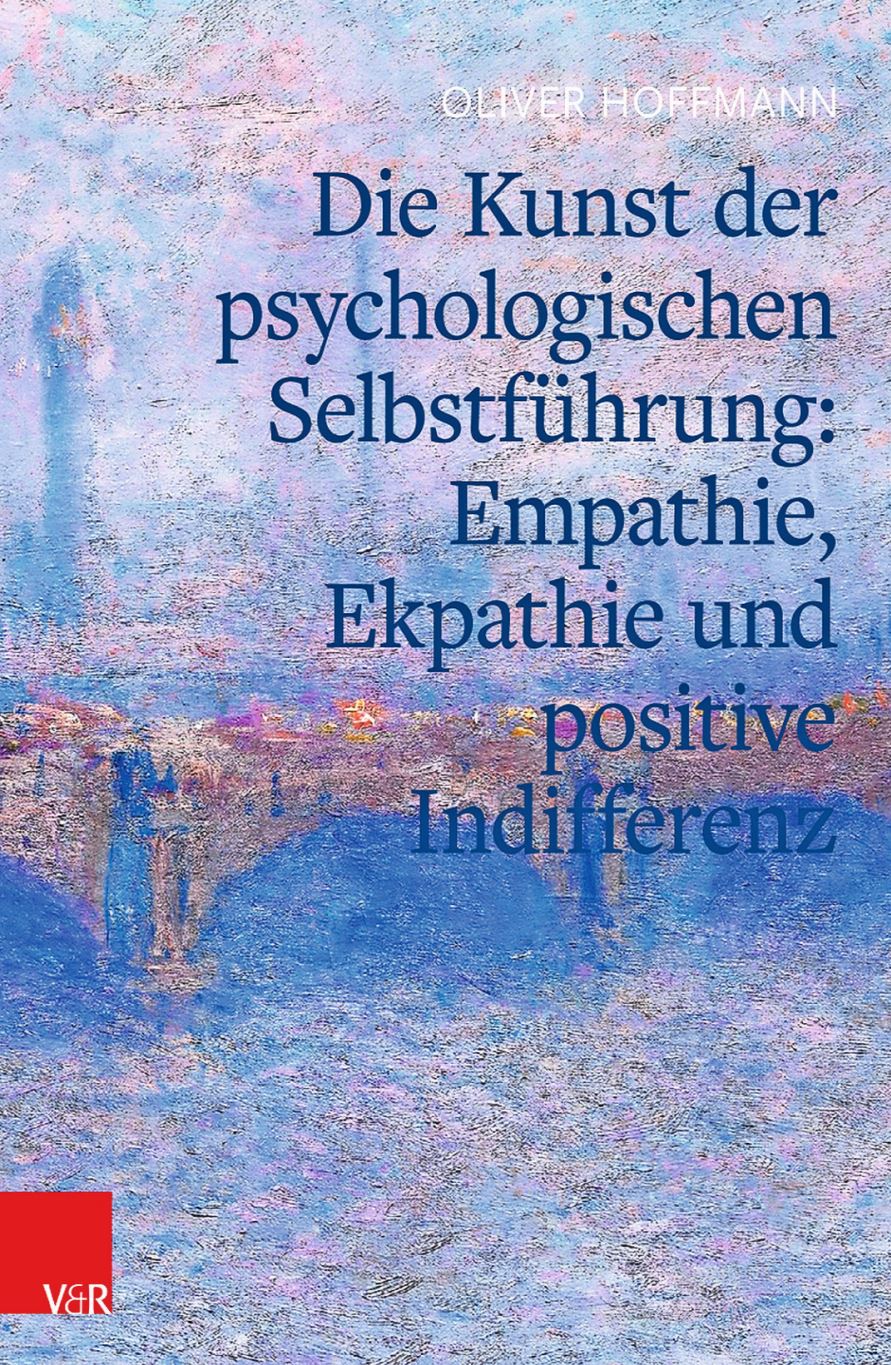
m&k In your book "The art of psychological self-management", you describe empathy as the "moral imperative" of our time. Would you say that our society overvalues empathy - and if so, why?
Oliver Hoffmann: Yes, I would say that empathy is not only overrated in our present day, but overcoded. Empathy has gone from being a psychological skill to a moral badge: Those who sympathize are considered good; those who differentiate are considered cold. This is a dangerous shift. Empathy is no longer used according to the situation, but is demanded across the board. This leads to a kind of obligation to respond, which in many social, professional and media contexts no longer even asks whether empathy is appropriate, helpful or psychologically viable in a specific situation.
It is particularly irritating that empathy is often confused with attachment. It is believed that the more one resonates, the more authentic the relationship is. In reality, excessive empathy can push people beyond their limits, drive them into secondary traumatization and make them vulnerable to manipulation. The exaggeration of empathy is therefore also a silent economy of exploitation: if everyone is always supposed to understand, some people always have to deliver. And these are usually the sensitive, the caring, the well-socialized women, the employees in care professions. My criticism is therefore not directed against empathy as such, but against its moralization. Where empathy becomes a permanent requirement, people lose their right to inner distance - and thus to psychological sovereignty.
How did you come up with the term "ecpathy" - and how does it relate to classic concepts such as emotional intelligence or resilience?
The term ecpathy was originally coined by Spanish psychiatrist Luis de Rivera, who introduced it into the psychological debate in the early 2000s. De Rivera wanted to create a counterweight to the inflationary use of the term empathy - not to devalue empathy, but to complete it.
In his clinical studies, particularly in the field of psychotraumatology and burnout research, he observed that excessive empathy in therapists, doctors and nurses leads to exhaustion, identity diffusion and secondary traumatization. He therefore defined empathy as the "conscious ability not to take on other people's emotions", as an active protective mechanism of psychological autonomy. While empathy enables the influx of other people's emotions, ecpathy describes the necessary counter-process of draining them out - a form of emotional hygiene that keeps closeness and distance in balance. I was immediately fascinated by this term because it highlights a deficit in current psychological thinking: we constantly talk about openness, resonance and empathy, but hardly ever about separation, filtering and self-protection. Yet empathy and ecpathy are not opposites, but two movements of the same psychological system - inhalation and exhalation.
In my further theoretical development, I have detached ekpathy from its purely therapeutic context and developed it into a universal principle of inner economy: the ability to remain emotionally selective without becoming cold. Etymologically, ekpa-thie - from the ancient Greek ek ("out of") and pathos ("suffering, affect, experience") - refers to an escape from pathos, i.e. the conscious decision not to become emotionally absorbed. It is not an escape, but a form of conscious non-appropriation, a controlled closing inwards. When emotional permeability is considered a moral virtue, it is almost subversive. In relation to classical concepts, ecpathy can be described as the missing third instance. Emotional intelligence helps us to recognize and understand feelings. Resilience helps us to deal with and survive stress. Ecpathy decides which emotions we allow into our mental system in the first place. It is the preventative dimension of psychological self-management - the ability to consciously shape affective boundaries. Without it, emotional intelligence quickly turns into self-exploitation, resilience into compensation and empathy into moral blackmail. In this respect, I understand empathy as the foundation of emotional sovereignty: as a conscious, responsible form of saying no from within, which makes relationships possible in the first place because it prevents overwhelm. It is not a contradiction to compassion, but its condition.
You talk about "emotional sovereignty" as a future skill. What skills should education and business promote in order to develop this ability in a targeted manner?
If we really take emotional sovereignty seriously as a future competence, then it is not enough to offer mindfulness courses and resilience training. We need to start earlier and deeper. Firstly, we need differentiation skills: the ability to differentiate between our own feelings and those of others, to separate secondary from primary emotions and, above all, to recognize the source of an emotion.
Many people are not unsovereign because they "feel too much", but because they don't know whose feeling they are feeling. Secondly, language skills are needed. If you can't verbalize emotions, you can't regulate them. We have a huge lack of language around emotions in organizations, which is why there is so much moralizing. Thirdly, distancing skills are needed: the ability to switch to an observer position when emotions are involved without leaving the relationship. This can be taught - through role play, supervision and reflective feedback formats. Fourthly - and this is often underestimated - institutionally protected zones of unavailability are needed.
No one can be permanently confident if they are constantly being emotionally addressed. Sovereignty needs breaks, otherwise it becomes a façade. Education and business should therefore not only teach skills, but also create structures in which non-permeability is permitted.
"Ecpathy is the 'conscious ability not to take on other people's emotions'."
To what extent is your concept of positive indifference compatible with modern leadership ideals such as servant leadership or empathic leadership - or does it run counter to them?
I don't see a contradiction here, but rather a necessary addition. Servant leadership without positive indifference leads to leadership dissolving into complacency. Empathic leadership without empathic correction dumps all the emotions of the organization on the leader and then wonders about burnout at the top.
Positive indifference does not mean that I do not care about people, but that I do not make my inner flexibility completely dependent on their emotional fluctuations. In leadership, this translates into a very simple but rarely practiced attitude: "I see you, I take you seriously, but I won't live your feelings." This creates leadership that touches without being taken over. Servant leadership needs precisely that, because otherwise servant leadership becomes selfless self-abandonment. Empathic leadership does the same, because empathy without boundaries ultimately centres the organization around the loudest feelings, not the factually correct decisions.
Positive indifference is therefore the invisible spine of modern leadership: it holds, but it is not loud about it.
You emphasize that ecpathy does not mean coldness, but self-respect. Where do you draw the line between healthy detachment and emotional avoidance?
The boundary is where the relationship with the other person is still possible. Healthy boundaries say: "I'm here, but I won't let myself be swallowed up." Emotional avoidance says: "I am not there so that I am not touched." In ecpathy, I remain accessible, I remain approachable, I perceive the other person - but I decide which parts of their affective material I integrate into my system. Avoidance, on the other hand, breaks off contact or obscures it: you take refuge in irony, over-intellectualization, cynicism or permanent preoccupation.
A very practical differentiation criterion: after healthy detachment, I feel clear and present. After avoidance, I feel untouched, but also empty or disconnected. Ecpathy strengthens self-esteem because it says: "My psychological capacity is valuable." Avoidance weakens it because it says: "I can't stand life." This is a fundamental difference.
Your book combines philosophy, psychology and spirituality. In your opinion, which discipline offers the most fruitful approach to emotional sovereignty?
Each discipline provides a different organ. Philosophy provides the conceptual organ: it allows us to precisely distinguish phenomena of interiority instead of letting them blur into everyday psychology. Psychology provides the diagnostic organ: it shows which patterns, bonding experiences, traumas or transference lead to people getting too involved or not getting involved at all. Spirituality - I don't mean esotericism here, but practiced, contemplative traditions - provides the organ of experience: it makes it possible to experience the state that I call "quiet clarity", i.e. presence without entanglement. If I had to choose, I would say that the quickest and most fruitful approach is the combination of psychological self-enlightenment and spiritual practice. Philosophy makes the whole thing sustainable because it provides the language and the concept. Pure psychology without spiritual experience often remains reparative. Pure spirituality without psychological self-enlightenment quickly becomes a workaround. Only triangulation brings sovereignty.
"Empathy as a moral badge: those who empathize are considered good; those who differentiate are considered cold."
You refer to Stoicism and Buddhist equanimity (Upekkhā). Which of these two traditions has had a greater influence on your own way of thinking?
I have adopted strictness from Stoicism and softness from Buddhism. Stoicism taught me that a person can only really dispose of their inner self, so that setting a boundary is initially an act of reason: "This is within my power, this is not." This is essential for the modern idea of boundaries. Buddhist equanimity has taught me that even rational control can be too much, that there are states in which I do not actively set boundaries, but in which phenomena are simply allowed to come and go without me tying them to my self-worth. These two lines meet in the "art of demarcation": the Stoic distinction between what I can influence and what will happen to me, and the Buddhist renunciation of attachment. If you like: Stoicism has sharpened my concept, Buddhism has softened my tone.
If empathy, ecpathy and positive indifference form the "regulatory triangle" - can one of these three attitudes be overemphasized, and what risks does this entail?
Yes, the triangle is meant to be dynamic, not static. Overemphasized empathy sucks you dry; it leads to compassion fatigue, to parentified leadership, to over-therapized teams. Overemphasized empathy makes relationships weak; it can tip over into intellectualized distance or unapproachable professionalism, which is clear but no longer warming. Overemphasized positive indifference, on the other hand, can tip over into arrogant untouchability; it then becomes spiritually cloaked indifference. The risk always exists when an attitude is no longer understood as an attitude, but as an identity. This is precisely what the regulatory triangle wants to prevent: It does not say "be empathic" or "be ecpathic", but "be able to do both - and choose according to the situation". Psychological maturity is not demonstrated by the fact that someone always empathizes, but by the fact that they can control when and to what extent they empathize.
How can emotional sovereignty be practically cultivated in a digital, hypermediaized world - especially in the face of algorithmic manipulation of emotional content?
The first step is disenchantment. We need to realize that our emotions are now part of an attention market. Platforms make money from the fact that we are outraged, moved, triggered - not from the fact that we are calm and clear. Once you have understood this, you can start practising digital ecpathy: not reading every story, not letting in every suffering, not commenting on every picture, not jumping on every outrage. This is not cynicism, but self-protection. In practical terms, this means: fixed time slots for media consumption, consciously curated sources, deliberate "silence formats" in everyday life (writing, walking, doing nothing) and above all: the ability to notice emotional contagion before it becomes identitarian. A simple sentence helps a lot here: "This is not mine." If I can learn again to say "This is not my feeling, even if I am feeling it right now", then I can remain confident in a noisy, affective world. Without this practice, we are emotionally ruled by algorithms.
"We have a huge lack of language around emotions in organizations."
You speak of an "ethics of feeling". What moral guidelines result from this for interpersonal relationships or leadership contexts?
An ethics of feeling means, first of all, that feelings are neither absolute nor relativized. They are true - but only for those who feel them. For relationships, this means: I take your feelings seriously, but I don't make them my job. For leadership, it means: I acknowledge emotions in the system, but I don't manage according to moods, but according to meaning. In moral terms, this means: I do not instrumentalize emotions (neither for manipulation nor for blackmail), I take responsibility for my emotions and I do not impose my emotional interpretation of the world on others. Such ethics protect against emotional moralism - in other words, against the attitude: "Because I am affected, you have to behave." It leads to more mature relationships because it reconnects emotion and judgment.
Your book suggests that emotional freedom does not mean control, but "quiet clarity". How can this state be trained or taught?
You can't prescribe it, but you can make it possible. "Silent clarity" arises when perception is sharpened, reactivity reduced and language refined. This can be achieved surprisingly well through regularly practiced self-observation: diary forms in which not only events but also feelings of others are noted; short contemplations in which one learns to see emotions come and go; dialog formats in which one names feelings without making them a yardstick. It is not the state that can be taught, it is the discipline of repeatedly putting oneself in this state that can be taught. Organizations need role models for this: Managers who accept emotional appeals but do not jump up and down. In therapeutic or coaching contexts, spaces are needed in which non-reaction is not interpreted as coldness. Silent clarity is ultimately a way of practising - like making music. You don't finish, but you get better.
"Ecpathy strengthens self-esteem because it says: "My mental capacity is valuable."
In conclusion: What do you hope will be the social impact of your book - a personal change in awareness or a cultural paradigm shift in dealing with emotions?
I don't expect a book to change a culture immediately. But I do think it is necessary for us as a society to close a blind spot: We have learned to open up, but not to close down. We have learned empathy, but not ecpathy. We have liberated emotions, but not integrated them. If the book helps people to stop thinking of their detachment as selfishness and start thinking of it as adult self-care, a lot would have been gained. If it also helps companies, educational institutions and management to realize that not every emotional imposition creates a moral obligation, then that would indeed be a small paradigm shift. Ultimately, I am interested in a more mature, more differentiated emotional economy: less pathos, more clarity. Because freedom does not begin where we feel everything, but where we can choose what we want to feel.
Prof. Dr. Dr. Oliver Hoffmann
He is a business psychologist, author and board member. His claim: "If you don't know what to do, come to me."
Book cover: zVg
Column: The potential of doubt
Instead of pathologizing the imposter feeling as a weakness, we should interpret it as a sign of active change. It’s a signal that we’re in the process of driving change and challenging the status quo.
Aissu Dallo
-
February 25, 2026
Aissu Dallo. picture: zVg
At the end of last year, I received a request from the Federal Center for Cultural and Creative Industries. As part of a congress, a panel was to be held with the title "Future entrepreneurship - creative tech as the key to change and growth". The Minister of State for Culture and the Media would be present and they would be very happy to have me as a panelist. My first reaction to this request was a feeling that I had actually thought I had overcome after many years as a speaker, panelist and moderator. Instead of reading the invitation as a confirmation of my expertise, I began to look for the error in the system. Was there a mix-up here? Were the people in charge really aware that I was the owner of an advertising agency? Of course there was no confusion. The panel talk went extremely well and I was able to talk to many guests afterwards who, inspired by what I had to say, wanted to talk to me.
For the first time in many years, I had simply been confronted with a phenomenon known as imposter syndrome. Imposter syndrome, or impostor syndrome, describes the conviction that one has not earned one's own success. Those affected do not attribute their achievements to their own competence, but to external factors such as chance, luck or sympathy. The term was coined in 1978 by psychologists Pauline Clance and Suzanne Imes, who observed that highly qualified women in particular tended to attribute their successes to external circumstances instead of internalizing them as their own competence. Language creates reality. The coining of the term "Imposter Syndrome" was an important step in feminist research, as it turned a supposedly personal feeling into a collective reality. But as valuable as the research on this topic was, the choice of words was misleading. The term "syndrome" implies a clinical disorder that does not exist. The message: the problem lies with you. You are not self-confident enough. You need to work on yourself.
Current sociological research is shifting the perspective from the individual to the system. For women and marginalized groups in particular, the feeling of being an impostor is often a reaction to a lack of belonging and the lack of a welcoming culture in a system that clings to old structures. When people move in spaces that were not historically designed for them, they feel the resistance of the structure. When role models are absent or one's own competence is constantly and subtly questioned in everyday life, the resulting doubts are not a "syndrome" but the result of a centuries-old narrative. Defining this reaction as "insecurity" is a form of structural gaslighting. It individualizes a problem that is actually inherent in the nature of our society. I would therefore like to suggest another perspective: perhaps the absence of absolute self-confidence is not a deficit at all, but precisely what modern role models need.
While unquestioned self-evidence often leads to a loss of reality, doubt leads to reflection, which in turn leads to empathy. Those who question themselves develop a finer sense of the barriers that others also face and, at best, ask themselves why it should actually be desirable to fit perfectly into an outdated grid.
So instead of pathologizing the feeling of imposter as a weakness, we should interpret it as a sign of active change. It is a signal that we are initiating change, challenging the status quo and thus taking the first, important step towards making spaces more inclusive.
Roland Ehrler: "Success spurs us on"
Roland Ehrler will step down as director of the SWA at the end of 2026. In an interview with m&k, he reflects on his years with the association and explains why the SWA Annual Meeting is now called SUMMIT.
Anna Kohler
-
February 25, 2026
Roland Ehrler set the tone at SWA for 14 years. He is taking early retirement at the end of 2026. Picture: zVg
m&k The SWA Summit: A new name, a new president, where is the SWA heading?
Roland Ehrler It is indeed fitting that we are giving the previous annual meeting a new name, "SWA SUMMIT". This is now that we have had a new president in Jan De Schepper for a year. However, this does not mean that everything will be different now! Rather, the new name fits the content and audience of our event even better. After all, the event has long been regarded as the "top meeting in the Swiss advertising market". The fundamental orientation of the SWA is therefore not changing at present.
The claim is "The New ROI". The "I" does not stand for investment, but for impact. Could you explain that, please?
Well, what we mean by the new ROI and return on impact will then be presented by our speakers on stage at the SWA SUMMIT. Our aim was to discuss how advertising can generate sufficient attention and impact in the target group in today's world. So first ROI with impact and only at the very end ROI with investment. In the second part of the SUMMIT, we will also ensure a lasting impact at the stand-up dinner, so that advertising clients, agency and media representatives can once again engage in extensive discussions.
Who has been invited as a speaker this year and why?
We always invite our speakers independently and only committed to the topic. With Mike Follett from Lumen Research, we first have a leading expert on attention research on stage. Then Prof. Dr. Sven Reinecke will give us a scientific perspective on ROI. And last but not least, Dennis Lück, a creative personality, will offer a completely different perspective.
Why is the SWA relevant for the industry and why is it becoming increasingly important?
As mentioned, it was the representation of the interests of advertising clients that prompted the founding of our association in 1950. This has not changed to this day. The SWA can act on behalf of its members at national level and at the same time meet the challenges of the market in an international association with the umbrella organization WFA (World Federations of Advertisers). After all, more and more advertising money is flowing to the international platforms, which is why such an association of national and international federations is becoming even more important! At the same time, we in Switzerland have strongly adapted the SWA to the needs of its members over the last 25 years and now offer many services, added value, further training and an exchange of ideas among members. This has been well received by marketers in companies, as the rising membership figures in recent years show. This success spurs us on to become even better and more relevant in the future.
You will be stepping down as Director of the SWA at the end of 2026. Do you already have plans for the time after that?
This year, I started the 14th year of the association with a crying and a laughing eye. Now that it is clear that 2026 is my "farewell year", I always get a little emotional at the thought. Especially when I think about no longer working for the SWA and the many beloved members. At the same time, I am looking forward to my planned pre-retirement and the few mandates that I will still hold for the SWA until 2028. I can't yet say exactly what I plan to do with my free time, it's still far too far away! It will certainly include a few vacation trips and other things I've had to do without in recent years.
Is there any news about your successor yet?
With the communication about the changes in the SWA, we placed a job advertisement last November and numerous people applied to our President for this association function. I can now say that the recruitment process was successful and we have found a person. We will communicate everything else in due course. At the same time, I will still be working for our members and partners until the end of the year. With this in mind, I look forward to many encounters.
SWA Summit
On March 19, advertising clients, agency and media representatives will meet at the SWA Summit at Stage One in Zurich.