
Eruption of young idea volcanoes
What does it look like when young creatives from all over Europe compete to create? The winners of best YET and their work are covered by the press throughout Europe. But how does the European creative elite work? How does the jury judge? Advertising Week took a look behind the scenes at the eighth Best Yet in London.


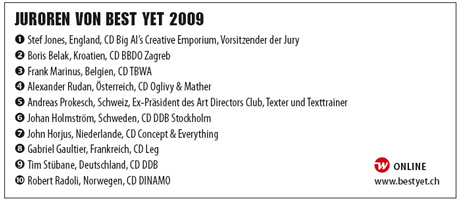
Thursday, May 7, 12 noon local time, London Islington. The 19 participating teams, country delegates and media representatives from ten countries arrive at London Art House. Croatians mingle with English, Germans with Dutch, French with Swedes. The Swiss delegation, which has traveled to London sponsored by Publicitas Publimedia, also explores the terrain: the two creative teams Bettina Klossner (OgilvyOne) and Laurie Morard (Advico Young & Rubicam) as well as Silvio Seiler (Wegelin & Co., Privatbankiers) and Oliver Schaich (freicom), as well as delegates Toni Vetterli from the Swiss Press Association and Marco Hendriks from Publicitas Publimedia, and Andreas Prokesch, former president of the Art Directors Club, copywriter, text trainer and one of the Best Yet 2009 jurors.
The mood is relaxed and full of expectation. What task will the young creative talents be given this year? The answer is clear at 2 p.m.: within 24 hours, they have to develop a newspaper advertisement for World Literacy Day, which takes place on September 8, 2009. It is being organized by Room to Read, an organization that aims to give children access to education and literature. A complex task, as the advertisement has three intentions: to promote the literacy day, to position the Room to Read brand and to fundraise for Room to Read. The young creatives have to scribble the ad. They are only allowed to use the Apple they almost all have with them for research. How do they get started?
Serious with fun
The Swiss teams retire for a conspiratorial meeting. They are joined by juror Andreas Prokesch and the delegates. The participants can ask the judges for advice on how to implement their work. However, the judges are not allowed to influence the creative ideas. Not so easy: Andreas Prokesch is practiced in only giving factual advice. The delegates, on the other hand, have to constantly bite their tongues to avoid bursting out with their own ideas. The process that is now taking its course is too captivating.
In a competition like Best Yet, it is important to approach the task seriously without losing the fun because of all the pressure. Prokesch knows this and reassures: "You have time. Let your thoughts run free and don't restrict them immediately. Don't think in terms of advertisements, but focus on the press aspect." Prokesch also advises not to tense up when searching for ideas: "You won't get the brilliant idea in a meeting, but in the toilet, in the shower or in your sleep. You can't force a good idea." The professional has spoken.
Relaxed thinking
Bettina and Laurie set up in the Rococo Room, Oliver and Silvio in the Baroque Hall. In each of the lovingly and inspiringly designed rooms of the Art House, workstations are prepared with everything the creatives need: paper and pens. Now all you can hear are clattering computer keyboards, scratching pens and muffled conversations, in all languages and with lots of Øs - the Nordic countries are strongly represented at this year's Best Yet. Every team is looking for THE idea. After an hour, the first sketches have already emerged here and there. The two Swiss teams have very different ideas that you can watch grow. Prokesch lets his youngsters work. "It's important that they now think in many directions and also think through approaches that seem strange," he explains. But he keeps an eye on the tight timeline: "I already tell our teams when they have to commit to an idea. But a deadline doesn't make sense now. Tomorrow at noon it will be time to focus on an approach."
Despite the relaxed attitude, Prokesch wants to keep the four of them on topic: "You shouldn't make art. Art is too often not looked at. Stay close to the core topic. The ad has to work within seconds." After just two and a half hours, the program includes a cooling off session for the hot brain coils: a city tour through the windy London Main afternoon. The young creatives, who are still pondering the ideal subject in view of the London beauties in stone and hot pants, at least do so in an oxygen-rich and cheerful atmosphere. Before and after dinner and a nightcap, the ideas continue to grow. "We worked on our idea until about two o'clock the next morning," reveals Oliver Schaich.
Fresh air for ideas
The two Swiss teams work in the hotel on Friday. "Please do not disturb" is signaled by hangers on their door handles. Every now and then, a door opens to reveal that Bettina, Laurie, Silvio and Oliver are talking to each other and discussing their ideas with Andreas Prokesch. Prokesch's wish for the two Swiss teams to act as friends rather than competitors in the competition has been fulfilled. "The four of them wanted to look at their ideas together," he says later. "I was very happy about that. There's never been teamwork like this before."
At around 1 p.m. local time, the Swiss teams drive over to the Art House to put their chosen idea on paper. The four of them also have to prepare a two-minute presentation of the subject in English. "I have a good feeling about our idea, and Laurie and Bettina's idea is also great," says Oliver Schaich on the way to the Art House. That's right. Silvio and Oliver will be presenting a newspaper without text. They want to convey what it's like when you can't read. The letter-free newspaper would be published the day before World Literacy Day to draw attention to the event. Laurie and Bettina have given each letter of the alphabet a value in euros. For example, you can text "Independence" to a number and donate the amount calculated from the letter combination to Room to Read. Despite the great ideas, the two teams are very excited. "But I'm excited too," says Laurie. "And I'm really looking forward to seeing what the other groups come up with." The other 17 teams of two were selected from 450 teams in country-specific preliminary rounds. The young European creative elite. The tension is rising.
Tense anticipation
When the Swiss delegation arrives at the Art House, the air is crackling. Concentrated work is going on everywhere. "Stay away from the other teams now and don't get distracted," warns Prokesch. "Now you have to get it done." The deadline is 3.30 pm. Two and a half hours to go. The first team has already finished their subjects by 1.30 p.m. and asks for cardboard and spray adhesive. Silvio and Oliver are getting hectic. This is largely due to the presentation, during which they have to explain their design in English. Prokesch reassures them: "The other teams don't speak English as their first language either. Before you start, wait until the audience is with you. And don't forget to smile: you're having fun in this competition." Prokesch does his best, but in the last few minutes before the presentation, nervousness is a thing of the past. It's not just the two Swiss teams who are excited. Apart from a few Frenchmen who are relaxed and smoking outside the door, there is a sense of hecticness or even panic among all the groups. After all, it's all about who is the best young creative team in Europe - and a trip to Cannes for the Cannes Lions Advertising Festival. Nevertheless, Prokesch radiates calm and maintains his eye for detail. Oliver wears a shirt with text printed on it. "Put a shirt on over it," Prokesch advises him. "The text on the shirt competes with your idea." You have to come up with something like that first.
Tough selection
After 38 minutes, 19 times 24 hours of work are presented. Anyone who takes longer than two minutes to present their subject is cut off by the squawking of a horn. The jury retires for evaluation. Each juror has three votes, which are used to select eight works in the first round of judging. The best three subjects are then selected from these eight. "As a juror, I don't see myself as a representative of the Swiss teams," says Andreas Prokesch. "Of course I would be delighted if one of our teams won, their ideas are really good. But if one idea is better, it's the enemy of the good ones." After 45 minutes, the result of the tough selection is clear: the subject of Belgians Ross Mc Currach and Arnaud Bailly from Saatchi Brussels has the most Post-its stuck to it. This makes them the best Young European Team 2009, with Job Damien Bakker and Paul van Raak from the Netherlands in second place and Philip Frendberg and Tobias Gronberg from Sweden third on the podium. "The standard of all the work is excellent," said a delighted Stef Jones, chairman of the jury.
Moving advertising
"We are surprised that we won," say the two winners. "The many super-creative teams presented great work. We were even a little scared to go up against such competition with our subject." Mc Currach and Bailly followed the idea that education prevents hardship and is therefore a good pill against HIV infection, for example. They presented the "pill" under the slogan "We found a cure for HIV" in the form of two books facing each other. This convinced the international jury. "We were looking for the simplest possible subject," explain the two winners. "And then we waited for an idea to come to us, not for us to come up with an idea. That's how we always work." Sounds good - even if we've heard it somewhere before.
Although Oliver Schaich and Silvio Seiler's subject was shortlisted by the jury, it did not make it into the top three. Bettina Klossner and Laurie Morard's work was also not awarded a prize. The four of them are taking it in their stride: after all, they are among the top young creatives in Europe. They can be proud of this even without gold, silver or bronze.
Anne-Friederike Wilhelm
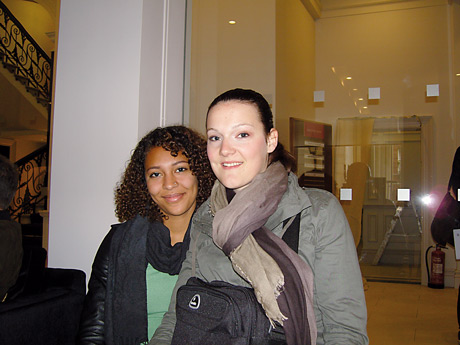
Team 1: Laurie Morard and Bettina Klossner.
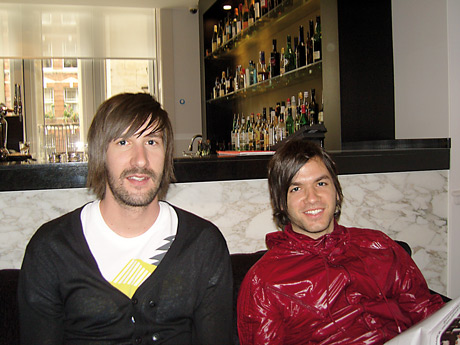
Team 2: Oliver Schaich and Silvio Seiler.
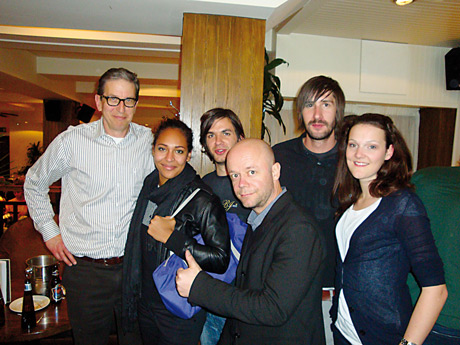
Juror Andreas Prokesch, Laurie Morard, Silvio Seiler, Marco Hendriks from Publicitas Publimedia, Oliver Schaich, Bettina KLossner.


