
In 57 percent of startups, Christmas cards are a matter for the boss


Christmas greetings are part of good manners in the business world - after all, they express trust and appreciation towards customers and business partners. For small companies and startups in particular, Christmas mail is therefore an important marketing tool that is carefully cultivated every year. The fact that a lot of work and thought can go into a small card with just a few words is often only known by those who select the cards, formulate the Christmas greetings and arrange for them to be sent.
So in the startup world, who takes care of organizing the business Christmas mail, how many cards are sent out, when do they start planning? And how does it look in contrast with large companies and corporations? kartenmacherei surveyed a total of 1134 people and found out how the annual Christmas procedure goes in (Germany).
Large companies focus on business partners
Of the small companies and startups surveyed, 88 percent send Christmas mail to their customer base - meaning they are sent Christmas greetings even more frequently than business partners (85 percent).
However, the larger a company gets, the more the business partners come to the fore. Among companies with more than 500 employees, only 54 percent send Christmas cards to their customers, but 75 percent send them to their business partners.
Customer greetings are therefore of particular importance for small companies and startups. As a reason, it can be assumed that customer loyalty is of high importance, especially for freshly established startups. In addition, the customer base of small companies is probably still significantly smaller than that of large companies that have been established on the market for years.
The sports & fitness industry sends the most Christmas cards
How could it be otherwise - the sports and fitness sector is particularly active. With an average of 310 cards, startups and small companies from the sports sector send by far the most Christmas greetings. This is followed by the industry with an average of 246 Christmas cards. The marketing industry, of all sectors, brings up the rear with an average of just 76 cards sent out for the festive season.
This is far below the cross-industry average of 135 Christmas cards sent by small businesses each year. Surprisingly, most cards are sent by medium-sized companies at Christmas, an average of 355. Even large companies send significantly fewer, with an average of 291 cards.
Christmas cards are a matter for the boss
Someone has to do it - but who really takes over the organization of Christmas cards at small companies and startups? At 57 percent, it is the management at more than half of the companies surveyed. In 28 percent of small companies, the task is passed on directly to the management assistant.
What becomes clear when looking at the study results: The larger the company, the more likely it is that responsibility is delegated. While 14 percent of managing directors at medium-sized companies still take care of Christmas card planning, only four percent of large companies do. Instead, the assistant to the managing director, the marketing department, an internal graphics team or other responsible persons are more likely to be entrusted with the task.
Particularly in startups and small companies from thematically close industries, the management assumes responsibility for the Christmas cards: in companies from the arts and culture sector, for example, 83 percent of CEOs and from graphics & design 82 percent of them are responsible for the cards at Christmas.
Executive assistants are most likely to be tasked with organizing Christmas cards in the automotive industry (67 percent), engineering (56 percent) and energy (50 percent).
Marketing departments are most likely to take on the task in the fitness sector (40 percent) and industry (38 percent). Christmas cards are rarely the responsibility of internal graphics teams - most likely in the culture industry with eight percent.
The complete study results are available at www.kartenmacherei.de.
Large companies start planning significantly earlier than small companies
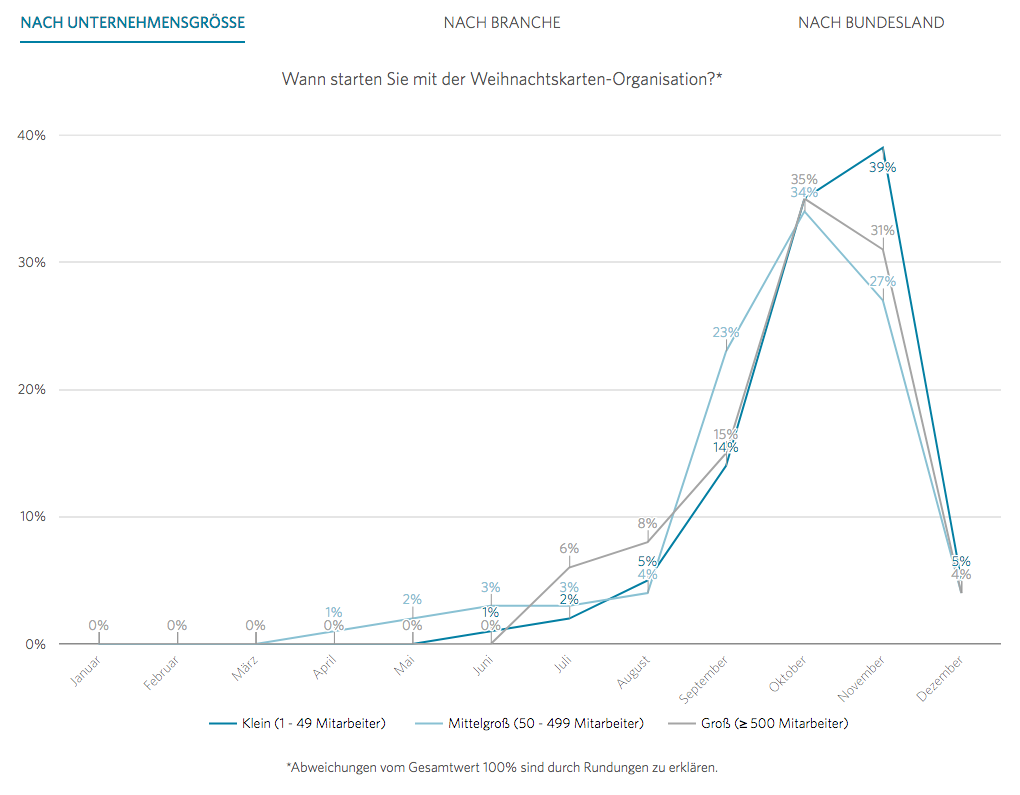
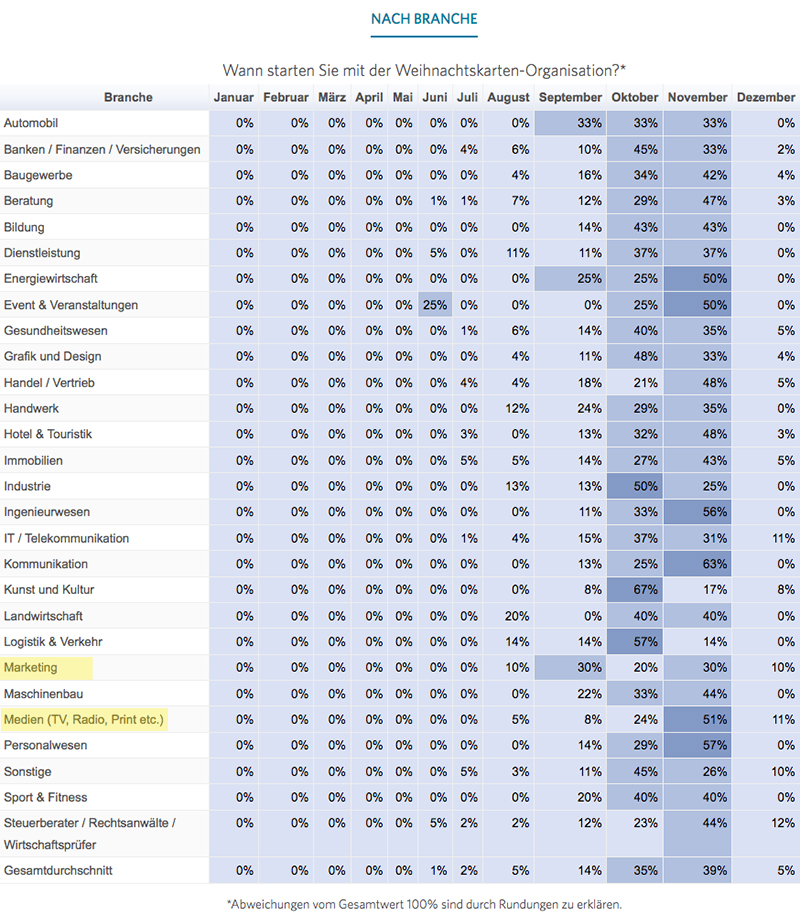
Most small companies (39 percent) start organizing their Christmas cards in November. Large and medium-sized companies, on the other hand, largely start planning as early as October (35 and 34 percent respectively). On average, therefore, small companies start planning their Christmas greetings later than their larger counterparts. Medium-sized companies stand out in September: one in five begins planning Christmas cards during this time. Among companies with more than 500 employees, a not insignificant percentage - six and eight percent - even start organizing as early as July and August, respectively. Of course, there are always those who plan "at the last minute". Among small companies, just under five percent do not start thinking about their Christmas cards until December.
The motif is the most important point in the design of business Christmas mail across all industries
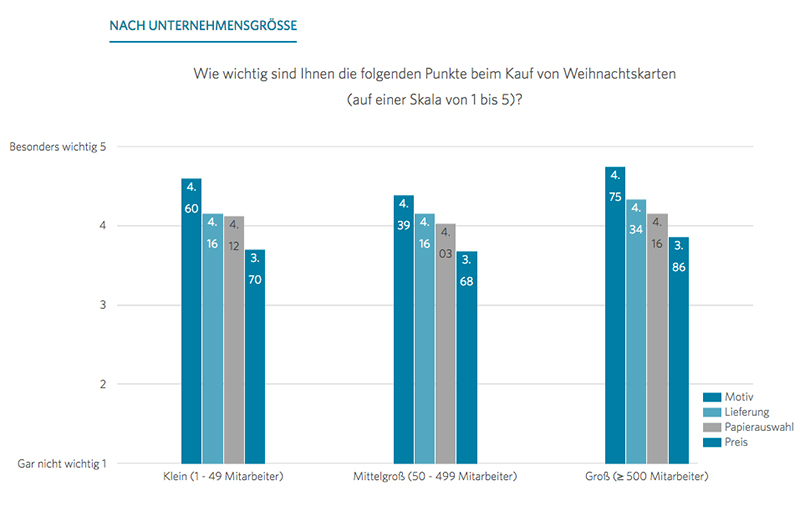
What factors are particularly important in the design and organization of business Christmas cards? Clearly the motif! Regardless of the company's size and industry, the visual appearance of the Christmas cards is the most important criterion. However, fast delivery and a large selection of paper are also crucial. Large companies seem to be stingier than their smaller counterparts: Price is of greater importance for companies with more than 500 employees than for small and medium-sized companies.
When comparing the corporate sectors with each other, some conspicuous features can also be identified. In the brand-oriented automotive sector, the motive is particularly important for all respondents, as is the use of the company's own color. On the other hand, only one third - and thus the lowest value among the sectors - consider a favorable price to be (particularly) important.
German trades can once again score with punctuality: Of these, most companies (just under six percent) state that fast delivery is not at all important - after all, this is also where the organization of Christmas cards is tackled the earliest. Less importance is generally attached to the integration of photos.
Only one percent of companies completely forgo print products
Printed Christmas mail is still part of good manners in many companies. But how important are print products in general for corporate communications? Is stationery still up to date, are brochures still distributed and event invitations printed, or have e-mails and websites replaced these products?
The study shows that business cards are the most frequently used print product, regardless of company size. They are used by 88 percent of small and medium-sized companies and 79 percent of large companies. Printed flyers and brochures as well as stationery are used by more than half of all companies.
Printed invitations to company and Christmas parties, on the other hand, play only a minor role in the startup world (15 and nine percent respectively). These are used more in large companies with more than 500 employees (29 percent).
However, the kartenmacherei survey shows that print products generally still have an important role to play for companies; on average, only four percent of the small companies surveyed, regardless of industry, do without print products.


