
75 percent of marketers can barely keep up with changing consumer demands
A recent survey by Goldsmiths and Adobe of European consumers and CMOs shows that inspiring customer experiences are the key to greater loyalty. Experience-focused marketers outperform their competitors by 14 percent.


Consumers are changing, the ecosystems of the digital economy are changing and the complexity of marketing is increasing. It is not always easy for marketing managers to stay on the ball: Around 75 percent of German marketers admit that they struggle to keep up with the rapid changes in consumer behavior. And they are not alone in Europe: Three quarters of their European colleagues are also struggling to keep up with the new consumer.
This is the result of the current Goldsmiths study "Reinventing Loyalty: The New Loyalty Experience", for which more than 5,000 consumers and around 130 marketing decision-makers from international companies were surveyed across Europe on behalf of Adobe.
The study shows just how worthwhile it is to keep an eye on the changing consumer with the following result: brands with a clear focus on the new requirements of today's consumers and a consistent experience business outperform their competitors' customer loyalty by a whopping 14 percent.
"Digital technologies have changed the traditional mechanisms of customer loyalty forever and present marketers with major challenges. The vast majority of them have immense difficulties in keeping up with today's consumers and their changing demands and needs. For brands, this means one thing above all: they must completely rethink their entire customer communication in order to keep pace with customers and address them in a relevant way. Our latest study shows that brands with inspiring experiences have a much more loyal and profitable customer base. Everyone else should carefully review their content and data strategies to transform into an experience business," says Stefan Ropers, Managing Director Central Europe at Adobe.
Strengthening customer loyalty with the right data and artificial intelligence
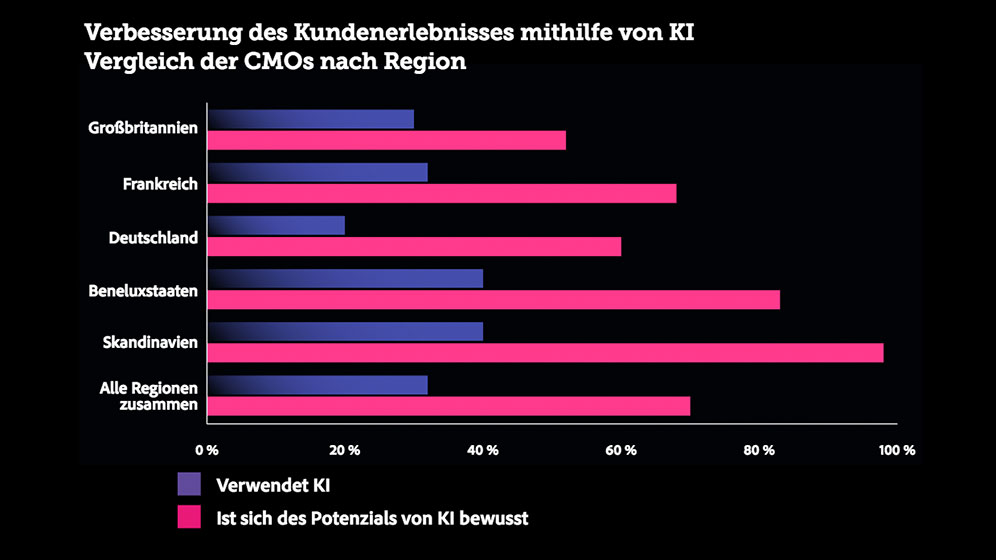
Almost two thirds of German consumers (65%, Europe: 61%) remain loyal to brands that tailor the customer experience to their requirements and needs. This customer wish is already being put into data-optimized practice by 63 percent of German marketers (Europe: 65 percent). However, the advantages of artificial intelligence (AI) are used by very few: Although 60 percent of German marketers (Europe: 69 percent) firmly believe that AI can sustainably promote customer relationships, only 20 percent (Europe: 32 percent) are using it to improve the customer experience. In general, 40 percent (Europe: 44 percent) believe that today's consumers are willing to disclose personal data about themselves. However, more than one in two consumers (59%, Europe: 76%) would like more transparency regarding the use of their data.
Chris Brauer, Director of Innovation at the Institute of Management Studies (IMS) at Goldsmiths, University of London: "Over 50 years of brand loyalty research has defined loyalty experiences that only partially describe today's customer experiences in a world of cultural and digital change. Our efforts to redefine customer loyalty clearly show that brands are now facing a new, much more self-aware and digitally savvy consumer who is looking for products and services that adapt to their individual needs. Companies that create added value through tailor-made experiences will be ahead in terms of customer loyalty in the future."
Consistent customer experiences at every location
With the right data, marketers are able to target consumers with added-value content at the right time and place. This data-optimized approach offers a great deal more convenience, especially when it comes to shopping, which 56% of consumers (Europe: 59%) consider to be particularly important. 77% of German marketers have already recognized this and ensure the greatest possible convenience online (Europe: 71%). Significantly fewer (57%, Europe: 58%) also offer their complete services on mobile devices.


