An algorithm learns to compose
When it comes to creativity, humans are still way ahead of machines. But the air is slowly getting thin: a learning algorithm developed by EPFL researchers writes pieces of music that imitate certain styles but are still as original as those written by humans.


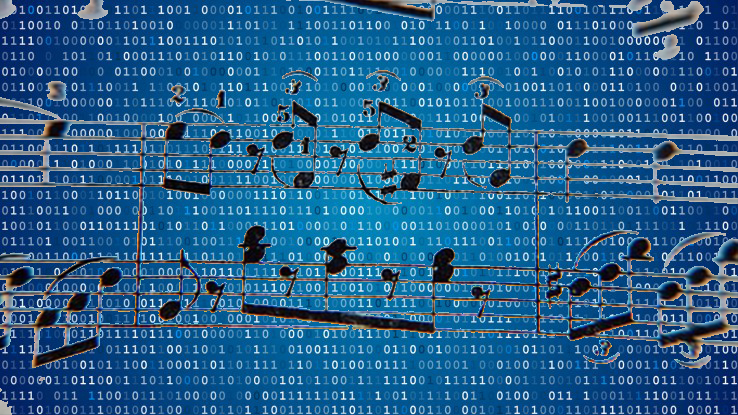
Computers have already surpassed humans in games such as chess or Go. Learning algorithms can even transform photos into imitations of works of art by well-known artists. But artificial intelligence is also catching up in another field that was previously a stronghold of human creativity: a deep learning algorithm developed at the Swiss Federal Institute of Technology Lausanne (EPFL) composes melodies.
Admittedly, the "Deep Artificial Composer", which Florian Colombo and Wulfram Gerstner from EPFL recently presented at the EvoStar conference, also imitates something that already exists. However, it does not produce plagiarized music, but rather pieces that are just as original as a human, the EPFL announced on Thursday. The algorithm writes notes and does not produce audio files.
Composing without theory
There are already several projects to teach artificial intelligence how to compose. These include algorithms from Google and from researchers at various universities around the world that produce jazz music or imitate works by Bach, for example.
Many of the existing machine composers are based on traditional music theory, wrote the EPFL. The algorithm now presented, however, learned to compose from scratch. Colombo and Gerstner fed it a data set of Irish folk and klezmer pieces, which it analyzed note by note and calculated probabilities as to which note would follow next and how long it would be. In this way, the "Deep Artificial Composer" created his own set of rules for these musical styles. However, the same would also be possible with any other style.
The researchers then had the algorithm trained on further pieces and improved its predictions. As soon as it could predict the following note with a hit rate of 50 percent and its length 80 percent correctly, it needed no further training and could compose similar but new melodies from start to finish, according to the press release. Human post-processing is not necessary.
The right amount of training
The right amount of training is important: too little leads to melodies that sound unconvincing even to amateurs, while too much training is not good either: then the newly composed pieces tend to be too similar to existing ones. But the "Deep Artificial Composer" also notices this by comparing his new work with his data set of existing pieces of music.
The algorithm is still in its infancy, as it can only generate monophonic melodies, according to the researchers. In the long term, Colombo says he would like to develop it further so that it can write scores for an entire orchestra.
So the air could one day become thin for human composers if machines write convincing music for video games, advertising or even entire films. (SDA)