Manifesto with seven demands for responsible retargeting
«Retargeting needs an upgrade,» says Stefan Bernauer, Director of DACH at Rakuten Marketing, as he publishes his manifesto outlining seven demands for responsible retargeting. He believes the advertising industry is called upon to adapt its technologies and campaigns to the new realities of online advertising.


"Since retargeting was invented as an effective method of addressing e-shoppers, the requirements of marketing managers on the one hand and the expectations of Internet users on the other have changed considerably," says Bernauer. Brand-compliant environments are becoming increasingly important for advertisers, as incorrectly set up retargeting can even damage a brand. At the same time, campaigns must be staged in such a way that consumers are interested in the brand message. Today's users are emancipated when it comes to the Internet and no longer accept clumsy advertising. According to Bernauer, the technological possibilities are there to meet these requirements. In his opinion, the advertising industry must finally readjust its retargeting practices as follows:
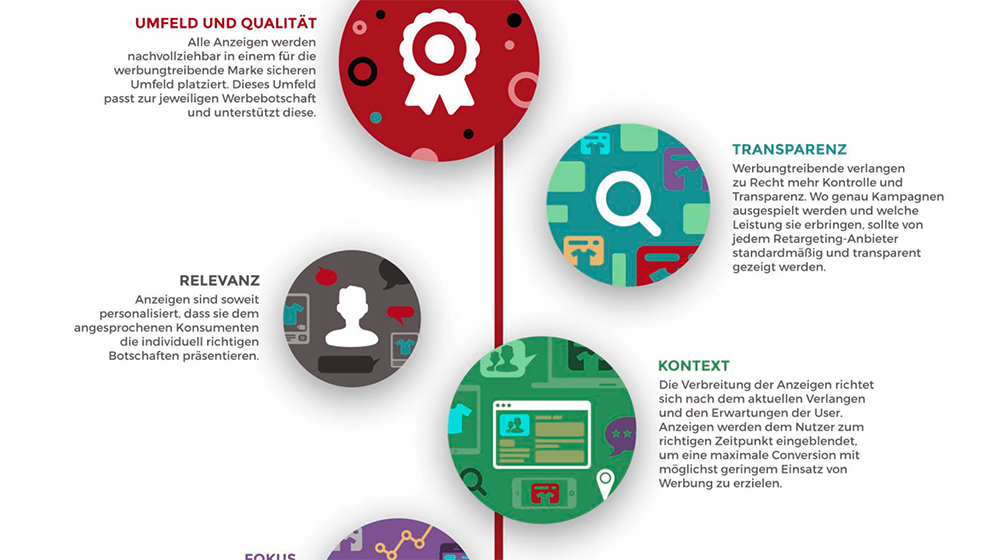
1) Transparency: Advertisers rightly demand more control and transparency. Where exactly campaigns are played out and how they perform should be shown transparently by every retargeting provider as standard.
2) Environment and quality: All ads are comprehensibly placed by the provider in an environment that is safe for the brand. The environment matches the respective advertising message and thus supports it.
3) Relevance: Ads are displayed in such a personalized way that they present the right individual messages to the targeted consumer.
4) Context: The distribution of ads by the retargeting provider is based on the current needs and expectations of the user. Ads are displayed to the user at the right time in order to achieve maximum conversion with the least possible use of advertising.
5) Focus: Campaigns are based on defined customer journey scenarios on the customer website. The advertising messages are then adapted to the corresponding scenario instead of spreading the same advertising message to all users. For example, prospective customers are shown a different ad to abandoners or existing customers.
6) Format diversity: Retargeting uses different advertising formats to counteract the saturation effect that quickly occurs with traditional retargeting with the same ad format.
7) Volume: Users are addressed at the right frequency and not as often as possible. Six to ten ads per campaign and day are sufficient. More than 20, as seems to be the standard, annoys users more than it encourages them to buy.

Bernauer: "The method of retargeting, which obviously makes sense for marketing managers, must be controlled in such a way that it firstly guarantees brand safety for the brand and secondly respects the needs and expectations of users. I call on all market players to join our manifesto and take retargeting to the next level of evolution."