Three augmented reality scenarios for retail
Kai Bösterling, Deputy Managing Director of Strategy at the German agency Delasocial, explains the three scenarios that augmented reality offers the retail sector.


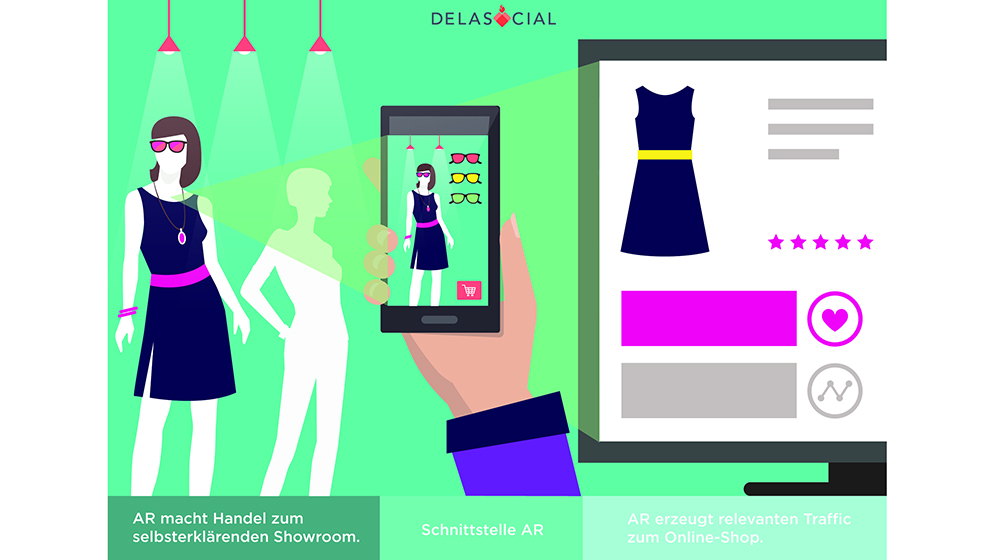
30 percent of retail companies are planning to implement augmented reality applications in their stores this year, according to a study by JDA and PwC. Augmented reality (AR) enriches the real world with additional digital information such as images, text, videos or graphics. An AR app and a smartphone display make this new user experience possible.
Scenario 1: AR becomes a shopping trip navigator
Who hasn't experienced the confusing maze of shelves in supermarkets, department stores, drugstore chains or DIY stores? AR can help here. The customer selects various tours in the retail app - from the "let yourself be inspired tour" to the top products from a specific segment to a route based on a shopping list. The smartphone shows the route through the store. Virtual secondary placements and other recommendations accompany the customer on their way to the virtual checkout.
Scenario 2: AR makes the salesroom infinite
The stationary sales area grows into infinity thanks to augmented reality. Whether color variants, different sizes or special designs - customers can configure their desired item in the store with the right AR application, experience it live, add it to their wish list or order it straight away. Either directly on site or at home on the sofa. Retailers that offer particularly large goods with long delivery times, such as furniture stores, benefit disproportionately from the virtual extension.
Scenario 3: AR merges stationary and digital shopping worlds
With virtual extensions, bricks-and-mortar retail is developing into a showroom that drives online retail. If the sofa recolored using AR in the store is to the customer's liking, they can order it straight away on their mobile device. What's more, thanks to AR, the customer journey that the customer takes in the store is immediately digitized. Mechanisms that were once reserved for e-commerce, such as behavioural tracking, customer profiles, individual recommendations and personalized products, can now also be used in-store. Augmented reality thus removes the boundaries between offline and online and makes omnichannel retail possible.
Augmented reality will drastically change the shopping experience and purchasing decisions. This has already been confirmed by various consumer studies from the USA. According to a study by Interactions, 71% of US respondents stated that they would go to a retailer that offers augmented reality more often. AR is therefore becoming a differentiating factor in stationary retail.
Delasocial is an agency for creative digital brand communication with a focus on social media, content marketing, media and influencer relations. The 50-strong international team based in Hamburg and Berlin develops strategies, ideas and content to get consumers interacting with brands and products.
Sources cited:
Study by JDA Software Group and PwC, "CEO Viewpoint 2017: The Transformation of Retail", N = CEOs from a total of 350 international retail companies from the USA, Mexico, the UK, Germany, China and Japan, February 2017
Study by Interactions Consumer Experience Marketing Inc, "Retail Perceptions: The Impact of Augmented Reality on Retail", n = 1062 US-Americans, October 2016