
Internet use does not mean turning away from traditional journalism
IaKom has published the report of the online usage study "Swiss Media Sites" 2016 commissioned by the Federal Office of Communications (Bakom). The study concludes that Internet use does not mean a departure from classic editorial journalism, even if the offerings of global providers such as Facebook and Google, for example, are used significantly more extensively.


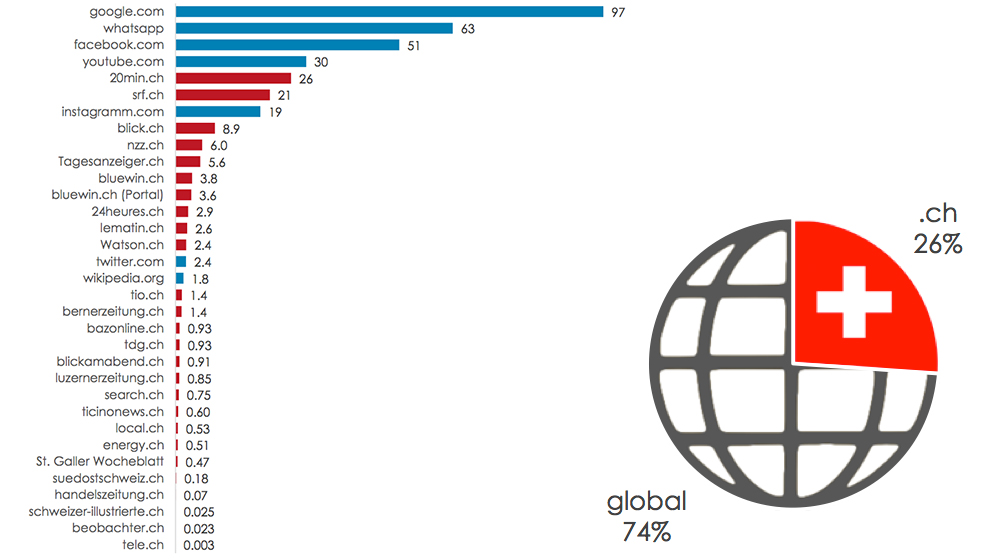
In summary, it can be said that global Internet offerings account for around three quarters of the usage time of the Swiss resident population. In addition to the classic .com sites (including Google and Facebook), this also includes Wikipedia.org and Whatsapp. One quarter of usage is attributable to the .ch sites. These primarily include Internet offerings from traditional media and Swiss search engines (such as Search.ch).
Men use the Swiss websites slightly more often, while women access the global offerings more frequently.Access to Swiss sites correlates positively with education. This means that Swiss sites are accessed more frequently with increasing education (low education 13% .ch, medium education 76% .ch and high education 68% .ch use). In German-speaking Switzerland, the proportion of users of .ch sites is slightly higher than in Ticino and especially in French-speaking Switzerland, at 30%.
The most extensively used Internet service is from Google.com. It is followed by the app Whatsapp, which was launched as a short message service and now belongs to Facebook. If Whatsapp and Facebook were counted together, their share would be higher than Google.com. Google is used more frequently, but for a shorter time per visit than Facebook. It can also be assumed that some of Google's offerings, such as Googlemail in particular, were not fully included in the respondents' answers. Youtube, another Google service, is in fourth place.
The first Swiss offering, 20min.ch, is in fifth place. It is immediately followed by the SRG offerings with an average of 21 minutes of use per week. Interrupted by Instagram, this is followed primarily by Swiss media sites and Swisscom's Bluewin.ch. The regional language offerings of Ticinonews.ch and Tdg.ch rank proportionately higher in their language regions than in the overall view.
Use of Swiss media sites
Of those surveyed, a total of 70 percent use the services of Swiss Internet sites. In German-speaking Switzerland, the figure is 72 percent, slightly higher than in French-speaking Switzerland (67%) and Ticino (62%). In comparison, the proportion of younger users aged 15 to 34 is slightly higher in German-speaking Switzerland (25 percent) than in Ticino (15 percent). In French-speaking Switzerland, users in the middle age group account for 28 percent. This proportion is minimally (not significantly) higher than in German-speaking Switzerland (27%) and Italian-speaking Switzerland (26%). In the oldest group of respondents, French-speaking Switzerland is marginally (but significantly) lower than German-speaking Switzerland and Ticino, both with 20 percent.
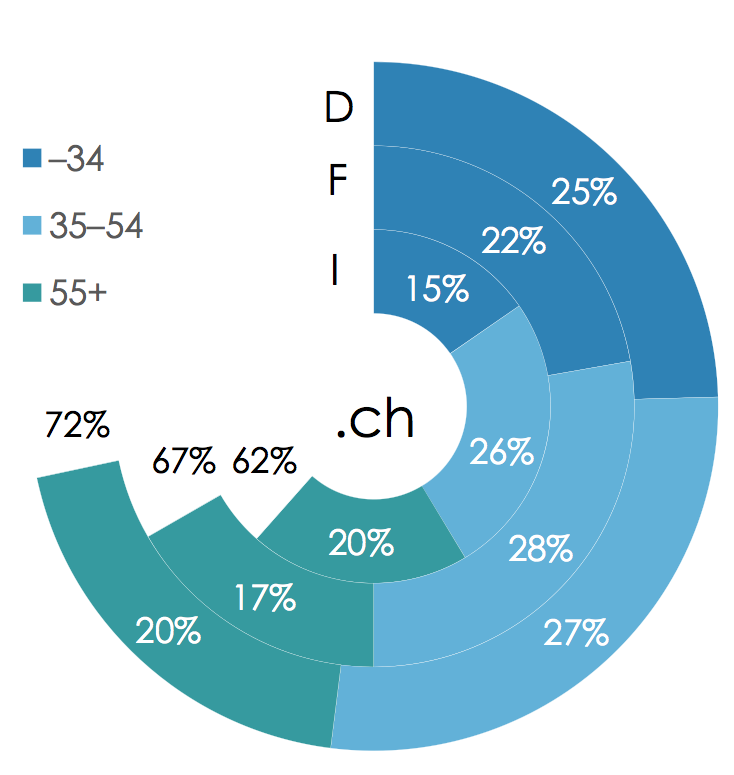
If the offerings of the other Swiss online services are included, the proportions rise minimally. In German-speaking Switzerland, the figure is 74 percent compared with the 72 percent use of .ch media sites. In French-speaking Switzerland, the difference is greater, with 75 percent overall use versus 67 percent use of media sites. In Ticino, the difference is smaller again with 66 percent overall vs. 62 percent for media sites.
More than half of the respondents (57%) use apps from Swiss media on smartphones or tablets. At 60 percent, the proportion is significantly higher in German-speaking Switzerland than in French-speaking Switzerland at 51 percent. In Ticino, at 35 percent, apps from Swiss media are used even less frequently. A comparison of the age groups shows that the middle age group uses apps more frequently than the youngest age group. This is due to the more frequent use of Swiss media in general (see also Fretwurst et al. 2016) and the more frequent use of tablets. The oldest group (55%) is on par with the youngest age group (54%). The use of Swiss media apps clearly differs between the educational groups. Of the most highly educated group, 61 percent use apps from Swiss media. In the middle education group, the figure is still 55 percent, and among respondents with the lowest level of formal education, it is 40 percent.
In German-speaking Switzerland, 60 percent of respondents use the 20min.ch website. Its counterpart in French-speaking Switzerland is still used by half of the respondents (51%). In Ticino, 20min does not play such a major role and accounts for 4 cases in the sample, i.e. 7 percent. In Ticino, Tio.ch is the most frequently used provider with 55 percent.
SRG's Internet services are used by a good two-thirds of respondents in German-speaking Switzerland and Ticino (37% and 38%). In French-speaking Switzerland, the proportion is 48 percent.


