"Believing that everything in the world can be measured has something to do with our tendency to manipulate"
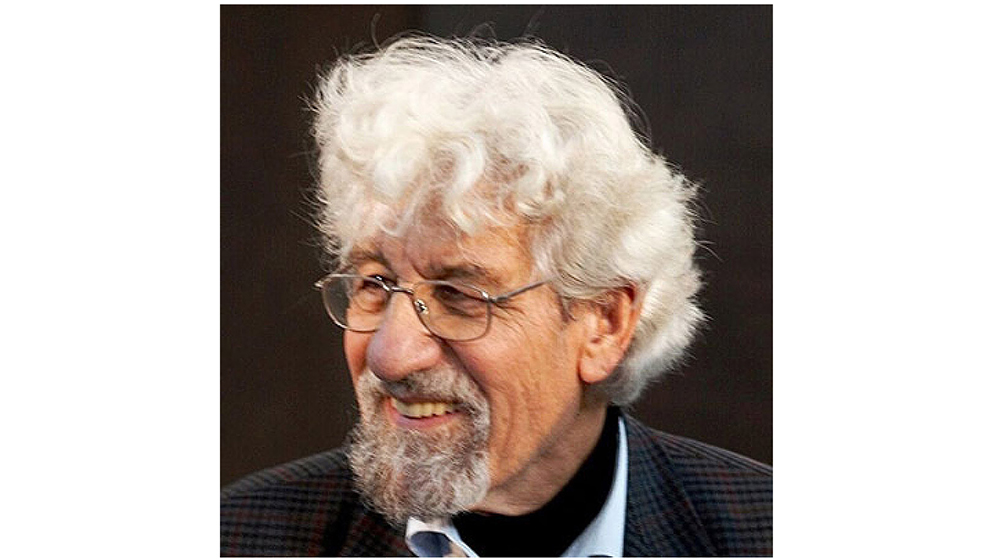
15 years ago, business journalist and Werbewoche author Werner Catrina conducted an interview in Basel with the renowned nuclear physicist and award-winning business ethicist Hans-Peter Dürr, who died in 2014. What Dürr had to say about the information society back then is still as relevant today as it was then.


In January 2002, the Internet and e-mails were established. However, the social network Facebook, which is used today for immense communication flows, was not founded until 2004, and Twitter began flooding the world with short messages in 2006. And today's ubiquitous smartphone only saw the light of day in 2007 at the US company Apple. This makes Dürr's comments on communication, the generation of knowledge and advertising all the more visionary.
Werbewoche: Are we on the way to a knowledge society?
Hans-Peter Dürr: I don't believe that we create something like knowledge by inundating ourselves with information, because knowledge is digested, processed information that is incorporated into existing knowledge. In this way, it becomes part of people and is reflected in their actions.
Are there recipes for generating real knowledge?
Only someone who has already communicated a lot will have the ability to extract the essentials from the flood of information. If I find 226 emails after two weeks of absence, that's exactly what I have to do. I skim through the senders and filter out the ten or twenty emails that are important to me, deleting all the others - my experience helps me with this. If people I know professionally or privately or family members send me a message, I definitely open it; that also has a lot to do with trusting the sender.
How do you generally deal with today's flood of information?
Today, many people are deafened and dulled, so to speak, by information overload. We don't know exactly what it means to recognize what is relevant, because there are no objective criteria for relevance. It's more like fitting a key. Everyone has to find out for themselves what information is important to them.
What is your general assessment of the age of communication?
Communication is the wrong word; it is mainly about the exchange of data. In my opinion, communication only begins when I consciously take in the information with a certain degree of concern, i.e. when it triggers an emotional reaction. If I store data and then spit it out again later, I am acting like a computer, only much less efficiently.
Isn't data transfer the lifeblood of the modern economy?
Where people process large amounts of data according to fixed criteria, their jobs are highly endangered, because computers can take over these functions. All work where something more complex is done in the selection process, in particular where the significance of a process has to be assessed, has a future.
Where does your skepticism about technology come from?
Technology should be there to serve people. Today, however, it is often about training people to fit the technology. Pressing plastic buttons is absolutely not a sensual and certainly not an erotic experience.
Are young people better at dealing with this flood?
If you are flooded as an inexperienced person, I fear you will hardly learn how to make a selection at all.
Does school knowledge help you find your way in the modern world?
Most of what you learn in training cannot be used immediately. However, once you have really understood something, this living knowledge can give rise to many new things that can be applied to all kinds of situations.
Can you elaborate on that?
When applying knowledge, we learn to recognize similarities. They serve us for future orientation. Similarity means discovering a generally applicable pattern, a structure. Real communication therefore requires building on what you already know and integrating the new into your existing knowledge. For me, the whole learning process is also largely a process of remembering.
What do you think of advertising?
So many resources are thrown away because the individual advertisement, the individual brochure is only noticed by a small minority. And every advertiser does everything they can to get Mr. Dürr not to delete his email.
How do you rate the Internet as a field of application for today's advertisers?
To me, the Internet seems like a department store that advertises endless amounts of stuff that I don't need. The surfer is guided to buy as much as possible. Of course, the Internet can also be very helpful in providing information.
As a skeptic, how do you deal with the abundance of advertising?
When we examine the frog's eye, we realize that it is blind to everything except what is moving. This is how the frog reacts to mosquitoes with lightning speed. So it uses the information in its environment very skillfully. If you look at the evolution of living things, you realize that it is not the increase in information that has played a major role, but how effectively living beings ignore information that is irrelevant to them. This is exactly what the frog's eye does perfectly: it overlooks everything that is not really useful to life.
So we should behave like the frog?
People have to emancipate themselves and choose what serves them best and can develop them the most. In doing so, we are dependent on trust; when we are deceived and misled by advertising, it makes me sad and angry.
Can't the frog principle help advertising to attract more attention?
If advertising really discovers and implements this principle, it will reach a new dimension, because this principle bypasses the intellect and addresses the instincts and emotions.
How far along do you think advertisers are in this development?
There is a whole machine working in the background today to investigate people and find out how they deal with the complexity of everyday life. They are finding out more and more about us, finding out what simplification criteria we have. Advertising and sales strategists take advantage of these open flanks and get involved.
Doesn't advertising boost the economy?
24 hours a day, this sprinkling, it permeates and clogs everything! It destroys humanity and blocks a deeper view of reality.
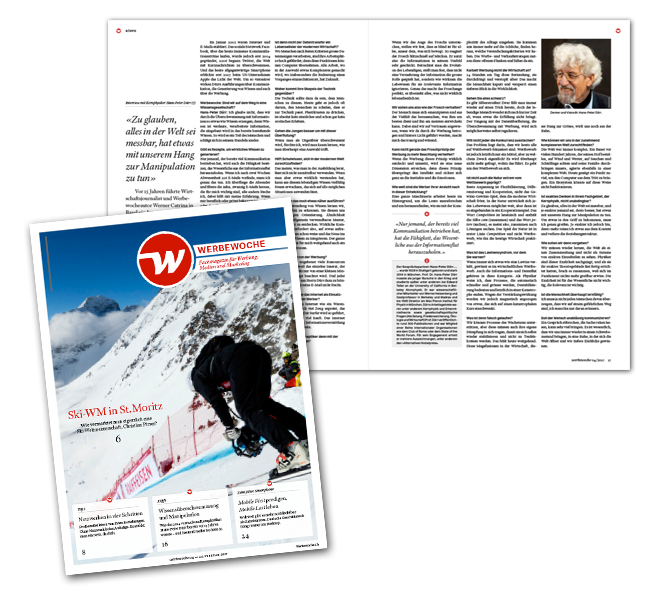
The whole interview in the current issue of Werbewoche 4/2017 from February 24, 2017. Not yet a subscriber? Here you get the license to read.
Hans-Peter Dürr was born in Stuttgart in 1929 and died in Munich in 2014. Prof. Dr. Hans-Peter Dürr had to go to war as a young boy and later studied atomic physics under Edward Teller at the University of California in Berkeley, among others. He was a research assistant to Werner Heisenberg and a visiting professor in Berkeley and Madras and was Director at the Max Planck Institute for Physics in Munich until 1995. Dürr's areas of work included nuclear physics and epistemology as well as socio-political issues (disarmament, peacekeeping, ecology and economics). Prof. Dürr published around 300 papers and was a member of a number of international organizations such as the Club of Rome and the State of the World Forum. He has received several awards for his commitment, including the "Alternative Nobel Prize".
Interview: Werner Catrina