Swiss made - taken very precisely
On January 1, 2017, the new Swiss-made law will take effect. From then on, only products that are manufactured in Switzerland to a high percentage or contain Swiss ingredients may be labeled with Swiss symbols. The exact percentage of Swiss content required for a product to be labeled as “Swiss-made” is strictly defined. Anyone who violates the new regulation faces heavy fines or even imprisonment. That’s why advertisers and branding agencies should also be well-informed about the new regulations. A thoughtless little cross on a red background can quickly become costly.


"The aim of the new legislation is to protect consumers from deception," explains Ueli Grüter, a lawyer and lecturer in communications law at the Lucerne University of Applied Sciences and Arts. In the future, consumers should be able to rely on the fact that Swiss ingredients and Swiss work are really in it, where "Swiss product", Swiss made, Made in Switzerland or similar designations are written on it, which refer to the production in Switzerland. This regulation also applies to classic Swiss symbols such as the Swiss cross, the Swiss coat of arms, the edelweiss or Heidi.
Swissness is still a very good selling point, both at home and even more so abroad. But if Swiss manufacturers want their products to stand out from those of other countries and justify the fact that Swiss products are more expensive in a market comparison (because Swiss origin is also paid for), they must also be able to prove that the consumer is holding a genuine Swiss product in his hands. This is the basic idea behind the initiative of Council of States member Thomas Minder (Trybol AG), which brought about the new law.
In principle, the new legislation is well understood; it enhances the Swiss label. 78 % of the Swiss population think the law is a good thing, according to a survey commissioned by the Federation of the Swiss Watch Industry. On the other hand, for companies for which Swissness plays a cen- tral role, the new law makes a whole series of adjustments necessary and produces sharp cliffs that have to be navigated around. Emmi, for example, has been working for over a year on adapting its 5,000 or so products to the requirements that must be met from the start of the new year.
The revised Trademark and Coat of Arms Protection Act regulates the admissibility of Swiss-made labels for natural products, foodstuffs, industrial products and services. The regulations provide for the following in detail:
Swiss natural products
Natural products such as vegetables, mineral water, meat or gravel may only be declared as Swiss products if the place of their harvest or extraction is in Switzerland. Animals whose meat is declared as Swiss meat must have spent the majority of their lives in Switzerland; they must have been hunted or fished there.
As soon as a natural product undergoes substantial processing, it is considered a foodstuff (e.g. sausage) or an industrial product (e.g. wooden furniture) and is subject to the corresponding regulations.
Swiss food
For food products that are to carry the Swiss made label, 80 % of the raw materials must come from Switzerland. The supply level is taken into account here, i.e. the possibility of obtaining this raw material in Switzerland. The supply grade depends on the industry: Eichhof beer brewed with 99 % of Pilatus water may be labeled as a Swiss product, even if the hops and malt come from Germany - but this is only because consumers consider Pilatus water to be essential for this product and this is now regulated by law.
If the supply level of raw materials is below 20 %, the raw material is not taken into account in the calculation of Swissness; this would be the case, for example, with Swiss olive oil, where the olives cannot come from Switzerland because none grow here. For this to be the case, the processing or refining of the oil to 100 % would have to take place in Switzerland for the Swiss made label to be allowed. At a supply level of 20 to 49.9 %, half of the raw material is counted; at a supply level of more than 50 %, it is fully counted. Milk must originate 100 % from Switzerland if a dairy product is to be labeled as a Swiss product.
In addition, the processing that gives a food its essential characteristic must take place in Switzerland if it is to be considered a Swiss product, e.g. the processing of milk into cheese.
If a single Swiss ingredient is significant or essential to the product in terms of weight, it is permissible to indicate it on the back of the product, e.g. by stating "with 100 % Swiss meat" on a lasagna package. Placing this remark on the front is misleading and therefore no longer permitted.
Swissness is costly
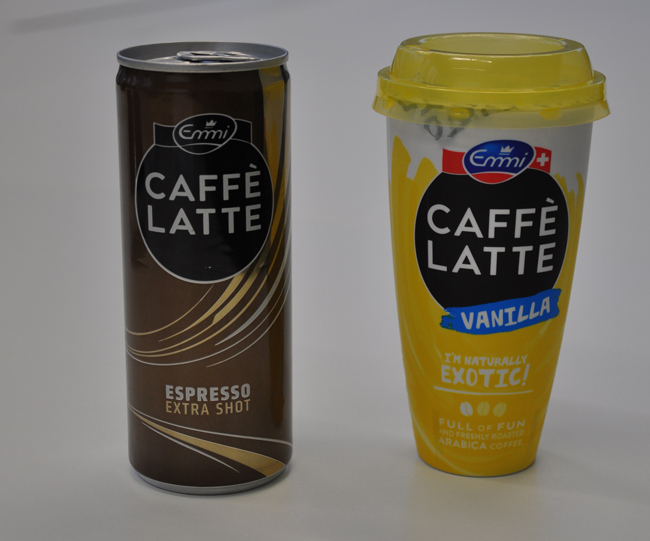
What do these requirements mean in concrete terms for companies in the food industry? Emmi, for example, has the Swiss cross in its company logo. Until now, all of its 5,000 or so products were labeled with it. From January 1, 2017, this will change - although consumers will have to look very closely to notice the differences: For example, the milk drink "Caffè Latte Vanilla" meets the Swiss-made criteria because it is made with 77 % Swiss milk and bottled in Ostermundigen. Its younger brother "Caffè Latte Espresso Extra Shot" does not meet the criteria - the drink contains Swiss milk but is produced in Germany. So the vanilla drink has the Emmi logo with a Swiss cross on it, and the espresso drink has the Emmi logo without a Swiss cross (see photo below).
When it became clear that the Swiss-made law would come into force, Emmi began to check all of its 5,000 products: For dairy products with 100 % of Swiss milk and production in Switzerland, the situation was unproblematic - Swissness fulfilled. The company had to take a close look at all other products and check whether Swissness should be fulfilled and, if so, how. The Lucerne cream cheese with 80 % Swiss raw materials was allowed to keep its Swiss cross, while the cross was removed from the Parmesan cheese. The Birchermüesli was to remain Swiss. In order to ensure this, some ingredients had to be exchanged so that the original Swiss powerhouse could continue to run under Swiss made: Although 100 % of the milk comes from Switzerland, the apple pieces in the muesli were previously sourced from Italy. However, as the supply of apples in Switzerland is 80 %, Emmi has had to increase the proportion of Swiss apples in Birchermüesli. Whether this is to the product's advantage in terms of taste remains to be seen. In any case, it is now Swiss made.
The fondue case seems absurd: Fondue from Emmi consists of 52 % Swiss cheese and 30 % white wine. But the latter comes from France, because white wine is not grown in Switzerland for industrial use. Only on November 15, the Swiss government exempted industrial wine for the production of fondue preparations from the Swissness calculation, along with 57 other raw materials. Various food industry organizations had submitted a total of 81 requests to be granted an exemption. The exemption for fondue wine is limited until December 31, 2018, and will be reviewed periodically. If the federal government had not approved an exemption, Emmi might have decided not to be able to meet Swiss made for fondue - and in the future also buy cheese more cheaply abroad...
In order to simplify the calculation of the Swissness-relevant portions in foodstuffs, the Federal Office for Agriculture FOAG provides on its website a separate Calculation tool available.
Swiss industrial products
For Swiss industrial products, 60 % of the manufacturing costs must be incurred in Switzerland; this takes into account fabrication, composition, research, development, quality assurance and certification. Costs arising from marketing measures, for example, may not be included. The production in Switzerland must characterize the product.
This means that a company cannot have its sneakers developed in Switzerland produced in Taiwan and then sell them in Switzerland printed with a Swiss cross simply because further development and marketing are controlled from Switzerland. Selling the shoes with a Swiss cross to Germany, on the other hand, would be permissible - because the application of the Swissness law ends at the Swiss border.
Natural products that cannot be produced in Switzerland, e.g. precious metals, steel or mineral oils, are exempt from the rule that 60 % of the manufacturing costs must be incurred in Switzerland. Materials that are not available in sufficient quantities in this country need only be taken into account to the extent that they are available in Switzerland.
Swiss services
For services, the rule from 2017 is that the registered office and the actual place of administration of the service provider must be in Switzerland. Mailbox companies will no longer be allowed to label their services with a Swiss label.
The Swiss airline Swiss, which was taken over by Deutsche Lufthansa in June 2007, is also subject to the new legislation. However, Stefan Vasic, media spokesman for Swiss, sees no need for action. In response to an inquiry from Werbewoche, he said: "The legislation you mention is also applicable to our company, but does not affect us in the context you describe for the following reason: Both the registered office and the actual place of administration of Swiss are in Switzerland."
The new rules will apply from January 1, 2017, and the sale of already produced goods and merchandise will be allowed until December 31, 2018.
Developed in Switzerland
Designations such as Designed in Switzerland or Engineered in Switzerland are still permitted, even if the requirements for a Swiss-made label are not met. However, this only applies under the following conditions: The entire specific activity indicated on the product - i.e. design or engineering - have taken place in Switzerland, and words such as Switzerland or Switzerland are not more conspicuous in color, size or font than the other indications. For example, the back of every iPhone says in small type: Designed by Apple in California - Assembled in China. However, the words "Made in Switzerland" or the use of the Swiss cross are prohibited under these conditions.
Caution with Swiss cross and coat of arms
In the future, caution is generally required when using the Swiss cross: Labelling with the Swiss cross or other typically Swiss symbols is only permitted if the Swissness provisions are met. In addition, the Swiss cross may not be used in such a way as to create the impression of a connection with an official agency or the Red Cross.
For decorative purposes, the Swiss cross may still be used, for example on a caquelon or on slippers. In these cases, the symbol should not generally be misunderstood by consumers as an indication of origin.
The Swiss coat of arms is an official symbol and may therefore only be used with a license from the federal government - this is now explicitly regulated in the Coat of Arms Protection Act. Victorinox or TCS, for example, must be able to show such a license from the federal government in the future if they want to continue to mark their products and services with the Swiss coat of arms (see photo 04).
If the license is not available and a Swiss coat of arms appears on an advertising motif, for example, advertisers can also get into trouble. This is because due diligence requires them to pay attention to such subtleties and, if necessary, point out provisions to their client. "Advertising is increasingly being assigned to the product," explains attorney Grüter. "That's why advertisers who advertise with Swissness have to inquire what's in the product, where it's made, and whether they're allowed to write Swiss made. It's not yet as extreme as with advertising for alcohol, tobacco and pharmaceutical products. There you can forget about advertising without a lawyer. But if you want to advertise Swissness, you better get legal advice."
So anyone thinking of incorporating an Edelweiss or Heidi image into their campaign from next year onwards should have the Trademark Protection Act in mind. And the address of a specialized lawyer in your wallet.
Caution is better than indulgence
Swissness legislation has been under discussion for over ten years, and it has been known since September 2015 that the new law governing the use of designations of origin and Swiss symbols will come into force on January 1, 2017. Emmi has therefore already been busy for more than a year adapting its products so that they meet all the requirements from January 1, 2017. Other companies for which the Swiss made factor is of crucial importance have also long since revised their products and services - and either adapted them or deliberately dispensed with the Swiss made label. "This is very exemplary, but also highly advisable," emphasizes attorney Ueli Grüter. "Because if it comes out afterwards that something only looks like a Swiss product, but was manufactured in China - that creates a veritable image damage. The media usually rolls out such cases very much, a super-GAU for every company."
Many Swiss companies, for whom Swissness is not such a key selling point, are nevertheless likely to take their chances if someone complains about their declaration practices. "As a rule, the competition will point out that the other market player may not be following the rules," says attorney Ueli Grüter. "This can lead to a lawsuit in court, or a dispute with the federal government. The law provides for fines and prison sentences of up to five years for commercial violations. But experience shows that nothing is as hot as it's cooked." And affected companies don't have to prove how much Switzerland is really in their products until someone files a lawsuit.
Anne-Friederike Heinrich