
Comforting finding
One in two media consumers no longer spends money on newspapers. This is the finding of the «Media Quality Yearbook.» Each year, the yearbook analyzes and documents the most important events and developments in the Swiss media industry.


The Swiss media audience attaches great importance to the quality of newspapers and news offerings on the Internet. Yet more than half of media consumers no longer pay for newspapers and hardly ever read classified reports on national or local politics.
These are the conclusions of the "Jahrbuch Qualität der Medien. The yearbook authors write of a "comforting finding." It is true that young adults use high-quality media less than older people. But this group, even if they hardly use newspapers, is nevertheless "aware of the importance of professional information journalism for society and democracy.
Those who frequently use public broadcasting news have greater trust in the media system. This finding holds true both in an international comparison and for Switzerland. Positive trust in the media system also increases users' willingness to pay for news and to accept advertising, for example in the form of online banners.
In an international comparison of countries, trust in the Swiss media system remains high. In terms of willingness to pay for news, Switzerland ranks in the middle of the 26 countries surveyed. These are the findings of the fög - Research Institute for Public Sphere and Society at the University of Zurich in a country comparison study published in parallel with the seventh edition of the Yearbook Quality of the Media.
Young adults express greater distrust
Individual news usage behavior has a decisive influence on media trust. People who regularly use traditional information media develop greater trust in the media system. Conversely, trust is lost when the ritualized use of professional information media loses importance or news is consumed predominantly or exclusively via social media. It is therefore not surprising that young adults express a particularly high level of mistrust in the media system. The proportion of those who turn their backs on news journalism is particularly high in this age group.
Pronounced distrust among sympathizers of political wing parties
Across all countries, the use of public broadcasting in particular has a particularly positive influence on media system trust. The use of paid subscription press also has a positive effect. In contrast, exclusive consumption of printed commuter newspapers reduces media trust, as does news usage behavior that is heavily based on social media (e.g. Facebook). Political attitudes are also significant: The more users sympathize with political wing parties, the greater the distrust - currently even greater among those on the right than those on the left.
"News-deprived" form largest user group of all
Fewer and fewer people are using a broad bundle of high-quality media. Already one third of the Swiss population belongs to the group of the so-called "news-deprived". This user group is far less interested than average in professional information offerings, and if they are, they resort to lower-quality information offerings or consume news via social media. Their share has risen by a remarkable 10 percentage points in recent years, from 21 percent (2009) to 31 percent (2016). This group primarily includes young, female adults under the age of 30. This media consumption has an impact on society's perceptions. The "news-deprived" pay a lot of attention to events that are aimed at the individual or morally and emotionally charged, such as disasters and scandals.
Social media
Social media are already the main source of news for almost a quarter (22 percent) of young adults in Switzerland. Traditional television consumption, on the other hand, is already well behind with a figure of 11 percent. With the growing importance of social media for news consumption, traditional media providers are gaining the opportunity for additional reach and new paying subscribers on the one hand, but on the other hand are partially relinquishing control over the further dissemination of their content. The media brands of traditional news providers are also weakened in the social network.
International survey data show that of the respondents who consume news via social media, on average less than half still perceive the original media brands at all.
Normative understanding of quality is supported
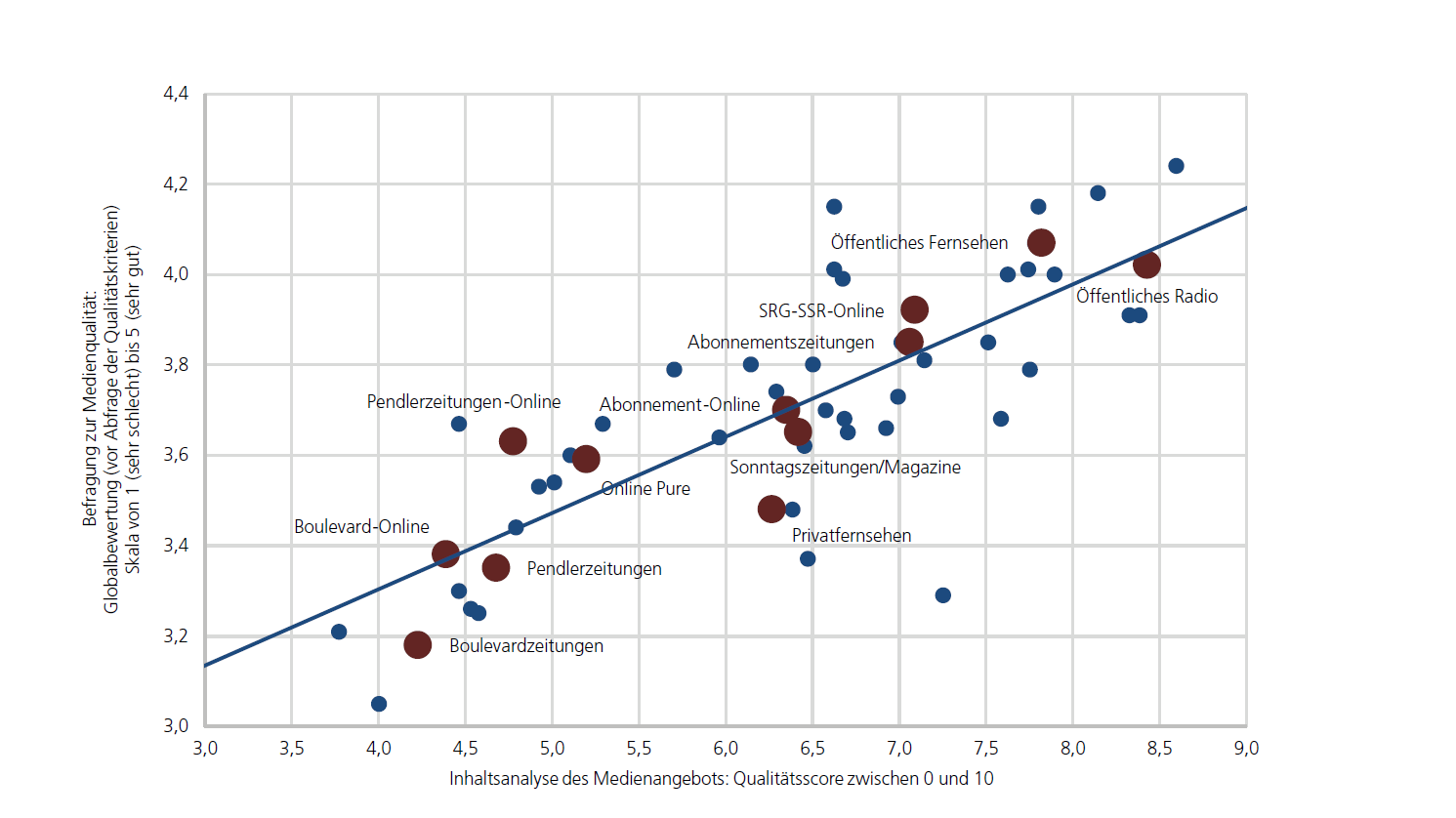
The fög's quality scoring again attests the best reporting quality to the information offerings of public broadcasting and the national, printed subscription newspapers in the current year of the study. This quality rating is also shared by the media users surveyed. The democratic theoretical understanding of quality on which the fög analyses are based is therefore supported by the population. This applies to all respondent groups, including young adults, who, according to the study, use more information media of inferior quality than other age groups. Users who consume low-quality news are therefore at least aware of this.
You can find more detailed information here.
|
The analyses of the Yearbook and the Quality of Media studies are based on the following data: Content analysis: The assessment of reporting quality is based on a random sample from 2015. A total of 25,389 articles from 64 high-reach information offerings from German-speaking Switzerland, Suisse romande and Svizzera italiana were examined. The guiding quality dimensions are relevance, diversity, classification performance and professionalism. Audience surveys: fög is the new Swiss partner organization of the international study "Reuters Digital News Report". The report, which is published annually, includes survey data on the media usage behavior of the public in 26 countries (over 50,000 interviews). In addition, a representative survey conducted by fög and GfK Switzerland since 2009 provides insights into media usage in Switzerland and respondents' perceptions of topics and events. Finally, a survey was conducted on behalf of the Stifterverein Medienqualität Schweiz, the publisher of the "Media Quality Rating" report (MQR-16), which shows how media users perceive the quality of information media. The fög is a scientific partner of this project. Key figures from the media industry: In order to analyze changes in the use, financing and ownership of information media, secondary data such as reach and circulation are used. Sources are WEMF, Net-Metrix, Mediapulse, Media Focus, the "Media Budget" publication of the Swiss Media Association. The data on virality on the Facebook pages of media providers was collected with the help of Netvizz - a data collection and mining application from the University of Amsterdam. Further data on the importance of the social media channel for news media (feed aspect) came from similarweb.com. Further information on the methodology, the understanding of quality, the quality scoring and the financing of the yearbook can be found at here.  Yearbook 2016 Media Quality - Switzerland Suisse Svizzera Since its first publication in 2010, the aim of the Yearbook has been to deepen the discussion about the quality of the media and to contribute to improving its quality. It is a resource for media professionals, political and business actors, academics and anyone interested in the development of the media and its content. The impetus for the Yearbook is the insight that the quality of democracy depends on the quality of media-mediated publicity. The yearbook provides the public with a benchmark for the journalism to which it wants to be exposed, the media makers with a benchmark for the journalism they want to produce and be responsible for, and politicians with an insight into the development of the media system and the resources available to information journalism in Switzerland. Who is responsible for this yearbook? The yearbook is compiled and published by the fög - Research Institute Public and Society /University of Zurich. Nine scientific and seven student employees are involved in the research and guarantee the quality of the analyses. Who finances and supports this yearbook? Funding for the Yearbook is contributed by the non-profit Kurt Imhof Foundation for Media Quality and the University of Zurich. The Foundation Board is composed of: Christine Egerszegi-Obrist, Mark Eisenegger, Barbara Käch, Yves Kugelmann, Fabio Lo Verso, Dick Marty, Oswald Sigg and Peter Studer. |


