
Between trade, state revenue and cityscape
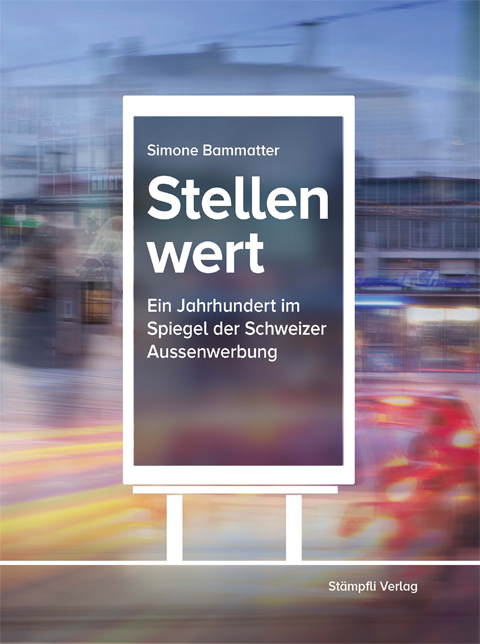
The company's own publication "Stellenwert" looks back on the history of out-of-home advertising in Switzerland to mark Clear Channel's 90th anniversary.


The Swiss outdoor advertising market is currently dominated by two large outdoor advertising companies: The market leader Allgemeine Plakatgesellschaft (APG) and the steadily growing company Clear Channel. Clear Channel currently markets around 20,000 of Switzerland's poster sites, giving it a market share of 24 percent. The second-largest Swiss poster company was founded in 1924 under the name Plakat und Propaganda A.-G, and was acquired by the US company Clear Channel in 2001. It had once broken APG's monopoly position within the poster industry. Accordingly, Clear Channel presents itself in the publication for its 90th anniversary as a company with a fierce nature that "fights for every poster site and defends itself against the authorities and the dominant position of Allgemeine Plakatgesellschaft (APG)". The publication, extensively researched by Simone Bammatter, not only celebrates the company's own success story, but also takes a detailed look at the entire development of the Swiss outdoor advertising market.
First state regulations
Advertisers were obviously resourceful early on when it came to placing their clients' messages in prominent places in an eye-catching way. As early as the 19th century, the first Swiss cities therefore began to regulate the gradually emerging proliferation of posters. In Zurich, an ordinance issued in 1856 regulated "wall billposting" and the city set up fixed, chargeable billposting sites. At that time, only a dozen or so posting points were needed. However, their number increased rapidly and towards the end of the 19th century the first criticism was voiced by the population, who were annoyed by the growing number of posters on public property.
Privatization of the poster industry
APG was founded in 1900 with the support of the advertising agencies Haasenstein and Vogler, Vettiner, David and Juvet. After the turn of the century, the exclusive claim of the authorities in many larger cities was transferred to private outdoor advertising companies. The main purpose of this was to ensure that the growing "poster business developed efficiently and its income was promoted". This was because the longer it went on, the more it became a significant source of income for the authorities. Privatization led on the one hand to a quantitative increase in poster sites and on the other to a qualitative improvement, as APG renewed the majority of billboards. For decades, the outdoor advertising company held a monopoly position. APG repeatedly took over the marketing of all public billboards under multi-year leases.
Resistance to monopoly
For a long time, the municipalities saw an advantage in the fact that APG's national network provided them with a standardized process and they did not have to settle accounts individually with countless poster companies. The sphere of activity of smaller poster companies was limited to private property. Only in Zurich did a dual system develop relatively early on on public land. In 1970, Clear Channel was first awarded a concession to display posters in a handful of city districts. To date, however, this has only happened in larger cities. Otherwise, APG still owns all poster sites on public land in many places.
Overall urban development concepts
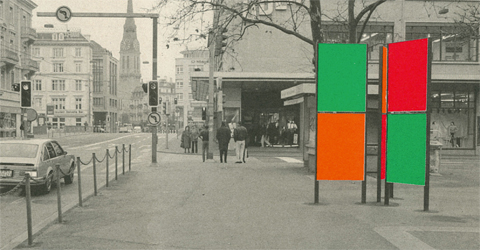
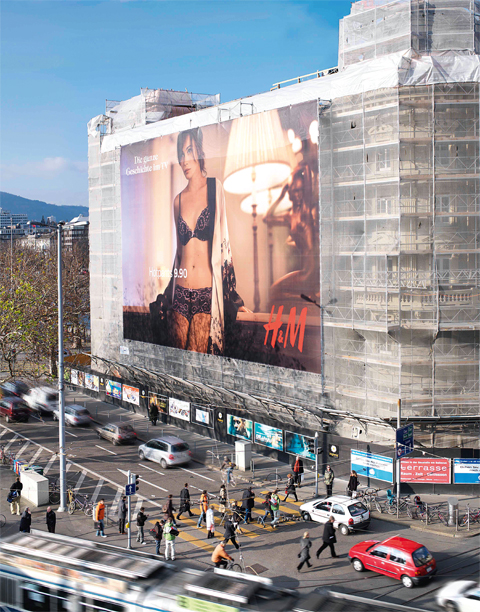
Until the 1990s, there were no overall concepts for urban billposting. It was not until 1992 that the so-called Overall Concept 92 was launched in Zurich. Among other things, it harmonized the variety of poster types and sizes and led to fewer, but better-placed poster sites. This practically doubled public revenue in one fell swoop. At the same time, however, greater consideration was given to the city's appearance. The number of posters on public land was reduced from 3160 to 2000 spaces. Some of the more numerous poster sites on private land were also subject to regulations. In the years that followed, GK 92 developed into the national standard. The overall concept remained valid until 2006, when it was replaced by the new PK 06. In it, advertising is seen as an integral part of the city and billposting as an urban planning issue. It stipulates, for example, that posters are only permitted in areas where commercial use is present. An update was also necessary with regard to technical innovations. In order to achieve maximum returns on existing sites, poster companies have been constantly looking for new ways to expand their advertising space in recent years. PK 06 also includes regulations for illuminated posters, rotating machines and prism turners - the latter are already considered outdated due to their energy inefficiency. sis


