With brains
For over 45 years, Kieser Training—in collaboration with its in-house research department—has been helping people build a strong body and a strong back. A new branding campaign aims to once again make it clear why we need this.


WW: Why does Kieser Training need an image adjustment?
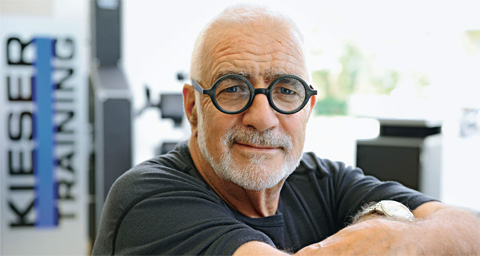
Werner Kieser: They don't even wear knickerbockers anymore. They used to be fashionable. Or the long hair in the 70s. When I look at old photos like these, I realize that you need a new haircut from time to time. That's relatively independent of the content. Our product is just as convincing today as it was when the company was founded in 1967.
Your company has carried out extensive research for this "haircut". What insights is the new image based on?
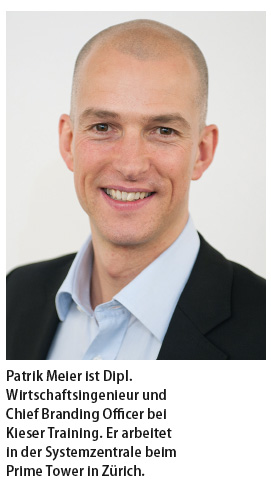
Patrik Meier: There have always been small adjustments in advertising. But for the actual positioning, we now wanted to take a self-critical look at the brand image, our marketing concept and our corporate identity. To do this, we surveyed 5,000 customers and 500 former customers, employees, business partners, doctors, physiotherapists and 2,000 non-customers. In addition to the advertising style, we also examined the core of the brand, the internal culture and the behavior towards customers. The evaluation showed that our offer has a lot of potential, but that the image of Kieser Training tends to be associated with "training for old and sick people". So we don't need to change anything about the product or the offer. The preconception that "you only go to Kieser if you are old and ill" is of course nonsense. We now need to revise this with the change of image, because our offer is aimed at a much broader range of customers. Our customer benefits lie in three areas: strong body, strong back, beautiful life. Our customers know this and are convinced by our offer. We only need to change our image among those who do not yet train with us.
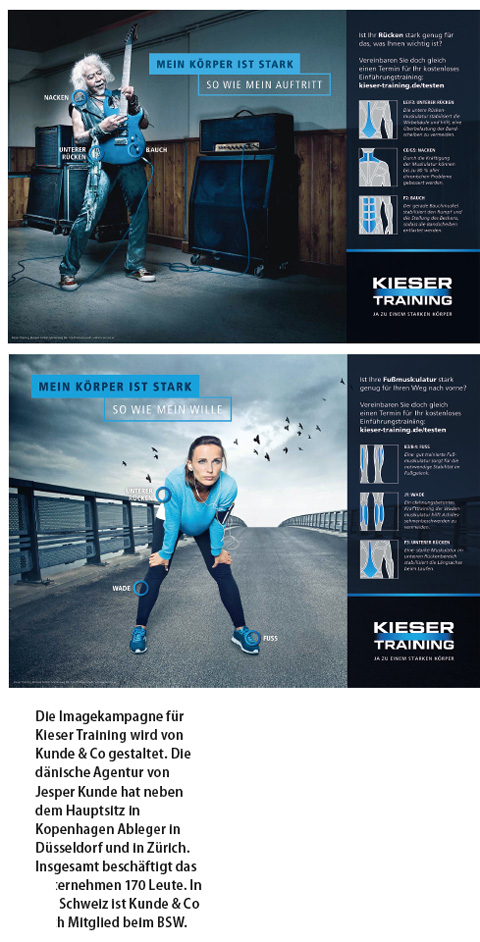
Kieser: The core task of the image adjustment is now to modernize the brand visually while highlighting the proven range. The quintessence is: "Strong body. Strong attitude." Together with the advertising agency Kunde & Co, we derived the new guiding principle from this: "Yes to a strong body." We also analyzed the fact that our corporate identity with its grey and yellow looks a little outdated. In the German market, the color yellow is also strongly identified with a well-known discounter. That's why we removed the yellow from the logo completely. Instead, we are now working with blue. Blue was already an important color for Kieser Training in the past. Our machines were also blue for a while. Originally they were even black and white. Even our advertisements and the first logo were once black and white. But that's just it: It's not just the hair that changes.
Meier: The association with the discounter particularly disturbed us. One could conclude from this that we offer less. In fact, we clearly offer less than the competition. But our range is of a much higher quality.
Kieser: For us, the "less" refers to the breadth. We are not a conventional fitness club where you can mainly maintain your lifestyle, but we have a medical focus. This came about almost 20 years ago. At the very beginning, it was mainly athletes who trained with us. Then more and more older people came and I realized that we couldn't just leave them to their training. That would be irresponsible because it could lead to health problems. This is how medically based training came about. And because the focus here is on back problems, this image of "Oh dear, if you're in pain, you have to go to Kieser. Or when you're old". Originally, it was the other way around: Zurich was mentioned in Playboy magazine as the "pick-up place for the most beautiful girls" in Switzerland. And they all came to us.
Should it now go more in the direction of lifestyle?
Meier: Lifestyle is too hackneyed. I like it better: Kieser Training is an iconic brand. We are extremely focused. When everyone else is offering a thousand different things, we stick solely to what works. Everything else is of little interest to us. If it works, it's good. If it doesn't work, we don't need it.
Kieser: That's the minimalism that has developed over time. I've been part of the whole development. I was the first in the Zurich area to offer a fitness program. Then John Valentine came along and the club in Nova Park. In the face of this competition, I felt I had to keep up. So I also added a sauna and bar. Until I realized that people were no longer training at all. They were just lying around. So I wanted to get back to the original concept. It turned out that science had come to meet us. We realized more and more that we were on the right track with our medical services. Today, I'm glad that I drew the right conclusions from my investment detour back then. I tore the saunas out again because I realized: People want to look different and feel better after a year. If they lie in the sauna for a year, they may be cleaner, but not better trained. So we have consistently pursued our own concept ever since.
Meier: However, this offer becomes a problem if we are simply summarized without reflection among the wider fitness scene. Those who don't know Kieser Training then see us as an unattractive fitness club. We cost a little more and offer less. But anyone who knows us knows what our customers get. There are people who say: "I never go to a fitness club. I go to Kieser."
Did everything work with word-of-mouth propaganda in the past?
Kieser: Up to 90 percent of clients have come to us on recommendation. The rest through press reports. Then I said to myself: if I don't advertise, I don't know how many more would come. So we started a bit with advertising. But even then we realized: the most important thing is the product. If it's good, then it does relatively well. However, at every stage there are people who come to training for a while and then stop coming. You can then replace this estimated quarter of customers with advertising.
Which channels are used for advertising?
Meier: Following the launch of the print campaign in January and February, there will be another wave nationally in the fall. Our communication is ongoing on the website, in social media and with our customer magazine every three months as well as with Werner Kieser's blog.
What target audience is the campaign now aimed at?
Meier: Our image communication is aimed at people aged 30 to 55, but younger and older people can also come. But it was important to us that our imagery does not show people exercising on machines. That's more like advertising for the fitness scene. For us, it should be people in everyday or leisure situations. People who are focused and doing something. Kieser should not be the purpose of life for these people. Kieser Training helps to promote their purpose in life. That was the idea. For the bodybuilder, bodybuilding is life. They go to the gym every day. With us, people come once or twice a week. They do something because they know: The muscles are rebuilding. It's simply part of human nature. That's why you have to do something about it.
Kieser: It is a hygiene measure. It's not so much fun and pleasure. Nor is it a way of getting to know people, although you can do that too. I always compare it to dental hygiene. It's also something that has a huge impact on your health, tripling the lifespan of your teeth. But it's not fun and it's not particularly attractive. I have nothing against fun. But I want to emphasize the necessity of what we offer. Anyone who trains with us will no longer have back pain afterwards and will experience a whole range of positive changes. Unlike with teeth, however, the public is not yet sufficiently aware of this when it comes to the musculoskeletal system. We don't just do sport. Sport is maximization. What we do is optimization. And that requires a slightly different approach to advertising. We can't advertise with beautiful girls or bring in sex appeal like others do.
Kieser Training is represented in 8 countries with 140 branches. How widespread is the campaign?
Meier: We conducted our analysis in Germany, Austria and Switzerland. The first phase of our campaign also ran in the DACH region. The campaign will later be continuously expanded to the international market. We are taking print media, online media and now also social media into account. Employer branding is also very important. It is important that we also properly introduce our own people to the new brand. The new marketing concept was presented to the workforce at an internal kick-off in Cologne's Musical Dome in September 2013. Each company then prepared itself for January 2014, when we launched the image campaign.
Kieser: We are a franchising system. We have our business partners. There is a national promotion in each country, which is made up of elected representatives from the system headquarters and the franchisees. With the budget managed here, we ensure that the national marketing activities are covered. Based on this, each company has its own task to work on the marketing plan in the area around its location. Local and regional marketing activities are therefore carried out by our business partners.
Do you offer print on demand?
Meier: Yes, our advertising agency Kunde & Co created an ordering system for advertising elements for all 140 Kieser Training studios in the DACH region. With the new print-on-demand system, the studios can make their own adjustments to the predefined advertising elements, have them produced at minimal cost and then place them accordingly.
How did you come across Kunde & Co?
Meier: It was a pitch. Although there are rumors, because Kunde & Co are our neighbors in the Prime Tower in Zurich. There's a story about that. I saw an advertisement in the Handelszeitung that a Danish agency owner had written a book. My wife is Danish, so I have an affinity with the country. So I ordered this book by Jesper Kunde by fax - and the very next morning a gentleman was standing in front of the door to our system headquarters and wanted to hand over the book. I thought: Wow, a super service. Then it turned out that the gentleman was our new neighbor. When the philosophy described in the book was a perfect fit for us, we also invited the agency to our pitch. The philosophy is about the constellation of "young people with energy who want to give their all, working together with older people who can contribute their experience and decide what is good and bad". This is just as true for Kunde & Co as it is for Kieser Training.
They used to have 19 branches in Zurich. The franchise was not renewed in 2010, and in 2011 Kieser started with six new branches of its own. Are you now planning to grow again?
Kieser: Yes, we do. But we have limited resources and don't want to just go ahead and expand. The franchisee at the time adopted our concept. In this respect, there is no emergency in Zurich. So we prefer to invest in development. We have developed three new types of machine, which are now also causing a lot of international discussion. Our job as a franchisor is to be ahead of the game. That costs millions. A research project to solve a problem quickly becomes very expensive. We did this for our ankle and pelvic floor machine. The pelvic floor is a huge problem, including incontinence in men over 50, but it can be solved and we are the first in the world to do so.
Will the business with the machines soon be bigger than the training offers?
Kieser: So far, we are happy if we can supply all our own businesses on time. The fitness industry doesn't do what we need. It is geared towards the gym owners. They are only interested in legs, stomach and bottom. So it's the purely cosmetic aspect. But there are muscles that are very important, but you can't see them. And they cause people problems after a certain age. We have concentrated on that. No other fitness studio takes care of the pelvic floor. There are a lot of pelvic floor schools, but only women go there. But it's just as important for men. You have to look after your body. I have constantly pursued this approach. In the meantime, 'high intensity' has suddenly become fashionable. Something we've been talking about for 40 years. This development confirms my conviction: If you recognize something correctly, then you have to consistently continue in that direction.
How big a part does your wife, who is a doctor, play in the company's success?
Kieser: I got to know her when she was doing her A-levels. Then came her medical studies and her dissertation on postoperative strength training after cruciate ligament operations. My wife grew into the business and became very important. She has more of a clinical view than I do. We now have a doctor in every studio. For the doctors, everyone is ill. On the other hand, we have instructors and sports teachers. For them, everyone has to get fit. These are two different worlds of thinking.
Can we say they are united in the new slogan: "Yes to a strong body"?
Kieser: The body must be at the center. Muscle and strength. What we sell must be honest. We don't need a dream image. That would be harmful. People come to us and have to move heavy loads here. They need to make an effort. And that's what we sell. That's why we put the body at the center. The core of the brand is the efficiency of the method. We've been saying for years that one or two 30 to 40-minute workouts a week are absolutely enough. We can guarantee this because we have machine technology that is designed for efficiency. We have a method that is geared towards efficiency, and that's why we can say: that's enough.
Interview: Andreas Panzeri