The smart makers
With its real-time personalization software, Boxalino is making e-commerce smarter and easier for customers. And, if former Google executive Andreas Schönenberger has his way, it will soon do much more.


Boxalino is a high-tech company that produces software for real-time personalization in mobile and e-commerce. Its customers include Pfister, Fujifilm (Switzerland) AG, FashionFriends, Geschenkidee.ch, World of Games, Redcats, Mode Bayard Gruppe and Qualipet. Founder and CTO is Michael Ammann. Andreas Schönenberger, who headed the Swiss branch of Google from 2006 to 2010, serves as Delegate of the Board of Directors and, since October 2013, also as CEO.
The days when people could browse through a web store while enjoying a glass of wine and hit the jackpot are over. "Today's users don't want to be bamboozled, they want to reach their destination relatively quickly," says Matthias Fröse, Vice President Sales & Marketing at software provider Boxalino. Anyone who searches for "brand X shampoo" on a search engine and is redirected to an online store that displays brand X, but not the shampoo, but a deodorant, is quickly gone. Even if the store would have had the sought-after hair product on offer.
E-commerce has grown significantly in Switzerland in recent years (online retail sales 2012: CHF 10 billion, University of St. Gallen; retail sales Switzerland 2012: CHF 97 billion, GfK). However, individual e-retailers benefit from this only to a limited extent. "Online retail is highly competitive," explains Andreas Schönenberger. The former Google Switzerland boss has been involved with Boxalino as a delegate of the board of directors since May and as CEO since October. "If customers don't feel well served, they switch to the next store." Purchased traffic is thus dearly gambled away. This is where the high-tech company pulls the lever. Boxalino has set itself the goal of optimizing its customers' mobile and e-commerce solutions and improving the customer experience, respectively. To this end, the company has developed personalization software that combines artificial intelligence (the system learns itself) with semantic intelligence (context is taken into account) and neuromarketing (users are assigned personality profiles). All in real time.
Put simply, it's about recognizing the needs of online customers, learning from their behavior and responding to them promptly. Nothing different from what happens automatically in the offline world. After all, the fashion salesman doesn't suggest the same thing to the 60-something gentleman who enters the store in a suit as he does to the 40-year-old who walks in dressed sportily. In the same way, customer A searching for "jackets" in a web store should not receive the same search results as customer B.
Like in the store
Just as the salesperson in the store assigns the incoming customer to a certain type ("older gentleman in a business outfit"), Boxalino's software also categorizes the user. Based on online behavior, for example, it determines whether the user is a "keeper" (reacts to the familiar/secure) or an "explorer" (wants to try out something new). The former is later offered the tried-and-tested classics, the latter the new collection.
And just as the salesperson in the store learns more about the customer's needs during the sales talk, the technology is also constantly learning. Depending on how the user behaves, other products are recommended as search results. If it is recognized that the customer does not like the color blue, she will not be shown a blue sweater in the top results. If the desired jeans are no longer available, an alternative is suggested. Once the customer has selected an item, other products in a similar style are suggested. "It's like in an ordinary store: You look for a shirt, at the end you have the complete outfit," says Schönenberger. The customer goes to the checkout with a full shopping cart, and the e-retailer is happy about more sales.
From A to Z
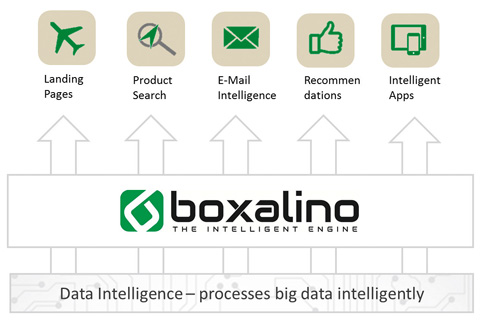
With various modules, Boxalino covers the entire customer journey - from the landing page to the product search, the app to email marketing. Thanks to real-time personalization, the user is already received individually on the landing page. Instead of always displaying the same page, a personalized landing page is created according to the available information (e.g. cookies, search behavior, information from the CRM, etc.) - in real time - which is tailored to the user's profile in terms of design and content. As a result, Boxalino demonstrably succeeds in keeping users on the site longer.
If the customer leaves the store without having bought anything, he or she is retargeted. However, not according to the "last product seen" principle, which is often used in trigger campaigns. "This is what often happens in retargeting," explains Fröse. "If I look at baby cribs in an e-shop for a long time and click on some diapers at the end, diapers are presented everywhere afterwards. Our software recognizes what the customer's actual need was."
Similarly, the app "Chocogreets" by Myswisschocolate, which was shortlisted at the Best of Swiss App 2013, tries to understand the user. While consumers send a "photo kiss on chocolate," the app analyzes user behavior, and the data thus obtained can be used to improve the customer experience. For example, individually good time windows for push messages are determined or the ordering process is personalized so that the user can move forward more quickly.
Passionate about Technology
Behind the different modules is a central engine at Boxalino. What happens on one channel can be used on the other. The information about the usage behavior in the web store is merged with that from the CRM and is finally played out again in the newsletter campaign.
Boxalino promises e-retailers simplicity of use and transparency of impact. The supporting tools keep the administrative effort or that of the IT low. The reporting also makes the effects of the optimization comprehensible for the customer. How much was the bounce rate reduced and the conversion rate increased? How high is the ROI per AdWords and SEO customer visit? So far, Boxalino has targeted stores with at least 2000 products or a turnover of 0.5 to 1 million Swiss francs per year. This limit is to be dropped as soon as possible. Currently, the provider is developing modules for smaller and medium-sized stores as a cloud service, so-called SaaS solutions (Software-as-a Service). This enables companies to use e-business products on a reduced scale without having to procure or operate the expensive software and infrastructure themselves. At Boxalino, we are convinced that intelligent websites are increasingly becoming the standard. Not only in the area of e-commerce, as Schönenberger says. "Google has the intelligence to bring customers to the right page. We make sure that from then on they reach their destination as quickly and easily as possible."
Isabel Imper