Flight route customer service
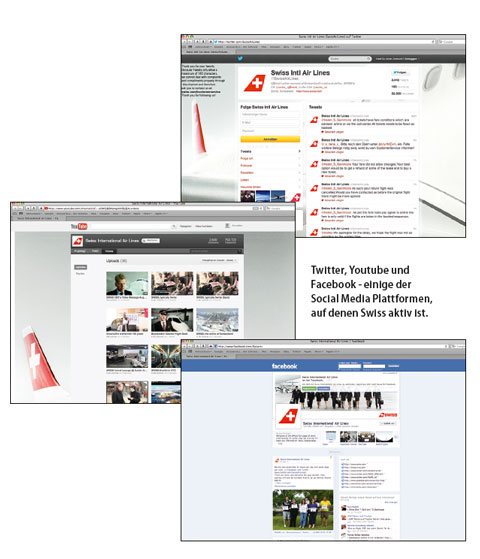
Like many airlines, Swiss is extremely active on social media. Since customer service is of particular interest to users on the social web, the airline expanded its service offering this summer.


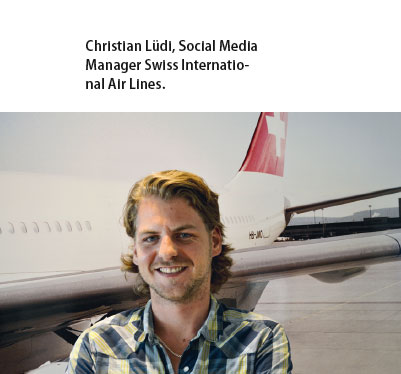
We sit in the business lounge in Miami and are disappointed: few non-alcoholic drinks and only munchies." "Can't claim compensation online for canceled flights? " "Why can't I book business class seats online on European flights?" Increasingly, passengers are contacting Swiss via Twitter or Facebook when they are dissatisfied with a service or have questions about a flight or booking. To be sure, Swiss' social media channels are much more than a customer hotline: Employees give customers and fans a look behind the scenes on the blog, and special offers are published alongside photo spreads, YouTube videos and contests. The core of the social media strategy, however, is customer service. "In our case, it became clear early on that this was the service users wanted most of all," says Christian Lüdi, Social Media Manager at Swiss International Air Lines. "If we only published offers on Facebook, this would be met with a lack of understanding from users. By their very nature, social media channels are not designed or geared for that. The focus is on dialog."
The online service experienced a temporary rush in spring 2010, when the Icelandic volcano Eyjafjalla paralyzed half of European air traffic. Lüdi provided the latest information via Twitter and Facebook and answered around 1,200 customer inquiries within five days. Subsequent questions were also answered on Twitter and Facebook. However, only the expansion of the team now makes it possible to offer the service in several languages and to respond quickly - and thus to meet a 24-hour service.
Around 25 employees stationed in Basel and Cape Town are on duty for this with immediate effect. Agents from the customer service department will take turns answering the phone and then responding to inquiries on social media. Lüdi doesn't want to be pinned down on how quickly Swiss responds to inquiries. "We have set a maximum time limit internally for processing. However, we deliberately do not communicate this information. There are also isolated cases that can take longer because the clarifications are complex." A review of the Twitter stream shows that the response times mostly range from a few minutes to one or two hours.
More than a telephone hotline
For the user, the advantages of the social media service are obvious: no waiting on hold for the telephone hotline, simple and free contact with the company that is available everywhere thanks to mobile devices. For simple questions, the service works without any problems. As soon as things get more complex, however, the limited space puts a spoke in the user's wheel. It's not easy to formulate a complicated question in 140 characters. Swiss therefore also refers its customers to e-mail contact for such inquiries. Frequently, inquiries must also be handled by email for confidential reasons: "As soon as we need the booking reference, for example, we can no longer communicate via a public channel like Twitter for data protection reasons, but have to switch to email."
Currently, Facebook and Twitter are used about equally for requests, Lüdi said. But it looks as if more inquiries will soon be made via Twitter. And this is despite the fact that Swiss has far fewer followers on Twitter than fans on Facebook. Unlike the telephone hotline, requests on Twittter and Facebook are usually visible to other users. From the company's point of view, this has the advantage that frequently arising questions do not have to be answered again and again. The flip side of the coin: Criticism and belligerent comments are just as visible. One or the other passenger sometimes writes himself into a rage when the flight is delayed or something else goes wrong. How does Swiss deal with such reactions? "Everything stays on the wall with us, except spam," says Lüdi. "Nothing is deleted unless it is a sexist or racist comment." If a user comments inappropriately, this is usually dealt with within the community, as other users intervene.
However, Swiss has also been confronted with a major avalanche of negative feedback: When it unveiled its new logo about a year ago, it was met with a hail of negative comments on the social web. In such cases, Lüdi relies on providing users with background information - which Swiss did in the case in question. The Chief Commercial Officer, Holger Hätty, answered questions about the logo in a chat for an hour. "After that, it suddenly quieted down," says Lüdi.
Whether the reactions are positive or negative, it's the two-way communication that is the main attraction of social media from the company's point of view. "We work a lot to offer the community something. At the same time, we receive valuable feedback," says Lüdi. "Frequent flyers in particular, who know our products and aircraft well, have a great need to share and often see potential for improvement." Swiss also uses social media as an inexpensive and effective market research tool. A survey is quickly created. For example, to find out whether customers are satisfied with the newly introduced Business Class. Likewise, Lüdi used the portals to recruit for a food tasting, in which food for long-haul flights was to be tested. In no time at all, 100 applications came in via Facebook. The social media manager needed 30 testers.
Lüdi also has to keep an eye on what users write about Swiss on other portals. Surprisingly, the social media manager does not have a specific monitoring tool for observing communication on the web about Swiss. For monitoring, Swiss relies on free tools such as Google Blog Search or search queries on Facebook and Twitter. And, if necessary, approaches commentators: "We even contact users who still write about Swissair when they have a problem."
Social media soon everywhere
Due to the expansion in the area of social media, Lüdi's main task at the moment is to network all employees involved with social media internally and to ensure that everyone reaches the same level. "Social media is permeating the company more and more," says Lüdi, describing the current situation. As the example of the customer service employees shows, the responsibilities lie with different departments. The two country-specific Twitter channels for Switzerland and the USA, which exist in addition to the official channel, are maintained by the respective marketing department. Local support for the social media channels is currently taken care of by employees at various geographical points - in Zurich, New York, Mumbai, Tokyo and Shanghai. And employees from all areas write for the blog.
Social media activities are carried out in close cooperation with the corporate communications department. And of course, the branding department also wants to have its say. "Every social media manager has discussions with the branding department at the beginning - just because of the restrictions of the platforms. " For example, the airline is called "@SwissAirLines" on Twitter due to the limited number of letters, and not "Swiss International Air Lines" according to the rules. The old logo, the double cube, also proved unsuitable for social media because its rectangular shape did not fit into the square embeddings. This led to the development of new guidelines for social media in the branding. In the case of the old logo, it was agreed to present only one of the two cubes.
In addition, Swiss is confronted with the dependency on third parties such as Facebook, YouTube, etc. on the social web. "It would be a communications disaster if Facebook were to close overnight. Then the 124,000 relationships we have via Facebook would simply be gone," notes Lüdi. Swiss does not have a complete database in which all users are stored. It would be possible to obtain the email addresses of users with their consent or, for example, through competitions. However, all 124,000 would probably not disclose their details. In addition to the incomplete contact data, the airline has to cope with changes, some of which are made virtually overnight. The legal situation is also murky. "Facebook has the copyright on every image we upload to our page. As a company, if you want to participate, you just have to comply with the guidelines." Where the journey is headed is not yet clear to Lüdi. "As a company, we go with the community. It's a constant feeling out of what the fans want." Swiss is currently working on setting up location-based services. However, nothing is ready to be announced yet. One interesting development is specific networks such as Wayn.com, where the focus is exclusively on travel, so the target group is easier to grasp: "There, we already know that everyone is interested in traveling around the world. However, such portals are still in their infancy. So for the time being, the strategy is to wait and see.
Isabel Imper