Three-dimensional television is the trend
The second IGEMTechno update provided a relatively clear answer to the question of whether 3-D TV is a trend, hype, or flop: 3-D TV is no longer just hype and, given ongoing technological developments, is unlikely to become a flop either. It is currently trending, though it remains to be seen how quickly this trend will develop.


With the Techno-Updates, the Interessengemeinschaft elektronische Medien (IGEM) aims to provide its members with knowledge about important technical developments in the field of electronic media and the Internet. This knowledge is intended to help them recognize new business areas as early as possible and assess the consequences for existing business areas.
3-D is an artificially created illusion
Three-dimensional images are nothing new. The first three-dimensional or more correctly stereoscopically produced silent film, "The Power of Love", was shown in cinemas as early as 1922. In television, the first stereoscopic images appeared with the introduction of color television in Europe in 1972. But unlike the switch from black and white to color, 3-D TV is not simply the flip of a switch and everything that was previously monochrome is now multicolored. This is because 3D TV only conveys the illusion of three dimensions. Thanks to the stereoscopic recording process and suitable decoding, the illusion of three-dimensional vision is created in the viewer's brain.
In his presentation, Peter Biber, responsible for strategic developments at TPC (Technology and Production Center Switzerland AG), mentioned the fact that three-dimensional vision only works if both eyes have the same visual acuity. In Germany, it is estimated that 8 to 12 million people do not meet this requirement. That is 10 to 15 percent of the population. Even color-blind people are not able to decode what they see correctly in their brains. This is because three-dimensional images are nothing more than acrobatics for the brain. This is why many people experience disturbances associated with headaches or nausea when viewing them. This is particularly the case if the image is poorly implemented.
3D productions have different requirements
Realization is very important in three-dimensional TV productions. This also gives rise to a new profession, that of the stereographer. And this must be involved from the very beginning. As Nick Sieber, owner of Kamerawerk, a company specializing in 3D productions, explained, stereographic production requires completely different storytelling. It is also necessary to define much more precisely which person or object should be placed where in the room. An actual spatial logic has to be established - both during filming and in post-production. That costs money. Today, it is estimated that the additional costs are around a third. And only as much 3D can be used as is really necessary. If the 3-D elements are pushed too hard, the viewer simply feels uncomfortable. Of course, these conditions are not met, especially in the case of films shot in two dimensions and subsequently converted to 3D. As a result, the experience is limited in these productions.
Large screens can't do without glasses
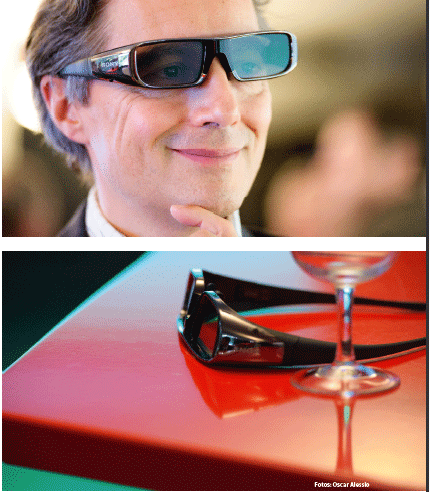
In order to be able to see in three dimensions, glasses are an essential requirement for large screens (including in cinemas), at least for the time being. This is because only glasses allow the brain to experience the sense of space from different positions. On smaller screens (such as cell phones, laptops, tablets), three-dimensional vision is also possible without glasses, as the viewing angle can easily be individually adjusted until the 3D illusion is perfect. With a TV screen that several people want to view from different angles, this is much more difficult. It requires the display of six to eight different images. However, this reduces the resolution for each image by a sixth or eighth. In other words, the improved picture quality thanks to HD technology is reduced again. For this reason, the industry is currently working on a massive improvement in the quality of HD technology towards so-called Ultra High Definition. The time horizon for this development is currently around 2020. And in any case: sitting upright in front of the device is a prerequisite. The whole thing no longer works in a lying position - with or without glasses.
3D TV commercials make no sense for the time being
But even with these developments, the problems have not really been solved. This is because a picture broadcast in 3D is only acceptable for viewers with the appropriate prerequisites. There is no compatibility for everyone else. This is in contrast to a color picture, which also works in black and white, and an HD production, which also works on analog devices. In Peter Biber's opinion, this circumstance is likely to mean that 3D productions will become established primarily via media libraries and less via linear television. For the time being, 3D productions are only likely to be of interest to advertisers in exceptional cases if they are broadcast as an advertising island within a 3D production. Otherwise, firstly, the commercial will be over before the viewer has found their glasses, and everyone who saw it without glasses will think they really need glasses now - because they only saw the commercial in a blur. Ueli Custer