
150 years of Campari - 130 years of advertising history
The traditional Italian company Campari is celebrating its 150th anniversary this year. The first Campari advertisement appeared in the Italian daily newspaper Corriere della Sera on January 7, 1880.


The starting signal for the celebration of 150 years of Campari was a gigantic Campari painting by the world-famous painter Ugo Nespolo, which greeted those arriving at Milan Central Station in January. In March, the Galleria Campari will open at the headquarters in Sesto San Giovanni. And this year, Switzerland will also be dominated by the Italian aperitif with the secret recipe, the company said in a press release.
On January 7, 1880, the first Campari advertisement appeared in the Italian daily newspaper Corriere della Sera. Ten years later, G. Mora designed the first advertising posters for Campari.
On January 7, 1880, the first Campari advertisement appeared in the Italian daily newspaper Corriere della Sera. Ten years later, G. Mora designed the first advertising posters for Campari.
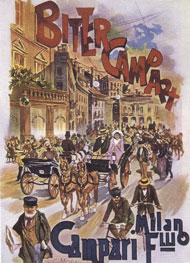

The first calendar was published at the turn of the century: a portrait of a woman by Cesare Tallone. Various artists such as the engraver, illustrator and set designer Adolfo Magrini interpreted Campari in the years that followed. In the twenties, Marcello Dudovich was the author of the poster of a couple kissing passionately. Leonetto Cappiello then created a series of posters, including the Spiritello rising from an orange peel. Further advertising opportunities opened up with the advent of cinema: in 1930, the first Campari commercial was shown to moviegoers in Argentina.
After the forced break imposed by the war, Carlo Fisanotti, better known as Fisa, was responsible for the new advertising campaign. In the 1950s, several artists such as Felice Mosca, Attilio Rossi and Giovanni Mingozzi illustrated the energy of Campari in a series of posters inspired by the world of sport. Another poster was designed by Nino Nanni: it shows a Campari bottle orbiting the earth like a satellite. The 1960s marked an important turning point in the marketing strategy of the Campari brand: With a graphic approach designed by Leonardo Stroppa, Guido Crepax and Franz Marangolo.
After engaging Hollywood stars such as David Niven and Humphrey Bogart, the great Federico Fellini directed a short advertising film, while Fanco Scepi staged the "woman in red" Kelly LeBrock as the protagonist of "Campari, it's Fantasy". Ugo Nespolo created a poster for the World Cup in Italy. Advertising in the 90s focuses on both television and advertising campaigns. Towards the end of the 90s, Campari begins a new collaboration with the renowned director of Indian descent Tarsem, who shoots the commercial "Il Graffio", the first advertisement in Italy to address female homosexuality. The collaboration with Tarsem is currently being continued with the commercial "Il Duello".
In the noughties, Campari undertook various rejuvenation and revitalization activities for the brand. These included a cooperation with MTV and the simultaneous introduction of the "Red Passion" claim. In particular, the Campari calendars, which were reduced to 9,999, caused a stir. Star photographer Mario Testino guided the sensual Salma Hayek through the fictitious Hotel Campari, with Hayek being followed by Eva Mendes. Testino in turn staged Hollywood star Jessica Alba as an unapproachable femme fatale at Club Campari in 2008.
In the year of Campari's 150th anniversary, Olga Kurylenko is the face of the new advertising campaign. She was captured by photographer Simone Nervi. Milan, the center of Campari's history, is the setting for this year's calendar entitled Campari Milano.
Even today, works from Campari regularly come under the hammer at auctions of historic posters. One of the most famous posters was created in 1964 and the work by Bruno Munari even made it into the collection of the Museum of Modern Art in New York.


