Column By the way: When beautiful pictures don't carry a clear message
In their column, our authors Laura Colledani and Klaus Ammon explain what the Graubünden tourism campaign reveals from an empirical perspective—and what it means from a strategic standpoint.



Tourism communication often works with strong images. The focus is on landscape, emotion and atmosphere. But this is where a key question arises: which message actually sticks? An empirical study of current Graubünden advertising using deeptrue from management tools shows how different the perception of the Swiss population can be - and how crucial a clear content priority is for positioning.
The pictures are impressive
Mountains. Vastness. Peace. Landscape. You like to look. You linger for a moment. And yet the central message remains ambiguous. This is precisely what the empirical evaluation of spontaneous perception of the current Graubünden advertising shows.
The respondents were asked openly what they remembered from the advertising.
The spontaneous mentions show a broad and heterogeneous picture. General vacation and nature associations such as mountains, landscape, recreation, hiking or sport were mentioned above all. In some cases, the diversity of the region is emphasized or a general „you have to go there“ feeling is described. Unspecific terms such as Switzerland or friendliness also appear. It is also noticeable that some respondents do not recognize a specific statement or merely characterize the advertising as „beautiful“.
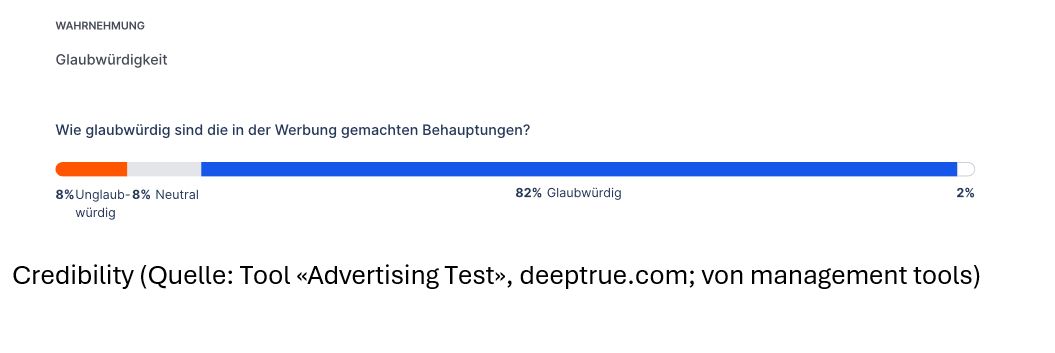
Only occasionally is a term mentioned: Golf. This is remarkable insofar as the campaign also wants to position Graubünden as a golf destination. Although this message is perceived and appears credible, it is not at the center of spontaneous memories. Associations with nature and vacations dominate.
Three patterns of perception
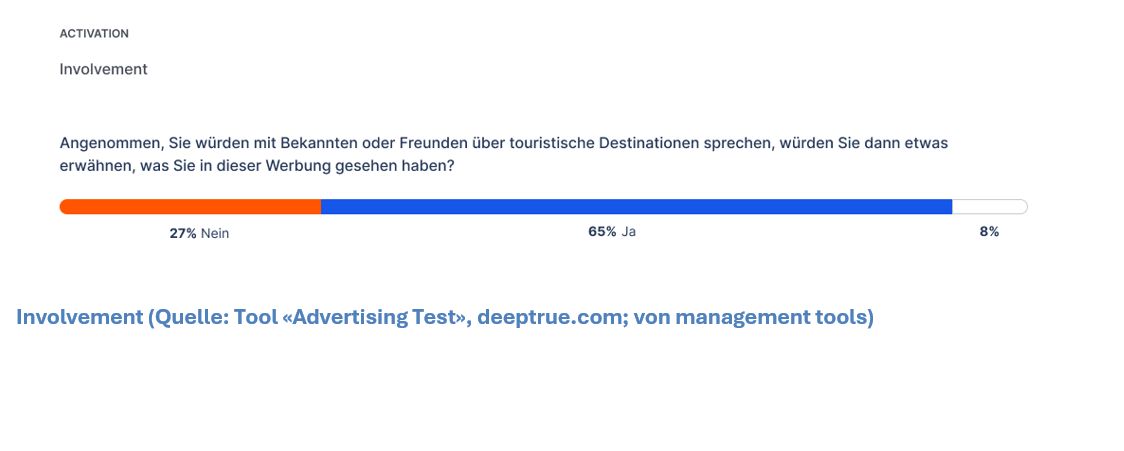
A large proportion of the spontaneous responses describe classic images of tourism: Nature, mountains, vacations, relaxation. Advertising is primarily understood as general vacation communication. Graubünden appears as an attractive Alpine region, but not necessarily as a specific golf destination. Nevertheless, almost 2/3 of respondents would mention content from the commercial:
Golf is noticed, but not dominant
A smaller group mentions golf or golf courses. Even there, the memory remains partially blurred: „golf in the mountains“, „you can play golf“, „Graubünden golf“. The message is there, but does not emerge as a central idea.
A not insignificant proportion does not recognize a clear message
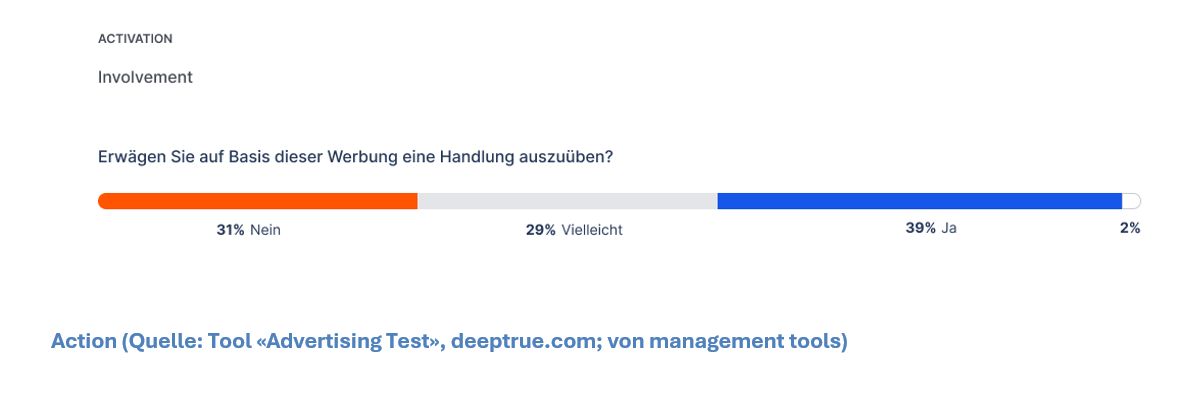
A further proportion did not mention any specific statement. The advertising is perceived positively, but without a clear consolidation of content. Terms such as „beautiful“ or „don't know“ indicate that the images are effective, but the strategic message remains open. The chart below clearly shows that the activation of the ad still has potential for optimization with 39% approval:
When communication strengthens the category
A consistent picture emerges in the overall classification: Nature and vacation associations clearly dominate. Golf is remembered by a smaller group.
A further proportion do not perceive a clear message. The communication is therefore interpreted more as general tourism advertising than as specific positioning.
- Advertising works emotionally.
- It generates sympathy.
- It conveys a vacation feeling.
- It conveys nature and vastness.
At the same time, the content focus remains open. This shows a typical pattern of brand communication: advertising primarily strengthens the category - rather than the specific positioning.
Viewers see the Alps. They see vacations. They see landscape, but the anchoring of Graubünden as a golf destination remains less pronounced.
The question of strategic leadership
This is not a design problem. It is a question of strategic management. Because communication is not only effective through aesthetics. Above all, it works through clarity. If several messages are conveyed at the same time, attention is spread. The memory remains broader - but less specific. Tourism communication in particular often faces this challenge. There are many mountains. Nature too. Peace and quiet too.
Differentiation only arises through a clear mental priority.
With golf in the Alps, Graubünden has a possible focus. This is recognizable in the advertising, but is not the focus of perception. In the end, a positive overall picture remains. But - no clearly dominant message. The empirical results show precisely this: the advertising is received positively - but interpreted differently. It appeals - but does not position itself clearly. It shows many things - without setting a clear priority.
And therein lies the real insight: communication can be convincing in terms of design - and still remain strategically open. Not because it shows too little. But because it allows for several meanings at the same time.
By the way...
The biggest challenge of good communication is rarely the design. It is deciding which message should take center stage.
Laura Colledani and Klaus Ammon have more than 40 years of combined experience in consumer research and marketing research. Over the years, they have developed a keen sense of what moves people - even beyond the numbers. Both authors advocate a communication culture that listens before it broadcasts. With the new approach of consumer listening management tools, they want to support marketing managers in not only questioning consumers in the traditional way, but also entering into a genuine relationship with them.