
Heads of the week: animation troupe
At Elefant Studios, ten 3D enthusiasts based in Zurich are setting out to conquer the film world.


The idea had been floating around in the heads of the ten owners for quite some time. The ambitious project became three-dimensionally concrete at the beginning of this year. Since then, Elefant Studios on Zurich's Lessingstrasse has quickly become a top player in the Swiss creative scene. Whether for feature films, advertising, corporate or print, Elefant Studios offers the full range of creative services in post-production, from the initial concept to the final image. 3D animation, visual effects and compositing, 2D animation as well as motion graphics and design are the specialties with which the small Zurich elephants soon want to compete with the big names on the international scene.
Not a dream, but a feasible reality since ideas have become more important than technology or software more decisive than hardware in modern filmmaking.
"Working on 3D requires a lot of know-how and time. The prices for the technology have dropped massively. A software license that used to cost 15,000 can now be had for 3,000 francs," explain Dany Bittel and Marco Fischer. And on the basis of this software, which anyone can get from a retailer, the ten specialists at Elefant then build their own systems "with a lot of manpower." "We invest a lot in research and development," says Miklos Kozary. "Every franc we earn is immediately reinvested," adds Sandra Milly Pötschacher. She takes care of all the organization and administration and, as Visual Effects Producer, is the "tatschmeister" in the elephant house. In it, ten guys perform as the joint owners. But there are no bull fights in the enclosure. This entrepreneurial thinking, which is pretty much lost in today's communications industry - with ten equal owners as in ancient cooperative times - becomes credibly visible during a visit to the Elefant Studios. But this start-up is a clearly managed joint-stock company, not "cinéma-copains," although of course everyone on the Elefant team is a trusted and long-standing colleague.
"The scene is small. In Zurich, everyone probably knows each other. That's why we've been thinking for a while that we could join forces, buy larger equipment together, pool our know-how and thus specialize even more," is Elefant's basic idea. "With a larger store, we can also offer our services for larger projects," Dany Bittel is convinced.
In concrete terms, this need arose with Billag. When the collection agency for radio and TV fees wanted to realize a series of six commercials with Tobias Fueter, the director looked for alternatives in production. Dany Bittel was attracted by the challenge. But he "couldn't handle it alone." So he looked for three colleagues - and that ultimately led to the birth of Elefänchen.
Creative bunker
Some of the digital savages in the loft on Lessingstrasse could almost still pass for students at the box office, but have a good number of years in the business between them. "We've all worked as freelancers before with interesting clients and many agencies. Those connections are still playing out. In the meantime, however, we can offer our old clients much more," say the united young entrepreneurs. That's why they no longer consider it a drawback that their studio with its many screens looks more like the creative bunker at a film school than an expensive address for advertisers. Clients such as Bucherer, Mini, Sandoz, the Locarno Film Festival, Swisscom and Swisslos, who have already been in and out of the studio, love the atmosphere - "and they also see what we spend our money on.
To bring ideas from the first sketch into 3D form, different teams are formed depending on the project. In these pools, there are specialists for each area. Some are completely dedicated to animation. Others come from lighting, shading, modeling or compositing. The ten "bosses" have been able to gather their experience in a wide variety of well-known companies.
Miklos Kozary graduated from Bern with a degree in computer science and computer graphics. After a stay in London, he joined the Swiss branch of Treibhaus Postproduction as a compositer in the film and commercials department. A stint at Mr. X. Inc. in Toronto was "tough but very educational," as he was also responsible for several feature films such as "Resident Evil" and "Shoot 'Em Up," but was able to work "until he dropped." In Switzerland, Kozary was digital compositor for "Grounding."
Marco Fischer is a trained graphic designer. However, his track moved "more and more in the direction of animation" during a freelance period of over ten years in various advertising and design agencies. He later served many of his clients with his own company Tronics animated design, where he also made image and corporate films, but mostly "on a low flame", which is why he felt like joining forces with the possibility of larger projects.
Dany Bittel was fascinated by the magic of 3D even as a teenager. After graduating from high school, he designed websites with a friend in Lausanne. In between, he was always tempted by the three-dimensional, also at the company Regardez in Zurich. Here he designed logos and trailers for Swiss television. After the dissolution of Regardez, he continued to offer his knowledge as a freelancer and worked during this time for "Grounding" as well as on several commercials.
Fabian Gasser graduated as a visual designer from the Zurich University of the Arts in 1997, was also a partner at Tronics and a graphic designer at various multimedia agencies.
Fadri Jecklin was a geomatician and 3D artist at QBUS, which he co-founded.
Kunal Ghosh Dastider comes from the animation class at the Lucerne School of Design and has been working as a 3D specialist mainly abroad. Among others, he worked on "Lissi und der wilde Kaiser", "In the Name of the King: A Dugeon Siege Tale" and has recently become a certified Pixar Renderman Instructor.
Patrick Graf has a degree in scientific illustration and most recently worked at Treibhaus for seven years.
Vladimir Jankijevic graduated in photography from the Zurich F+F and then worked for four years at Frame-Eleven as a 3D artist in advertising and corporate. Yukio Satoh studied media art at the Fachhochschule für Gestaltung in Aarau and gained his experience with feature films at The Mill in London, among others.
Stephan Schweizer was an early lecturer in compositing at SAE College in Berlin. Later, he worked abroad as a freelancer on feature films such as "The Chronicles of Narnia: Prince Caspian", "The Red Baron", "300" and also "Lissi und der wilde Kaiser" by Michael Bully Herbig.
Sandra Milly Pötschacher started her media career at IP Multimedia. First she worked in the online area, later in broadcasting. This sparked an interest in further development in postproduction. When the greenhouse had to declare bankruptcy, Pötschacher became a freelance production assistant, for example on the feature film "Elisabeth Kopp," Pipilotti Rist's first feature film "Pepperminta" or Reto Caffi's graduation film "Auf der Strecke," which has since received worldwide awards. Her last station was Egli Film before she was brought to Elefant by the "boys".
Andreas Panzeri


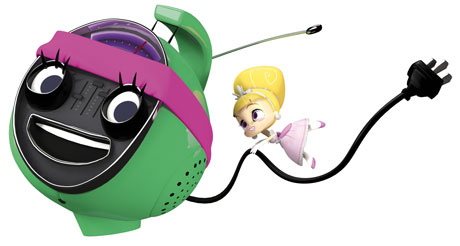
Midwife for the start-up: the Billag campaign.
References
More about these versatile bios and works can be found on the naturally very elephantine website www.elefantstudios.ch. There is nothing to read about the secret, but of course obvious dream that this start-up wants to become active in feature films soon.
References
More about these versatile bios and works can be found on the naturally very elephantine website www.elefantstudios.ch. There is nothing to read about the secret, but of course obvious dream that this start-up wants to become active in feature films soon.


