
PrintOnline gains market share
For the first time in a long time, PrintOnline is not reducing its rates. This is because the volume of advertisements transmitted fell last year - and is likely to continue to fall.


Print advertising declined last year. Although the December figures for the Wemf advertising statistics have not yet been published, the total number of advertising pages is likely to have fallen by around 10 percent, even though the Sunday press, for example, continued to record growth.
The digital data courier PrintOnline (POL) also suffered from this decline in advertising. POL, founded in 1997 by Publicitas, Tamedia, Ringier and NZZ, functions as an "electronic data courier" and transmits entire advertising campaigns from advertising customers and agencies to the affiliated publishers. In 2008, POL's transmission performance fell for the first time since 2002 - by 3 percent to 127,006 individual advertisements. However, this puts POL well below the decline in the industry as a whole. "It seems to me that we have gained market share in terms of transmission," says Managing Director Kurt Obrist. This applies all the more to small ads (those under 311 square centimetres), including classified ads.
Increase in classified ads
While the industry suffered the main slump in this area in particular, POL was actually able to make gains here. The share of small advertisements in the total volume transmitted by POL rose from 58 to 61 percent, which corresponds to an absolute increase of 1,500 individual advertisements. This is all the more astonishing as POL had lost market share in this type of advertisement in recent years to the specialized providers for online and print classifieds markets (Publiconnect, Scout24, Unio or Prospective). Now there seems to be a trend reversal, at least in terms of transmission for print. "But don't ask me why," says Obrist with a grin. Perhaps because POL is actively approaching advertising clients and is constantly winning new customers, he says.
The decline in volume has a price consequence: for the first time in several years, POL is not able to reduce its rates, but is leaving them at the 2008 level. Large publishers therefore continue to pay an annual connection fee of CHF 15,000 and CHF 11 per transmitted advertisement. Smaller publishers without a connection fee pay CHF 31 per advertisement. If the advertisements are smaller than 311 square centimetres (half a tabloid page), large publishers will continue to pay CHF 7 and small publishers CHF 19.
The fact that publishers and not advertisers finance POL has to do with the fact that the data courier is intended to make it easier for advertisers to handle print advertising - in the sense of an industry solution. However, as a non-profit company, POL passes on its surpluses to the publishers in the form of rate reductions. Since it was founded ten years ago, POL has already been able to reduce its rates several times - most recently a year ago.
More effort for clarifications
POL has been feeling the effects of something more and more frequently recently: the trend among in-house publishers to grant agencies direct booking compensation (DBE). The consequence for POL: more clarification work because incorrect orders or double bookings increased. The reason: anyone booking directly with a self-directed publisher can no longer go through the P booking system, which contains all the publishers' data. They have to enter the data in the POL system themselves. In addition, there are still no direct interfaces between POL and the publishers - currently only P has such interfaces.
For some time now, P and POL have therefore been working towards a standardized interface for data exchange. This requires investment on all sides. P has now taken the first step and adapted its system; POL, publishers and agencies must now follow suit. "That still needs some convincing," says Obrist. But in future, it should no longer matter how the booking is made or whether a title grants a DBE or not, because both leased and self-publishers will then be served via a standardized interface.
Markus Knöpfli
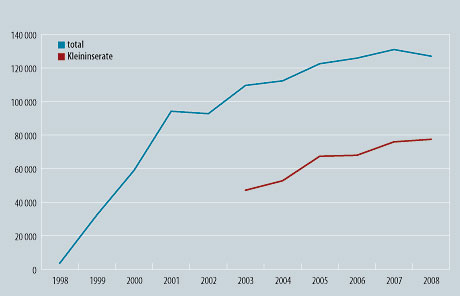
Legend: Although the total number of advertisements is decreasing, the number of small advertisements submitted continues to grow.


