Five future scenarios for data-based targeting without cookies
All market participants in the advertising ecosystem currently need to urgently address the question of whether cookies are on their way out and what will come next. Data specialist Emetriq believes that, in the post-cookie era, third-party cookies and new ID solutions are likely to coexist.


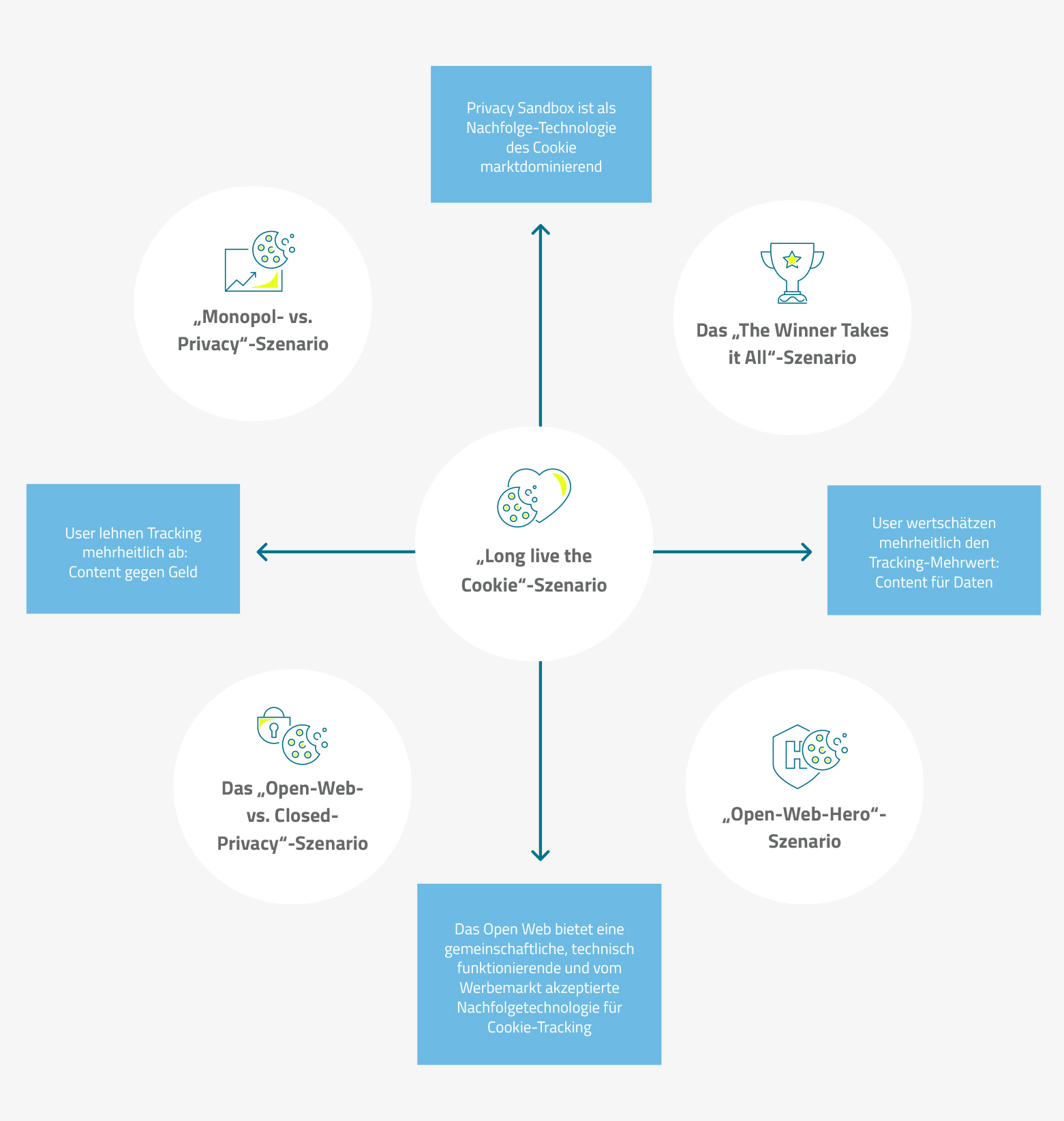
The same applies to a mix of freely available and ad-financed content and subscriptions. The Deutsche Telekom subsidiary comes to this conclusion in a new white paper that takes a look at the post-cookie era in 2023. The future of cookies is uncertain: will an alliance of cookie saviors emerge after the BGH ruling in June 2020? Or are the days of the third-party cookie numbered? To answer these questions, Emetriq draws up five future scenarios of what the new data-based targeting could look like.
1. the "monopoly vs. privacy" scenario
As the driver of the privacy sandbox, Google has a quasi-monopoly, as other players have failed to establish a common cookie substitute. The majority of users reject tracking methods due to data scandals, but the Chrome browser suggests considerable data protection. Advertisers are grateful for the centralized offer of the sandbox, but have to let the lack of competition dictate their prices.
2. the "the winner takes it all" scenario
With the Privacy Sandbox, Google has established the only market-dominating cookie substitute. Users willingly use the Chrome browser, through which personalized advertising continues to be delivered. At the same time, the other players have not succeeded in introducing an accepted cookie substitute. Users and advertisers put all their data in the hands of Google.
3. the "open web vs. closed privacy" scenario
The Open Web offers a market-relevant cookie substitute. This new technology has resulted in even better and more stable tracking than cookies from the advertising industry's point of view. Competition law complaints against Google have led to the sandbox being banned. However, most users reject tracking methods and are annoyed by irrelevant advertising. Browser manufacturers are therefore developing new blocking mechanisms.
4. the "Open Web Hero" scenario
The Open Web offers a market-relevant cookie substitute. The non-GAFAs have created an ID network without third-party cookies. All browsers can be used for tracking again. The Open Web offers a transparent tracking solution and unrestricted access to the free web. Many payment barriers are removed and more content becomes accessible. The reward for free access is data and advertising based on it.
5. the "long live the cookie" scenario
The BGH ruling from June 2020 turns out to be a cookie reboot. An alliance of cookie saviors is forming and successfully exerting pressure on politicians. With success: the ECJ threatens to break up Google if the US company does not keep its business model open. The privacy sandbox cannot be introduced as planned and the third-party cookie continues to exist. Nevertheless, the Open Web is also introducing an ID network without third-party cookies. The result is the coexistence of cookie and ID solutions described above.
Regardless of which scenario ultimately materializes, Claas Voigt, Managing Director at Emetriq, calls on advertisers to actively participate in the debate: "The advertising industry should prepare for all eventualities regarding the future of third-party cookies, but not simply wait and see what will happen. We appeal to advertisers to get actively involved in the debate. They have the (advertising) money and the power to play a decisive role in shaping future developments. They should also not write off the cookie too soon. Despite all the criticism, it is still the most efficient, fairest and most functional solution on the market. It may therefore be worth developing the cookie further and, at best, allowing it to coexist with other identifiers."