Roger Federer plays against himself thanks to AI
Researchers at Stanford University have developed an algorithm that generates new sequences from real tennis videos. For example, the system can be programmed to have Roger Federer play against himself or win the 2019 Wimbledon final.


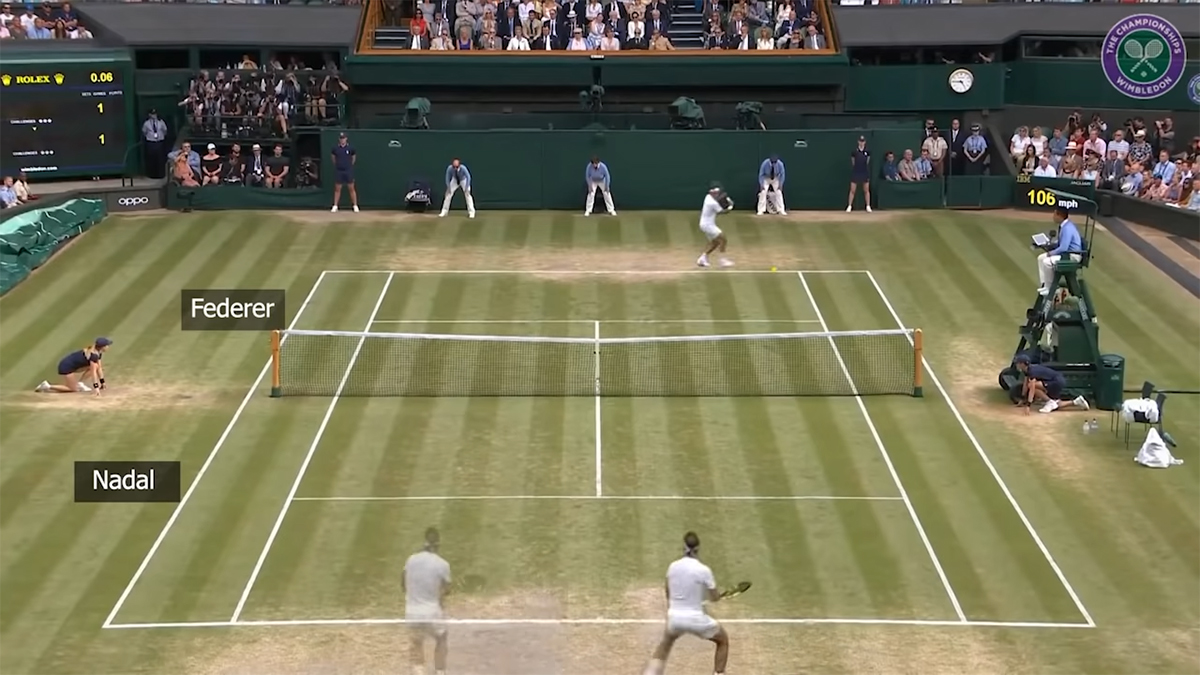
Federer fans still have nightmares about the 2019 Wimbledon final, the match in which the Swiss tennis star lost to Novak Djokovic. The 20-time Grand Slam champion could have added a ninth title at the prestigious tournament. But he made some fatal mistakes in the tiebreak of the fifth set.
What if Federer's forehand had stayed within the boundaries of the court on his first game point? AI researchers at Stanford University rewrote history in a video sequence. In this sequence, the famous forehand stays in the court, giving Federer the victory.
How machine learning generates new tennis games
The algorithm can generate fairly realistic imaginary matches between several players or even between a player and his doubles team. Footage published on YouTube shows Federer playing against himself or against Serena Williams. The machine learning model was trained using a database of annotated recordings. Graphic dots represent the position of the player and the impact of the ball. The algorithm thus learns which actions the real player is likely to take in a given game situation. By subsequently manipulating the position of the control points, a video synthesis system can convert the real images into new sequences. The algorithm thus simulates exchanges that correspond to the players' style of play.
The technology still needs to be refined
"According to tennis experts, the rallies generated by our approach are much more realistic in terms of player behavior than video sprite methods, which only take into account the quality of the motion transitions during video synthesis," say the Stanford researchers. Their technique is promising, especially for the creation of video games. However, the technology still needs to be refined. In the published sequences, for example, the audience is completely frozen, the players have no shadows and appear to float slightly above the playing field. (Yannick Chavanne/NetWeek)