
Influencers influence purchase decisions of Millennials more strongly than traditional advertising
Influencer marketing not only achieves a wide reach but also influences millennials' purchasing decisions more than other advertising formats, such as TV commercials, print ads, or Google Ads. This is shown by a study conducted by the University of Lucerne.


Worldwide studies on the effectiveness of influencer marketing show that 88 percent of consumers have already bought a product because influencers inspired them to do so. To what extent does this apply to Switzerland?
According to the Swiss Influencer Marketing Report 2020, 6 out of 10 Millennials aged 13 to 30 follow influencers on social platforms and 56 percent regularly search for product information there. More than half of these followers (53%) confirm that they have already made a purchase decision inspired by influencers. The study by the University of Lucerne in collaboration with Farner, Reachbird, HEC Paris, University of St.Gallen and gfm examined these and other questions by means of separately conducted surveys of millennials as a strategic buyer target group, influencers as content creators and marketers as advertisers.
"This study is the first of its kind in Switzerland because it brings together and compares the views of the three players: millennials, influencers and companies. This allows us to derive many theses for promising and effective influencer marketing in Switzerland," says Reto Hofstetter, Professor of Digital Marketing at the University of Lucerne, commenting on the large-scale study. "In order to exploit the full potential of influencer advertising, some gaps still need to be closed."
Instagram as an influencer platform is top, Facebook on the other hand flop
All three groups surveyed describe Instagram as the most important influencer platform. YouTube is especially popular with Millennials, and marketers also pay attention to LinkedIn. Facebook is the most relevant influencer channel for just 1 percent of influencers and 2 percent of millennials. Opinions differ when it comes to YouTube: although 16 percent of Millennials name YouTube as their most important influencer platform, only 1 percent of Influencers consider YouTube the most relevant channel for their influencer activity. Influencers could therefore reach even more Millennials if they made greater use of YouTube as a publishing channel.
Influencer collaborations yes - but clearly declared
28 percent of companies reported using influencer partnerships as a marketing tool at the time of the survey. In the 12 months prior to the time of the survey, the companies of the marketers surveyed worked with an average of six influencers when they basically invested in influencer marketing. Conversely, influencers implemented collaborations with an average of 12 different companies during the same period. There is agreement on all sides that partnerships of influencers with several companies at the same time are justifiable. However, this is only the case if they are not competing brands or products: Over half of marketers (59%) consider this important, just as the majority of Millennials (51%) would be bothered by competing partnerships.
Opinions differ when it comes to declaring collaborations: Almost half of millennials would like influencers to label their advertising in the hashtags. However, the common practice on the part of influencers is to include corresponding references in the texts or comments. Here, influencers can align themselves even more strongly with the Millennials' need for transparency - and the clients can demand and promote this with corresponding specifications.
A like for credibility through expertise
Credibility is the highest good for all three groups surveyed when it comes to influencers creating advertising content. "Being credible" means that the content and promises are perceived as accurate. So it comes as little surprise that for Millennials, the credibility of influencers themselves is not based on their reach through number of followers or a celebrity status, but on the fact that they are perceived as experts in their field or convey expertise in terms of product benefits. These aspects must be taken into account when selecting suitable influencers and planning and implementing content.
"Influencer marketing is still developing rather tentatively as a discipline in Switzerland - but the findings of the study make it clear that it would have long since earned a permanent place in the marketing mix due to its relevance and acceptance among young target groups," says Olivia Deubelbeiss, Influencer Marketing Specialist at Farner.
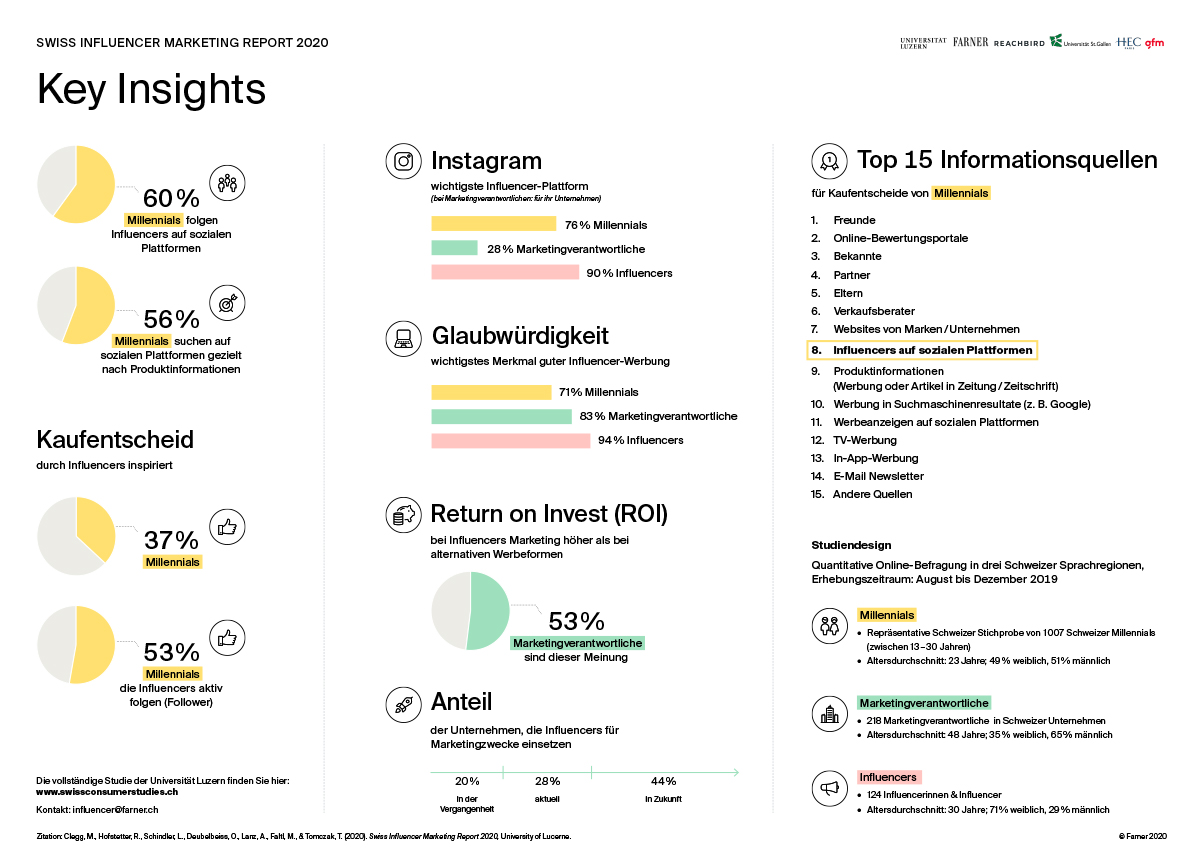
The summary with the most important marketing insights is on the Farner website available. The complete study is offered by the University of Lucerne on its website: Swissconsumerstudies.ch
Study details
Quantitative online survey, survey in all three language regions, survey period: Aug to Dec 2019.
Millennials: Representative Swiss sample of 1,007 Swiss millennials aged 13-30 (online panel by intervista), average age: 23 years, gender: 49% female, 51% male
Influencers: 124 influencers, (reached via reachbird.io, direct mail), average age: 30 years, gender: 71% female, 29% male
Marketing managers: Online B2B panel with 218 marketing managers in Swiss companies (panel by intervista), average age: 48 years, gender: 35% female, 65% male.
Study partners: University of Lucerne, Farner, Reachbird, HEC Paris, University of St.Gallen, gfm
Citation: Clegg, M., Hofstetter, R., Schindler, L., Deubelbeiss, O., Lanz, A., Faltl, M., & Tomczak, T. (2020). Swiss Influencer Marketing Report 2020, University of Lucerne.


