
Swiss companies leave the potential of behavioral economics untapped
Companies in Switzerland make little use of insights from behavioral economics. Yet these insights could help them be more successful, particularly in marketing. The reason for this lack of application is the low level of knowledge among companies. This is shown by a recent study by the ZHAW.


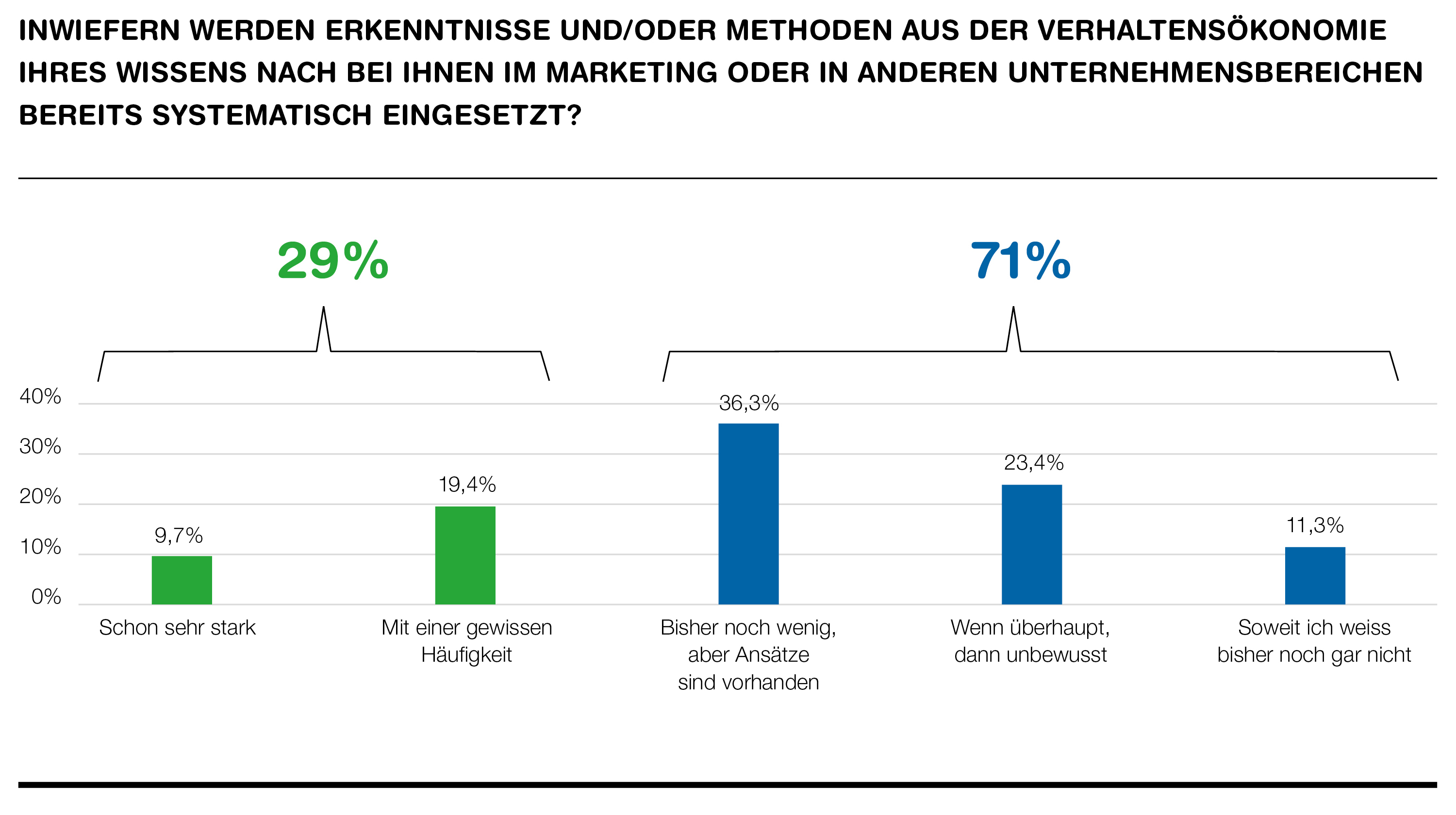
Over 70 percent of medium-sized and large companies in Switzerland do not yet apply behavioral economics findings and methods at all or only to a limited extent. The main reasons for this are a lack of knowledge and experience, but also a lack of awareness of the topic within companies.
At the same time, around 80 percent of respondents rate the potential of behavioral economics for their company and its marketing as medium to high, as the study shows.
Major competitive advantages
Behavioral economics deals with human behavior in an economic context. In particular, it examines people's actual decision-making behavior and analyzes the factors that influence it. "Especially in the English-speaking world, governments as well as NGOs and companies rely on the expertise of behavioral economists. They use them to better understand the behavior of citizens, employees or customers or to set incentives for desired behavior," explains Kurt Ackermann, lead author of the study and deputy head of the Behavioral Marketing department at the ZHAW School of Management and Law.
Scientific studies indicate that the application of behavioral economic knowledge can bring companies significant competitive advantages, such as increased sales growth. For example, it can be advantageous for a provider to present three product variants (e.g. small, medium and large) in an online store in order to steer customers towards the medium variant and promote its sale.
Basic terms little known
However, as the study shows, only just over a third of the company representatives surveyed in Switzerland are even familiar with the term "behavioral economics". Furthermore, only one in six is familiar with the term "nudging". It refers to simple measures that are intended to trigger desired behavior in people. "Examples of nudging include the application of adhesive strips that make it easier to keep your distance or other visual reminders that have become ubiquitous since the coronavirus crisis," explains Ackermann.
Importance will grow
The use of behavioral economics in Swiss companies is likely to increase in the future. "After all, around one in ten of the companies we surveyed already have employees who deal exclusively with behavioral economics topics and issues," says Steffen Müller, Head of the Behavioral Marketing Unit. Around 70 percent of companies that do not currently employ such staff would also consider it useful to have such expertise.

The "Swiss Behavioral Economics Study" is based on telephone and personal interviews with managers and marketing executives as well as a quantitative survey of around 130 Swiss companies from various sectors. The survey took place in summer and fall 2019.


