Social media in French-speaking Switzerland as important as print in shaping public opinion
Television dominates public opinion in Switzerland. According to the Swiss Media Monitor, social media platforms such as Facebook, Instagram, and Twitter play a role in shaping public opinion in French-speaking Switzerland similar to that of print media and are more important than online platforms.


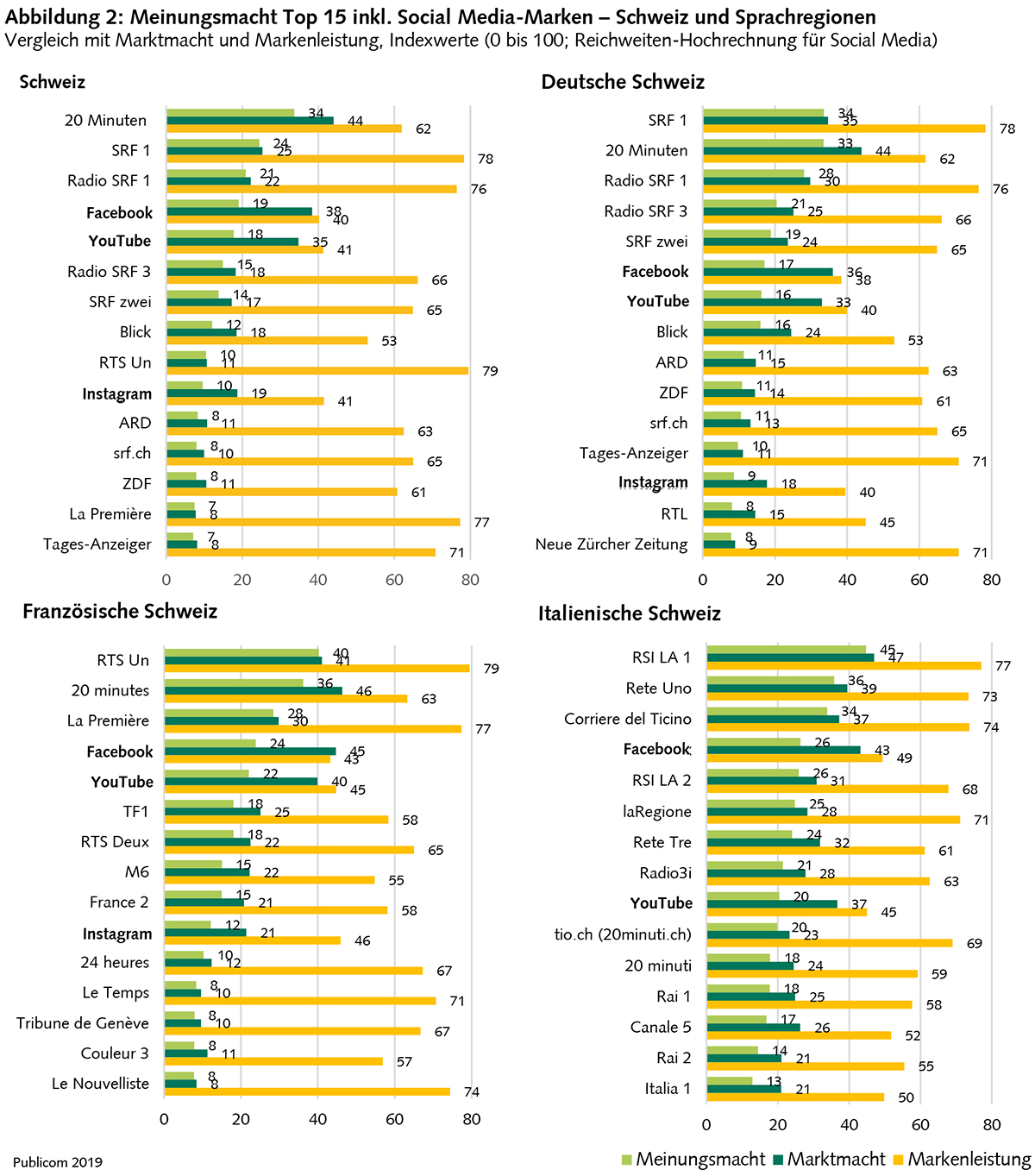
On Tuesday, the new Media Monitor Switzerland was published by the Federal Office of Communications Bakom. The 2018 study shows for the first time what potential YouTube and Co. have for shaping opinion in Switzerland.
In French-speaking Switzerland, social media accounted for a full 16 percent of regional opinion power, only slightly behind print (18 percent). Nationwide and in the German-speaking part of Switzerland, social media accounted for around 10 percent of total opinion power, and slightly more in Ticino.
In general, however, these figures should be interpreted with caution, writes Bakom, as no official reach data is available for social media. The overall influence of social media thus continues to lag well behind the traditional media offerings of TV (28%), radio (24%), print (20%) and online (18%).
The assessment, which is based among other things on a representative survey of the population, relates to general information usage. In addition to politics, it also includes business, society, culture and sports. However, the Media Monitor does not provide any information on selective use during political events such as votes and elections.
TV is the most important medium
In general, television continues to dominate opinion-forming in Switzerland. The dominance of television is particularly pronounced in Latin Switzerland. In French- and Italian-speaking Switzerland, it has a significantly greater power to shape opinion than radio and the press.
The Media Monitor Switzerland is published for the second time. In terms of media offerings, the changes between 2017 and 2018 were minor overall. The ratings of television and radio are almost unchanged. Print lost some of its influence in all parts of the country, while online offerings became more important for opinion-forming.
Despite concentrations in the industry, Medienmonitor does not see any acute danger to the free formation of opinion. There is no medium that enjoys nationwide supremacy. The individual groups are not in a position to unduly shape national, linguistic-regional or local-regional opinion-forming, the report says.
"Duopoly" with Tamedia and SRG
In many areas, however, a "duopoly" is forming with the Swiss radio and television company SRG and the Zurich publishing house Tamedia. The two largest media companies, which are active in all regions with their own offerings, together already accounted for slightly more than half of national opinion power in 2018.
SRG comes to 35 percent, Tamedia recorded 16 percent of the Swiss opinion market. Numbers 3 and 4 are the NZZ Media Group (6%) and AZ Medien (5%), followed by Ringier (also 5%) and the regional groups Gruppo Corriere del Ticino, ESH Médias and Somedia, which together account for a further 3 percent of national opinion power.
In Latin Switzerland, the first public TV stations come close to the opinion power threshold of 50 index points. This means they reach just under half the population with their information every day.
The study concludes that SRG is benefiting the most from the general strengthening of online and, with srf.ch, is also presenting the opinion power climber of the year. The multilingual free commuter newspaper 20 minutes of Tamedia, meanwhile, continued to be considered number 1 for opinion power among the most important titles. (SDA/pd)